
There is an awful lot to appreciate about ducks: their gracefulness on the water, their agility in flight, and of course, the magnificent beauty of their feathers.
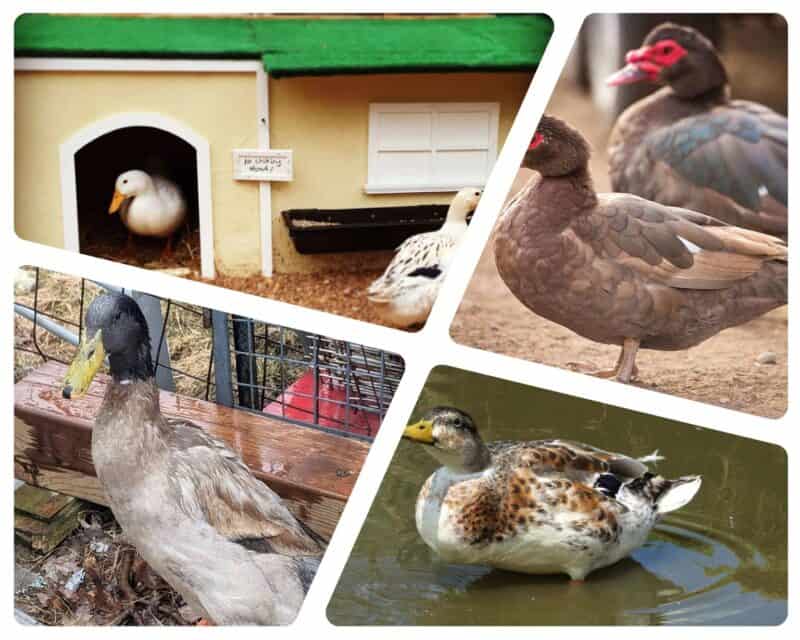
Ducks, whether wild or domestic, come in every color of the rainbow and patterns ranging from the subtle to the mesmerizing. Some of them are a riot of bright colors and dazzling patterns, while others are simple earth tones.
But make no mistake, sometimes simple can be quite beautiful indeed, as is the case with the 19 brown and white breeds we will talk about below.
Whether they are just brown and white or these colors are just two of many, all are gorgeous and unique. We will get right into it, and you’ll soon find a new favorite!
Hookbill
Hookbills are one of the most unique domestic species out there, typically raised for meat and eggs. They’re famously tame, calm, and easy to handle, making them favorites among duck fanciers.
As the name suggests, they have a long, downward-curving bill that helps them dig for food. Only rarely seen in the United States, they are slightly more common in Europe.
Females are a mingled copper and black, while males have a contrasting brown, tan, white, and dark green coloration.

Indian Runner
Another unique duck that is instantly recognizable, the Indian Runner has an upright stance that resembles that of a penguin. And they really can run, being one of the fastest ducks on land.
This medium breed is also known for excellent foraging abilities and being a prolific egg layer, though their eggs are pretty small.
The apricot trout color variety, sometimes known as the Saxony coloration, consists of a gray head, a white ring on the neck, a brown chest and shoulders, and a white underside. Not many other colors are common to this breed.

Silver Appleyard
A large and beautiful dual-use duck, Silver Appleyards are known for being capable layers of large eggs, averaging anywhere from 100 to 180 yearly, and also sporting an excellent carcass yield of meat, said to be of excellent flavor.
Nearly extinct at the close of the Second World War, they have only recently been resuscitated and slowly recovering since the 1980s.
The typical color of males and females is a white breast and underside that reaches all the way up across much of the neck to the face with patches of tan, brown, and black feathers. These ducks are gorgeous in a classical sense!
Saxony
A huge, stout duck that is today kept either for meat and eggs or for exhibition purposes, the German Saxony can tip the scales at upwards of 8 pounds.
Strikingly gorgeous, males have a slate gray head, tail feathers, and wing feathers set off by a white underside and rump, a white ring on the neck, and a lightly speckled mahogany brown breast.
Saxonies are a popular breed for meat owing to their excellent yield and rich flavor, though rarely raised for such in the United States.
Rouen Clair
A heavy French breed with a somewhat murky origin, the Rouen Clair is only standardized in its native France and the UK, but not in the United States. In fact, these ducks are almost entirely unknown in the US.
Nearly reaching 9 pounds in the case of drakes, this is a stocky, short-necked, and heavy-bodied duck. Predominantly raised for meat and also for reliable, if slow, egg output averaging a maximum of 120 a year.
Females are a speckled brown and tan all over with white eyeliner markings and a white throat and chin, with gray and black wing feathers are set off by small white bars.
Welsh Harlequin
Superb egg layers and popular pet ducks, the Welsh Harlequin is directly descended from the Khaki Campbell, itself being developed from the Indian Runner.
One of the lighter domestic breeds on our list, males rarely weigh more than 5 ½ pounds. Speaking of males, they are sometimes confused for Mallards, but they are significantly larger.
They have a dark head and pale yellow bill set off by a mingled brown breast, wings, and back with a white ring, rump, and belly. Females have pale and medium brown feathers interspersed by light white patches at the bottom of the neck, belly, and rump.

Muscovy
One of the oldest domestic duck breeds around, and one with a unique distinction: Muscovies did not directly descend from Mallards.
Sometimes colloquially referred to as Wood Ducks, Muscovies like to perch up in trees, which is impressive considering their great girth and weight: males can clear 12 pounds!
Also notable is the fact that males and females have sharp claws, nearly talons, on each foot. They ostensibly use them for climbing, but they work wonders for self-defense, so be careful!
Muscovy males and females come in a huge variety of colors, but chocolate magpie is the most relevant for our list since it consists of intermingled brown and white patches.
Mottled Duck
Mottled ducks are often found throughout Florida and along the Gulf Coast, which is their natural breeding range. Typically found inhabiting marshlands, levees, and sometimes fields, these boldly contrasting ducks build their nests from grasses in well-drained areas.
Most don’t go too far from the areas where they nest, and habitat loss has seen a sizable population drop since the early 2000s. Unfortunate, since they are so beautiful!
Drakes and hens are a speckled brown and black with pale white undersides on the wings and dusky white or pale gray markings on the head and neck.
Wood Duck
Some of the most beautiful ducks in North America, Wood ducks can be found across the Central and Eastern US and much of Southeastern Canada. Populations are also present all along the West Coast.
These typically inhabit heavily wooded swamps and freshwater marshes where females nest in hollow trees and other cavities above the water’s edge.
Males have contrasting white and black stripes breaking up patches of green, brown, and tan. Females are a subtler dappled tan and gray with white eyeliner markings and wing tips.
Blue-Winged Teal
A common sight in the American interior throughout the prairielands, the Blue-Winged Teal typically inhabits all sorts of wetland areas like marshes, flooded fields, ponds, and the like.
Females seek out these places to lay eggs but find new nesting grounds year to year as wetland conditions change. Tiny ducks, they rarely weigh more than one pound.
Males are a speckled brown and dark brown all over with dusky heads punctuated by bold, vertical white stripes. Females have much subtler and smaller white patches just behind the bill.
Gadwall
Gadwalls are medium-sized wild ducks notable for their subtle coloration but magnificent patterns in the case of males. Males have various tones of brown, tan, mahogany, and rusty red patches across their entire bodies and bright white leading edges on their wings.
Females are a brighter mingled dark brown and chestnut color all over with a buff underside and small white feathers on the ends of their wings.
Gadwalls can be found on a seasonal or semi-permanent basis throughout US and Canadian wetlands, fields, and meadows.
Eurasian Wigeon
Only seen in the United States as a rare visitor, the Eurasian Wigeon can be found all across the Atlantic region stretching from Iceland all the way east to northern China.
Females typically nest near water in wooded areas, laying between seven and ten eggs. Males and females have highly similar coloration consisting of an even, medium brown breast and flanks with a white underbelly.
Wings are a slightly contrasting, darker brown, and males have a copper-colored head and a pale gray bill.
American Wigeon
Found throughout Canada, the American Wigeon nests in far northern latitudes exceeded by few other duck species, preferring shallow lakes and mostly drained marshy areas that have lots of dry vegetation nearby.
Again we see males and females have very similar coloration consisting of multiple shades of brown all over the neck, flanks, and wings.
Males have an iridescent green patch behind the eyes and a white patch on the top of their head and on the rump. Both males and females have a white or cream-colored underside.
Northern Pintail
The Northern Pintail is noteworthy for inhabiting the coldest polar regions during its breeding season, nesting from Greenland throughout the Arctic reaches of Canada and all the way into Alaska, though they do make their way all the way south into the central US.
A larger wild duck, males weigh upwards of 2 ¼ pounds. Males have an even mahogany brown head and off-white neck, flanks, and underside. Females are much duller, with a medium brown head and body. The wings and back are darker…
Canvasback
Among the most striking ducks on our list, Canvasback males have bright white and pale gray feathers covering almost the entirety of their bodies. This is set off by an inky black breast and a magnificent, shiny brown head and black beak.
As expected, females are not as spectacular and are covered from bill to tail in various tones of brown. A large species, Canvasbacks can be spotted throughout the prairie marshes of the United States and elsewhere in North America, including Saskatchewan and Alaska.
Spectacled Eider
Another large species with a wingspan measuring 20 inches, Spectacled Eiders are only seen in North America along the coastal reaches of Alaska. Most of them are found in Siberia.
They typically nest throughout peninsulas and island chains with nearby tundra ponds. Males have a black underside and large patches of white across their head, neck, back, and wings set off by smaller sections of brown.
Hooded Merganser
The smallest of the mergansers, the Hooded Merganser is found predominantly in western Canada and the northernmost parts of the western US, including Idaho, Oregon, and Montana.
Their breeding range extends all the way into southeastern Alaska and much of British Columbia. Forested wetlands are where you will find them, and, like Wood Ducks, they typically nest in hollow trees and other cavities.
Female Hooded Mergansers have a grayish-brown head and a rusty-colored, prominent crest. The undersides of the wings and belly are a pale cream.
Common Merganser
Easily identified by its spiny head feathers and long, slender serrated beak, the beefy Common Merganser can be sighted all across much of the US and throughout central and western Canada, with a range that stretches from New England to Arizona and California to Alaska.
They will nest almost anywhere, from trees and cliffs to dug-out nests on the ground, and females can lay up to 12 eggs in a clutch. Pretty impressive for such a large duck!
Females have a copper-brown colored head and face with a white patch on the chin just behind the bill. The lower neck and breast are also white with gray speckles.
Ruddy Duck
Another tiny, charming, and instantly distinctive duck on our list, the Ruddy Duck exists in small numbers from Mexico and Baja California to much of the southern Rocky Mountain range and sporadically throughout the Great Plains.
Males have a vivid teal bill and shiny dark brown body punctuated by a black breast and cap. The cheeks and upper part of the neck are brilliant white.
Females are unremarkable by comparison, being a mingled earth-tone brown with off-white patches on the cheeks and a thin vertical marking on their keel.

Get your gift and learn things like:
- how to make this really quick pest spray
- how to prevent egg waste
- two cheap automation devices that will make your life easier
Tom has lived and worked on farms and homesteads from the Carolinas to Kentucky and beyond. He is passionate about helping people prepare for tough times by embracing lifestyles of self-sufficiency.