
There’s one thing that pretty much every living animal on Earth has in common: the fact that at one point or another, it will suffer from some kind of internal parasite. Yes, even our hardy chickens!
Parasites thrive in nature because they’re highly adapted to beating or dodging the host organism’s own immune system, and they then stay inside the host consuming resources and usually weakening or even killing it. You definitely don’t want this to happen to your chickens, but you can bet they will, at one point or another, contract some sort of intestinal worms.
So what do you do? Do you call a vet and use pharmaceuticals, or do you go the old-fashioned way and reach for the pantry to try some natural remedies? But do they really work?
There’s a lot of confusion when it comes to homemade dewormers. Time to cut through the noise and analyze what works, what doesn’t, and what might work.
How to Know Which of These Work
This post contains affiliate links. If you click them and buy, I may earn a commission. Read my disclosure policy.
Unless you have the budget to do your own randomized trial, the easiest way is to do a fecal egg count. The McMaster egg count is probably the more popular, but you will need a cheap compound microscope. But folks have been doing this test at home for a long time, so you could give it a try – if you have lots of chickens, it may be worth it.
Now, when you do try some of these remedies, particularly the natural ones, don’t be surprised if they donÄt work on your birds. If you open up the studies I quote and link to, you will see that they each target various specific worms. So if your bird doesn’t have that particular worm, there’s no guarantee it’ll work.
OK, now off to the remedies…
| Method | Evidence Strength | Efficacy Data | Notes |
|---|---|---|---|
| Fenbendazole (Safe-Guard) | Strong | 90–100% against A. galli and H. gallinarum in multiple trials; FDA dose-confirmation and field studies | Only FDA-approved poultry dewormer (Safe-Guard AquaSol); resistance documented in some commercial operations |
| Ivermectin | Strong (efficacy) / weak (regulatory) | 90–99% against A. galli and H. gallinarum across several field trials; also effective on mites/lice | No approved poultry product or standard dose; egg residues found in yolk up to 71 days post-dose in one pilot study; extra-label use only, requires vet oversight |
| Piperazine | Moderate | Effective mainly against Ascaridia galli specifically | Narrow spectrum — no effect on tapeworms, capillary worms, coccidia, mites, or lice; a 2020 trial found no evidence of resistance developing |
| Pasture rotation / lower stocking density | Moderate (plausible, undertested) | No controlled poultry-specific efficacy trials found; one survey found more pasture access was not linked to higher worm burden | Sound general husbandry; evidence is mostly extrapolated from ruminant grazing research, not poultry-specific |
| Pumpkin seeds (whole seed, field use) | Weak to moderate | One trial: 80.9% vs. A. galli, 75.8% vs. H. gallinarum (necropsy-confirmed). A separate trial found no effect | Contradictory field results, likely due to inconsistent dosing (no standardized backyard dose established) |
| Pumpkin seed extract (concentrated) | Weak to moderate | Comparable to fenbendazole in vitro and in vivo at 2000 mg/kg extract | Concentrated lab extract, not equivalent to feeding raw seeds — not directly replicable at home |
| Pomegranate peel extract | Weak | Some effect vs. A. galli, but weaker than pumpkin seed and fenbendazole in the same trial | Single unreplicated study; peel extract, not raw fruit; better evidence exists for anticoccidial (not anthelmintic) use |
| Garlic | Weak / indirect | Reduces infectivity of coccidia oocysts in lab/animal studies | Evidence supports anti-coccidial and general health benefits, not deworming specifically; nominally toxic at high doses |
| Diatomaceous earth (dietary) | Weak / breed-dependent | No effect on parasite-resistant breed; susceptible breed showed significantly lower Capillaria and Heterakis counts | Effect appears tied to the bird’s baseline parasite resistance, not a reliable standalone treatment |
| Oregano / thyme / cloves | Weak / unstudied in chickens | Active compounds (carvacrol, thymol, eugenol, curcumin) show lab antiparasitic activity; no chicken-specific dosing or field trials found | Biologically plausible, practically unproven for backyard use |
| Turmeric | Weak evidence | It worked in vivo against Ascaridia galli | |
| Apple cider vinegar | No evidence | No chicken-specific studies found; positive data in goats/sheep | Widely repeated claim with no supporting poultry research |
| Cucumber seeds | No evidence | No studies found in any species | Claim rests entirely on family resemblance to pumpkin/squash, not direct evidence |
Dewormer Solutions
OK, I’ll admit I tricked you. First I want to talk about the meds typically used in deworming… There are a few options out there, but one that’s FDA-approved just below, and others that are not – and with varying degrees of efficacy.
✅ Fenbendazole
Pharmaceutical anthelmintics are obviously not natural, but they also happen to have the strongest evidence behind them against internal parasites. One of the best ones that’s also FDA-approved is called Fenbendazole, and you can find it under names such as Safe-Guard or Panacur.
The way it works is you add 1 milligram per kilo of bodyweight to a chicken’s water for 3 to 5 consecutive days. That’s it! Here’s a video from a registered vet on how to administer it (don’t worry if it says it should be used on goats – just adjust the quantity):
❗️ Ivermectin
This is another popular substance that’s been used for a long time, but is not FDA-approved to be used in chickens. There are no guidelines on how much you should give to your birds, and then there’s this study showing that it tends to stick around inside egg yolks – probably not what you want.
On the other hand, there are studies showing ivermectin works, such as this one (a randomized trial), as well as a few that do egg counts to see if it works (this one and this one). It’s particularly effective against external parasites such as lice and mites.
❌ Apple Cider Vinegar
If you are a DIY’er, homesteader, or just prefer to use all-natural cleaning products, you’re probably already totally familiar with this entry on our list. Apple cider vinegar is well known and greatly beloved, not just for its health benefits but also for its germ-killing potential on surfaces in and around your home.
Despite this versatility, you can read in lots of places about ACV working as a dewormer in all sorts of livestock. In fact, lots of newbies on various forums point to it – only to get shut down by seasoned keepers: ACV used as a dewormer is very likely just a myth.
ACV, being acidic, it is said to create an acidinc environment inside a bird’s digestive system – acidic enough for the worms to start dying.
I wrote about the benefits of ACV for chickens before, and there is some research suggesting it helps combatting heat stress , and sadly, deworming is not one of them. And considering that ACV is generally safe and gentle on chickens, there’s not reason not to give it to them from time to time.
Keep in mind that vinegar is not a normal part of a chicken’s diet! It is very acidic, so don’t overdo it. As for deworming your birds, you should probably try something else on our list!
❓ Diatomaceous Earth (Food-Grade DE)
Another favorite around the homestead, diatomaceous earth, typically abbreviated DE for short, has long been used for pest control around livestock areas and even directly on livestock.
This stuff, despite the name, is not really dirt but is actually the finely ground shells of ancient, fossilized creatures called diatoms. Sold in the form of a fine, white or light gray powder, this stuff is surprisingly abrasive, and works to get rid of insects and other parasites by basically lacerating them on a microscopic level, bleeding or drying them out.
It works wonders on fleas, ticks, mites, lice and other bloodsuckers and it can do the same thing to internal parasites, all without harming your chickens.
But for internal parasites? The evidence is barely there,. In fact, a study that looked at the effects of DE in chickens concluded that:
We therefore conclude that the effect of DE on internal parasites was not robust. It did not improve resistance in birds that were genetically more resistant but may help birds that were less resistant to lower their parasite load.
Effect of diatomaceous earth on parasite load, egg production, and egg quality of free-range organic laying hens
D.C. Bennett,A. Yee,Y.-J. Rhee, K.M. Cheng
So what they did was the found no proof in the fecal egg count of one breed, but did find a difference in another. All in all, the evidence is weak but it is there, so if you want to use ACV in conjunction with something else, it’s probably a good idea.
Just don’t get your hopes up with ACV and remember that it’s much better at dealing with external parasites.
Deworming Plants from Your Garden
If you really want to go back to basics for deworming your chickens, you can simply add certain common garden plants to their diet. All of the following plants on our list have known and proven deworming properties.
Although they might take longer to work than the methods listed above, they have other benefits in the form of good nutrition and they are the gentlest possible approach for ridding your chickens of worms.
Stinging Nettles
Stinging nettles are a major pain if you run into them, but chickens aren’t affected by the burning, blistering toxin and furthermore love eating this notorious but tasty plant.
Aside from being highly nutritious, nettle also has superb anti-parasite properties that can easily flush out worms when it is a regular part of a chicken’s diet.
Simply let your chickens eat the stinging nettle plant several times a week as a regular part of their diet, or harvest it yourself, steep it, and then add the solution to their water.
✅ Pumpkin Seeds
Pumpkin seeds, like cucumber seeds, are a known vermifuge, and possibly even more effective than cucumber seeds. The reason I say this is because it has more evidence behind it, as you are about to see – though the evidence is mixed.
The reason pimkin seeds may work as a dewormer is because they have this non-protein amino-acid called cucurbitin (not to be confused with cucurbitacin).
In mice, it was shown that this substance can paralyze some intestinal worms such as the dwarf tapeworm parasite.
This other study looked at the effects in chickens (yay!) and found that pumpkin seeds had a 80.90% effectiveness against Ascaridia galli and 75.78% against Heterakis gallinarum, with mebendazole achieving 100% reduction as the positive control, and pumpkin seed treatment achieved 98.66% fecal egg count reduction. This is huge!
(…) efficacy of pumpkin seeds in reducing worm load and egg output ranged from insuffciently active (less than 80%) to highly effective (greater than 98%).
Evaluation of the in vivo efficacy of pumpkin ( Cucurbita pepo ) seeds against gastrointestinal helminths of chickens, Acorda et al. 2019.
Last but not least, yet another study that used pumpkin seed extract found that:
In vivo, the mortality rate of the worms extracted from the 2000 mg/kg pumpkin seeds extract-treated chicken was non-significantly different from that of fenbendazole for 48 h.
In vitro and in vivo anthelmintic activity of pumpkin seeds and pomegranate peels extracts against Ascaridia galli
As for actually feeding them the seeds, give it to them to your chickens daily until the worms are cleared up, and don’t cook the seeds if you want them to work.
Maybe the only drawback with this method is that you’ll need to make sure the chickens that are actually affected by the worms are actually eating the seeds. Most like to eat pumpkin seeds although they might be too big for the smaller breeds of chicken – at least if you have one of the larger varieties of pumpkin!
❌ Cucumber Seeds
Cucumber is a refreshing vegetable, but the seeds are also a vermifuge, or worm remover. Even better, chickens tend to like cucumber and they will definitely pick out and eat the seeds if you don’t want to harvest them yourself.
But do cucumber seeds really work? After all, they do share the same substance as pumpkin seeds, cucurbitin. Turns out, cucumber seeds have very small amounts of this substance – probably the reason no one bothered to test the seeds as a dewormer. I would dismiss this one as folklore until someone can prove otherwise.
❌ Fresh Garlic
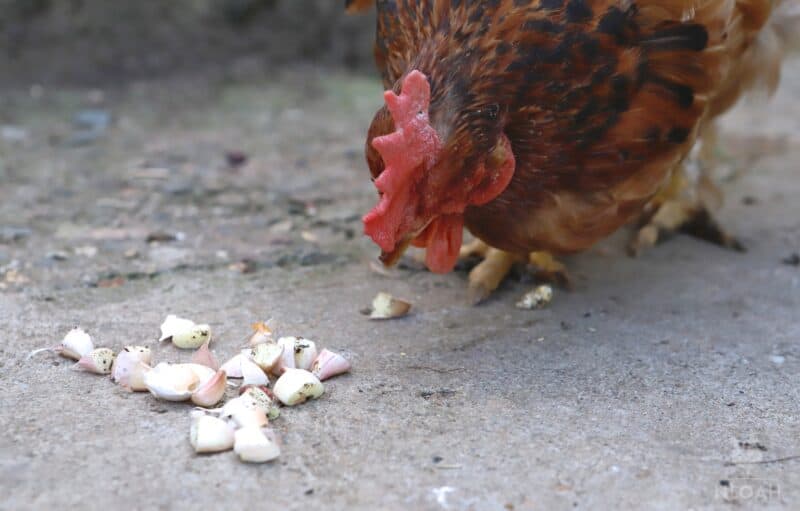
One of the oldest, best, and best-known natural cures for intestinal worms and chickens is garlic. Although nominally toxic for chickens, even using it as a treatment, your birds shouldn’t going to be getting that much of it because at higher doses it will be toxic to them.
But this is not just a dosing problem, the compounds in garlic have not been shown to affect any intestinal worms. They have been shown to work against coccidiosis. So you can go ahead and give it to them, but not to cure intestinal worms.
❓ Oregano, Thyme
These have carvacrol and thymol, two substances with parasite-deterring properties… but there are no studies looking at their effects in chickens that I could find. I woudl skip it and focus on others.
❓ Cloves
These have a different compound that’s anti-parasitic called eugenol. Same problem as with oregano and thyme: lack of evidence.
✅ Turmeric
This is one potent substance that’s often taken by humans for its multiple benefits to the body. But it can help chickens as well. How do we know it works? While research is thin, there is one study that fund that:
turmeric root extract @ 60 mg mL(-1) in vitro significantly (P < 0.001) proved paralytic and fatal against worms
In vitro, yes. But hang in there just a bit longer:
G6 that had 3.20 ± 1.33 worms was statistically significant
The G6 group of chickens was the one that got the highest dose of turmeric root extract 600 mg per kg of bodyweight.
This is worth saying again: the research is thin, and the one study I found focused on this one worm, Ascaridia galli. It might not work for you, but then again, it just might!
Wrap-Up
As you can see, there are several natural ways to free your chickens of parasites, just keep in mind they may have limited effects. It’s a trial and error at the end of the day, but the best way to keep these intestinal worms at bay is to practice good hygiene: keep their coop clean, set them up with a dust bath, replace bedding often, etc.

Get your gift and learn things like:
- how to make this really quick pest spray
- how to prevent egg waste
- two cheap automation devices that will make your life easier
Tom has lived and worked on farms and homesteads from the Carolinas to Kentucky and beyond. He is passionate about helping people prepare for tough times by embracing lifestyles of self-sufficiency.
There are different kinds, so you cant always visually tell. I deworm all of my animals 2x a year. Some people do quarterly. Personal preference. Also depends on what you are using.
I add garlic powder to my chicken food that I wet and make it like oatmeal.
How do you know if your chickens have worms?
Thank you