
If poultry to call your own is what you want, but chickens just aren’t your thing, ducks might be the answer. Ducks can provide you with lots of eggs and meat just like chickens, help control pests on your property and around your garden – and, of course, offer lots of entertainment throughout your day!
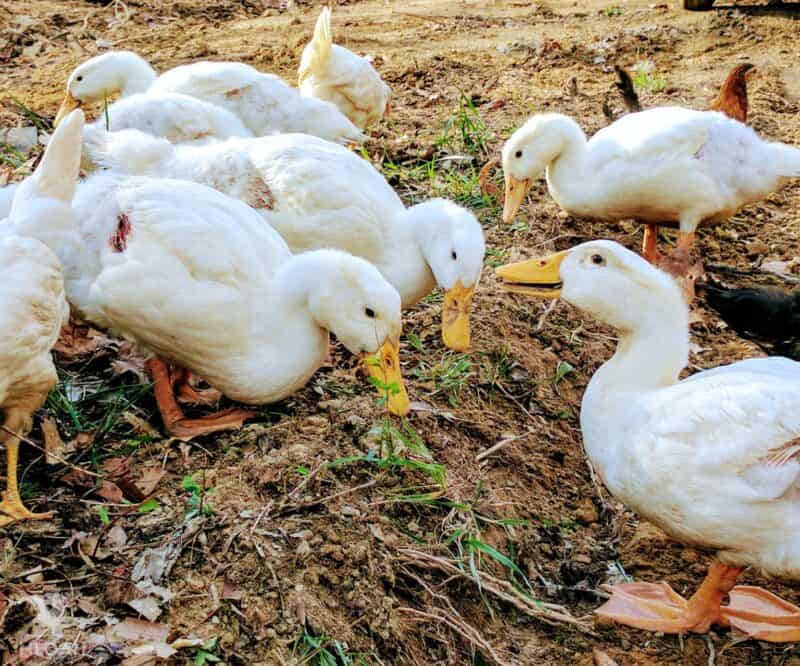
Like chickens, there are many different breeds to choose from, but for so many owners, a brilliant, pearl-white duck is the epitome of beauty. If you are among them, I’m here to help you zero in on your new additions with these 10 exquisite, shining white (or almost white) breeds (or hybrids!) that are sure to please. Whether you want meat, eggs, or just adorable pets, I’ve got you covered with the list below.
German Pekin
The German Pekin is pretty similar to the American Pekin we’ll discuss later on. Like the American Pekin, this is a large, plump duck that can grow around 6.6 to 9 lbs. Like their Yankee cousins, the German Pekin is a capable layer, producing around anywhere between 35 and 125 eggs yearly.
Although they have similar ancestry with the American Pekin (Chinese ducks brought to Europe in the 1800s) the breeds are considered two distinct and separate lineages, and bred from different stock. This breed is actually considered to be endangered, so expect to see it mostly at exhibitions…
Aylesbury
A distinguished and old domestic breed that has a “Critical” conservation priority list status, the Aylesbury Duck is bright white or off-white with orange legs and a distinct, pinkish-colored bill. Broad and stout, they can grow to upwards of 10 lb and are typically raised for meat, which is of excellent quality. This was one of the primary commercial breeds used in the U.K. until the Pekin took over.
Call
Distilled adorableness, the Call Duck is tiny, perfectly round, perfectly white, and so cute they border on painful. Kept as exhibition ducks and pets, the Call Duck was originally used as a living decoy by hunters to summon other ducks with its loud, clear call, hence the name. This is somewhat of a contested claim, so take it with a grain of salt.
Before you run out and get one, know that the Call duck is one of the noisiest, if not the very noisiest, domestic breeds out there – particularly the females. They are also quite flighty, so keep that in mind when thinking about the pen and run. On the flip side, they are super friendly, tame, and gregarious, and that makes the aggravation worth it for many owners.
White Muscovy
Large, stocky, and instantly recognizable thanks to their fleshy, bright red caruncles on their heads, Muscovies are one of the quietest breeds out there; they don’t quack, but they do hiss to communicate! They also have prominent claws on the end of each toe, and this can make them pretty intimidating for beginners.
Muscovies have an excellent carcass yield and are typically raised for their meat, but they’re also popular pet ducks for some. Note that many can fly pretty well, so wing clipping is a must (or appropriate fencing and netting), and they are often broody, which negatively impacts egg production.
American Pekin
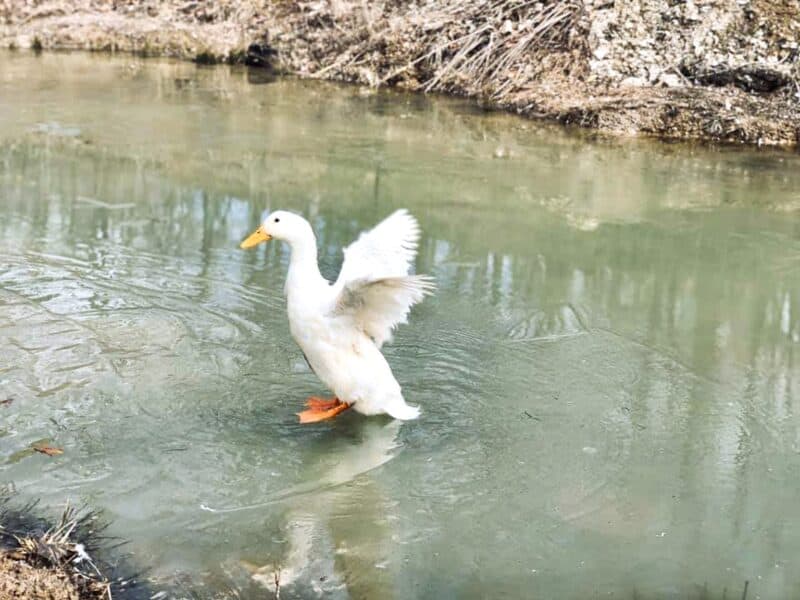
The quintessential American domestic breed. Originally from China and possessing iconic good looks with brilliant, optic-white plumage, cheery orange legs, and a bright orange bill, the American Pekin is as close to a generic duck in appearance as it gets!
Reaching around 8 to 9 lbs and up to 12 pounds in weight, they have a great yield of meat and that’s what they are primarily raised for in the United States thanks to their rapid growth. They are also average egg layers, too, with mature females producing anywhere from 140 to 180 eggs a year.
Generally friendly and docile, and good for beginners. However, take care to avoid overfeeding because they have a tendency toward obesity…
White Layer
Everything you need to know about the White Layer is in the name: these are pure white ducks, commercial hybrids that were bred specifically to be astoundingly good layers! They live up to the name, too, with hens laying anywhere from 200 to 290 eggs every year, (though 290 is more of a best-case figure)
White Layers are also distinctive-looking, being surprisingly slim, graceful, and long-necked with bright orange bills. If duck eggs are what you’re after and you want an easy-to-handle duck that takes up less room than its larger counterparts, the White Layer is the perfect choice. But because they are so small, they are less than ideal if you plan on harvesting them for meat.
Indian Runner
One of the coolest and funniest ducks on this list, and one of my personal favorites, is the Indian Runner. They come in all kinds of different colors, but pure white is an option, and that earns them inclusion here.
The Indian Runner is peculiar-looking, as they stand almost completely vertical. As far as ducks go, it looks like they are standing on their tiptoes, and they really can run; they’re one of the fastest ducks on land and are proficient foragers and hunters because of it.
They are also dependably good, but highly variable, layers, with hens cranking out anywhere from 100 to 180 eggs in a year. They need lots of room to roam, as you’d imagine, but as long as you can provide that, you’ll find them healthy, friendly, though they startle easily at any perceived danger, and start running around confused.
Mulard
The Mulard, or Mule Duck, is a legendary domestic breed, one of the most popular and common in Europe, typically raised for meat but also for their livers, used for foie gras. Large-bodied, bright white, and with a dark orange bill, these ducks are the result of crossbreeding between Pekins and Muscovies.
If you want these ducks, know that they are sterile hybrids and can’t reproduce, so you’ll have to raise both male Muscovy and female Pekins if you want any more.
Ancona
There are many varieties of the American Ancona, including solid and spotted, but you can have pure-white birds, though some don’t recommend them because they wouldn’t have the signature broken pattern of the breed.
A midsize duck with an athletic build, this is a dual-use breed that is a great choice for both meat and eggs, though their smaller size means they aren’t particularly efficient in a commercial setting.
Females can produce anywhere from 200 to 280 eggs yearly, and they are excellent foragers if you want to let them free-range.
White Silky
White Silkies have unique feathering, which gives them a fluffy, puffy, and silky appearance and feel. And because they are very rare, they are one of the most sought-after exhibition and pet breeds; few ducks look as good or as charming! Owing to their rarity but also to their small size, they are not practical for meat and egg production. They are, however, good foragers and faithful setters; something else that endears them to owners.


Get your gift and learn things like:
- how to make this really quick pest spray
- how to prevent egg waste
- two cheap automation devices that will make your life easier
Tom has lived and worked on farms and homesteads from the Carolinas to Kentucky and beyond. He is passionate about helping people prepare for tough times by embracing lifestyles of self-sufficiency.