
Powdered milk is one of those pantry staples that everyone has, but if I’m being honest, I feel like most people don’t know how to use it. It’s nice to have just in case, but when’s the last time you actually reached for it? When was the last time you made it and drank it?
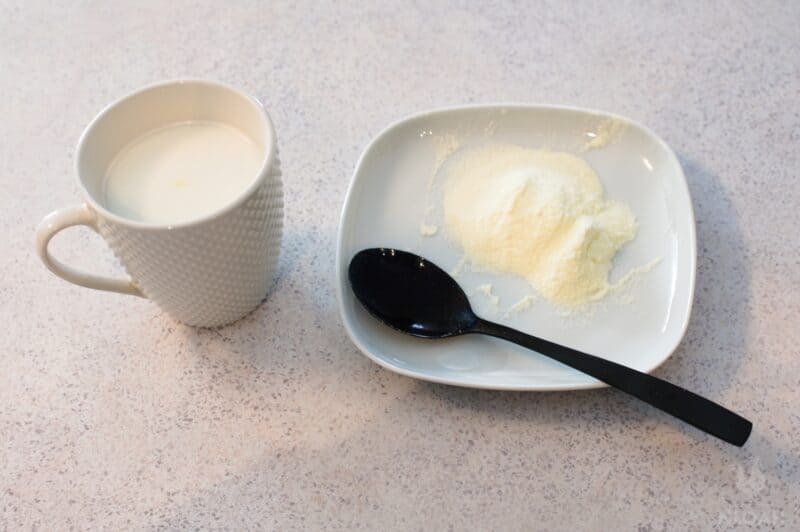
Have you ever used it for baking or recipes? Probably not, and here is why: most folks simply don’t know how to reconstitute it properly, meaning how much water you should add to it to bring it back to that normal, delicious “real” milk consistency.
If that describes you, that ends today. I’ll tell you everything you need to know about reconstituting powdered milk, and even better, how to reconstitute it for different uses.
It’s so easy and versatile you might start reaching for it more often than you do the jug in the refrigerator!
Whole (Full-Fat) Powdered Milk – 1:4
Nominally, if you want to reconstitute whole (full-fat) milk into its usual consistency, you want to use one part of powdered milk to four parts of water. After that, it’s ready to drink, add to smoothies, or use in recipes as normal.
There’s nothing to it, and it really is that simple. Whatever brand of milk you’re dealing with, you’ll rarely go wrong following this ratio.
Whole-fat powdered milk is definitely my preference, and that’s because I like to enjoy it chilled, in a glass, whenever I want a glass of milk. Just note that in most grocery stores, you’ll find the nonfat powdered stuff, which we will cover in the next section…
Non-Fat Powdered Milk – 1:4 or 1:5
Nonfat powdered milk is common in the United States and most other Western countries, but it can be a little more finicky compared to the full-fat version.
Start out mixing in a 1 to 4 ratio; one part powdered milk to four parts water. If it seems a little too thick or isn’t coming together quite right, add a little more water, nominally no more than five total parts.
This will produce a consistency that’s somewhere between low-fat milk and skim milk most of the time.
It makes for a good substitute for fresh milk in a pinch if you want to drink a glass, but there is definitely a difference and it is not my favorite. I’ll tell you how to improve it later in this article, so keep reading.
For Cakes, Pastries, and ‘Heavier’ Desserts – 1:3
One of the great things about powdered milk is that it can give you even greater control over how your baked goods turn out because you get to adjust the consistency and the intensity of the flavor while adding more or less moisture. If you’re going with fresh milk, you just get what you get when you’re adding any given quantity!
If you’re whipping up a cake, some danishes, or other heavier, sturdier desserts you can add less water to the same amount of powdered milk, about 1 to 3. This will make it thicker, richer, and impart more flavor to your baked goods without going overboard on additional moisture.
My neighbor made some raspberry turnovers this way using powdered milk only- never fresh! She got the recipe from her mom who got it from her mom, and they have been the talk of the town for decades.
You really can’t taste the difference, so don’t hesitate to give this a try the next time you’re firing up the oven to make a sweet dessert.
For Bread Making – 1:3.5
For making bread, imparting more flavor while keeping control over the amount of wet ingredients that go into the dough is always a good idea.
Make it just a little bit thinner than you would if you were making pastries or other desserts like we talked about above, aiming for a one-to-three-and-a-half ratio.
Your bread will still come out fluffy, full, and flaky with a flavor that’ll be out of this world.
As a Cream Substitute – 1:2
It rarely fails that I’m out of cream, or it has gone bad, when I need it. I know some people can struggle through it by melting butter and adding that to their milk, but I found an even better technique by whipping up a cream substitute using powdered milk.
One part powdered milk to two parts water will make a thick, viscous cream consistency that works surprisingly well!
But getting the right consistency can be hit and miss, so mixing it up properly is super important. Make sure you check the following sections for tips on how to achieve that consistency. Do that, and you won’t be able to tell the difference!
Always Check Your Powdered Milk Instructions!
There’s no shortage of powdered milk brands out there, more than eight on the shelf last time I was at my local grocery.
And though powdered milk is just powdered milk, no matter the brand, there can be a surprising difference in the quality and consistency, and that can affect the preparation.
I know it might be borderline offensive to seasoned homesteaders and expert home cooks, but take a glance at the instructions on the packaging before you get to mixing.
I’ve encountered a couple of brands that are remarkably concentrated, like Bob’s Red Mill nonfat; that product called for just two to three tablespoons for every cup of water! And they weren’t kidding; it turned out almost perfectly and has a wonderfully smooth consistency.
On the other hand, you’ve got a brand like Judee’s which is a lot closer to the ratios we talked about above, and might be a better choice if you are baking since the flavor won’t be quite as intense and thus more controllable according to your taste.
Don’t be afraid to experiment, of course, but you’ll rarely go wrong following the instructions if you have any doubt!
Mixing Your Powdered Milk for Best Results
Mixing up your powdered milk properly is essential if you want to have good results, whether you are drinking it or using it in a recipe.
For starters, always, and I mean always, use cool water! Not even room temperature and never, ever use warm or hot! That will facilitate clumping and it just won’t come back together properly.
Another trick I learned from my mom: mix it in a large mixing bowl and hit it with a whisk. This also helps to prevent clumping and dramatically improves consistency. If you can chill the milk after it’s mixed, it will taste even better…
Let it Rest for Better Flavor and Texture
One last tip, and it’s the best one I ever got concerning powdered milk. Let it rest after you’ve mixed it, and preferably let it chill while it is resting.
Giving it even an hour or two will help the proteins in the milk stabilize or co-mingle or do whatever it is that they do, and it will taste more like real, fresh milk than if you just mix it and drink it.
And don’t be afraid to let it rest overnight if you can: kept cold and in a clean bowl or bottle, your reconstituted milk will easily last 3 days in the fridge (unlike the powder stuff that can last months or even years). Make it before you go to bed, and it’ll be perfect and refreshing in the morning!


Get your gift and learn things like:
- how to make this really quick pest spray
- how to prevent egg waste
- two cheap automation devices that will make your life easier
Tom has lived and worked on farms and homesteads from the Carolinas to Kentucky and beyond. He is passionate about helping people prepare for tough times by embracing lifestyles of self-sufficiency.
I bought this to make my hot chocolate recipe but note in comments to use COLD water. If it’s in a mixture for the cocoa will it work? Also looking for ratio of mix vs water to make a quart My cocoa recipe needs dry mix that makes 8 quarts.
Thanks for the great article. I like using powdered milk for bread baking because I almost always start with a poolish. If I used regular milk, it might go bad in the poolish step. So, instead I add the powder along with the flour the next day.
Having weights would be good. For example; how many grams of powdered milk are used for 1 cup of milk? How many grams of powdered milk are used for 1 cup of evaporated milk?
Have you used powdered milk to substitute for canned powdered milk in custard pies like Pumpkin Pie?