
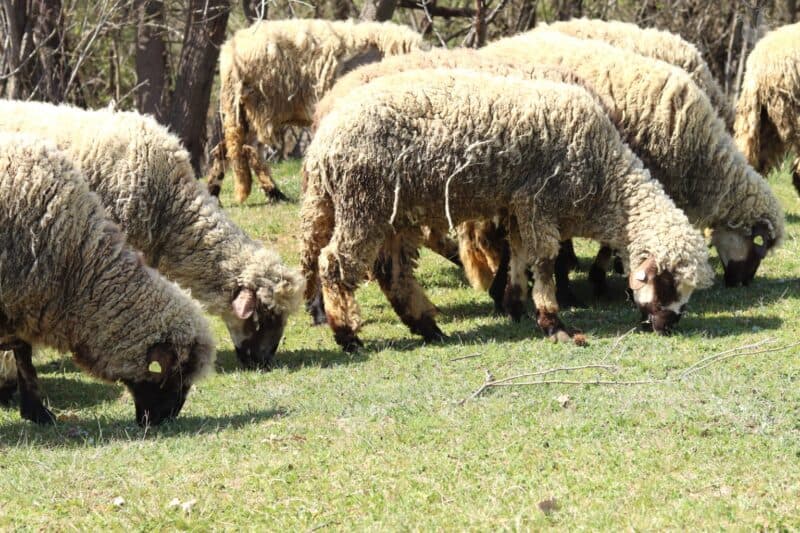
If you think about sheep eating, what do you imagine that they eat? If you picture them strolling around a pasture munching on grass and other tender greenery, you’re pretty much right on. But sheep cannot subsist on just one type of grass or other forage alone: They actually need a variety of greenery to meet their nutritional requirements…
Accordingly, shepherds tend to feed their flocks a diet consisting of different types of hay, grass, and other vegetation. Hay, especially, is a common component of their diet and a convenient one. But you should know that not all hay is the same for sheep.
Different kinds of hay have different nutritional profiles, different advantages and sometimes different risk factors. A good shepherd will learn these differences, understand them and implement them into the diet of their flock accordingly.
It can be a little intimidating, but you shouldn’t worry because I’m here to help. Below you’ll find a guide that will tell you everything you need to know about the most common types of hay fed to sheep. By the time you get to the end you’ll be a pro. We have a lot to cover, so let’s get into it.
What Kinds of Hay are Best for Sheep?
As a rule of thumb, sheep are attracted to “fine” and “leafy” hay types; that is to say hay that has more leaves and fewer stems, and that is softer overall.
Fine, leafy hay is more palatable and attractive to sheep, and they will more readily eat it and eat more often. High quality, leafy hay is also a better value proposition much of the time: sheep will discard or eat around the parts of the hay that doesn’t appeal to them, meaning waste for you to clean up and wasted money!
I mentioned this because you should get sucked into the raw data on paper, including what you see here in this guide.
A less nutritious and nominally less attractive type of hay might be a better fit for your flock if it’s made with more care and harvested at the peak of ripeness; more nutritious hay that is rough or mostly stems won’t make a bit of difference if your sheep don’t eat!
Learning to evaluate hay that is for sale and determine a baseline level of quality takes practice and experience. You’ll get there with time.
Good Hay Choices for Sheep
The following types of hay in this guide are not exhaustive, but they do represent an excellent cross section of choices that can serve the needs of your flock. Some make a good general purpose option for feed while others can better fulfill the needs of lactating weeks or growing lambs.
All of them are mainstays for my sheep and at different times and for different reasons that we’ll get into.
Alfalfa Hay
What is It?
Alfalfa is a legume, not a grass, and widely grown as a premium, high protein, high nutrient food for sheep and other livestock. Unlike grass hay, alfalfa is harvested throughout the year depending on the region, and different harvests or “cuttings” yield hay of differing quality, nutrient levels and price.
For many shepherds, alfalfa is a must-have since it can readily support growth, lactation and overall good health, though it is not without its downsides.
Nutrient Profile
Very! Alfalfa is remarkably nutritious for sheep It has lots of protein, between 15 and 22%, and a great amount of vitamins and minerals.
It’s so good that it is very common to find it as fresh pasturage and as hay, along with other types of feed for sheep. Crude fiber content is also good, but less significant than grass hay, averaging anywhere from 20 to 27%.
If we take a look at the vitamin content, we find that alfalfa is a remarkably good source of vitamin K, vitamin C, and many B-complex vitamins; all good stuff that sheep need in order to thrive.
The mineral content is similarly impressive, and alfalfa is a solid source of calcium, averaging 1.5%, and phosphorous, averaging 0.28% with lots of other good minerals besides.
Together, all of these macro and micronutrients make it an excellent nutritional option for sheep, though one that is still not nutritionally complete or that they can eat to the exclusion of everything else.
Benefits for Sheep
Alfalfa is excellent all around for sheep as it provides them with lots of protein, fiber, and calories for energy.
But the vitamins and minerals that it has, together, can improve pretty much every part of a sheep’s biology.
Abundant B-complex vitamins support metabolic processes, neurological health and nervous system function, red blood cell formation and oxygenation, and so much more. Vitamin K, another extremely abundant vitamin that alfalfa contains, is needed for bone growth and healing and also for recovery from injuries since it stimulates proper clotting of the blood.
Alfalfa’s minerals are just as critical for electrolyte balance, nervous tissue maintenance, circulatory health, wool growth, immune system function, and on and on.
It’s is also particularly notable for promoting milk quality and milk production in nursing ewes, something really critical if you’re expanding your flock or relying on your sheep for milk.
Can It Cause Health Problems for Sheep?
Yes, it can, and it’s actually well-known for the issues that it can cause. I’m talking, of course, about bloat. This is something of an Achilles’ heel for it, and has been a problem that is quantified at least since antiquity.
Alfalfa has a marked tendency to cause bloat in sheep and other animals when they eat too much of it in a single sitting or if they are introduced to it too quickly in their diet.
Bloat, however it occurs, consists of gas being trapped inside the stomach or rumen which will then put pressure on the sheep’s tissues and other organs. It starts out mildly uncomfortable and ends in profound agony and death for an affected animal. It is a bad way to go, believe me.
As scary as it sounds, it shouldn’t stop you from giving them alfalfa: Just make sure that you add it to their diet very slowly to give their rumen time to acclimatize to it, and don’t let them eat too much in any one serving.
How Often Can Your Sheep Have Alfalfa Hay?
Your sheep can have alfalfa hay pretty much all the time as part of their usual diet as long as they aren’t getting too much. For many shepherds, alfalfa in one form or another is indeed the primary item in their diet.
The rule of thumb, though, is that you must always slowly introduce it to their diet to avoid bloat and other rumen issues as mentioned, and make sure they get other foods they need to round out their diet.
Is Alfalfa Hay Safe for Lambs?
Yes, but cautiously. Alfalfa has lots of protein and nutrients that can definitely benefit growing lambs, but their young and fragile rumens are easily overwhelmed by rich alfalfa.
Make sure your lambs are totally weaned before starting them on it, and make sure that you do so very slowly and cautiously once they’ve grown up a little bit.
Typical Cost
Alfalfa can be pricey, especially the good stuff! Premium alfalfa prices can soar to $300 per ton in some places. However, prices fluctuate greatly depending on crop yields; abundant years might see it fall to as low as $150 per ton.
Red Clover
What is It?
This is a legume hay, like alfalfa. It’s not a grass variety that we will cover here in just a little bit. Red clover is often cultivated specifically for turning into hay because of its excellent nutritional content, and especially for sheep.
It’s typically harvested and dried at the very end of spring or sometimes early summer depending on the region. Red clover that is harvested just after it begins to bloom has maximum nutritional value.
Nutrient Profile
Although not quite as nutritious as alfalfa, red clover is still excellent compared to grass hay. Crude protein levels are somewhat variable and mostly dependent on soil nutrient levels, but young red clover that is newly in bloom is more nutritious than older plants.
Crude fiber levels typically range from 25 to 30%, though these can be slightly higher or lower depending on where the clover is grown. This is a calcium-rich hay, typically 1.2 to 1.5% with relatively little phosphorus at 0.2 to 0.3%. It’s rich with vitamins and minerals, including B-complex vitamins.
Best of all, for some shepherds, all of this nutrition does not come at the cost of taste for sheep: most really like the stuff in my experience!
Benefits for Sheep
Red clover is excellent for supporting growth and overall production in sheep, be it wool or milk. It’s not a hay that you’ll struggle to get sheep to eat, either, as it is consistently one of the most palatable and preferable types.
The increased calcium content is especially important for pregnant and lactating ewes, and improves overall bone health in all sheep. The high fiber content likewise aids proper function of the rumen.
Another perk for shepherds is that red clover is a nitrogen-fixing plant, meaning it can improve overall soil health and nutrient levels when utilized for pasture management.
Can Red Clover Hay Hurt Sheep or Cause Health Problems for Them?
Potentially if mismanaged or fed to the wrong sheep. Excess consumption of red clover and the phytoestrogens it contains has been linked to reproductive problems in females. This is only likely if red clover is fed to sheep over a long period of time or if fed excessively during or immediately before pregnancy.
Consider mixing red clover with other types of hay to avoid such an outcome for your girls. Also, like alfalfa, red clover is known to facilitate bloat if sheep overindulge or eat it when it is wet.
How Often Can Your Sheep Have Red Clover Hay?
Red clover is at its best as a dietary supplement, a menu item if you will, rather than a go-to mainstay for your flock.
Assuming your sheep are adapted to it, I recommend you feed it to them no more than three times a week along with grass hay of one kind or another. This will also minimize the risks we just discussed in the previous section.
Is Red Clover Hay Safe for Lambs?
Yes, but you only want to feed it to them in small amounts. The protein is great for growth and the calcium will facilitate bone density and skeletal health, but it is too rich to be the primary item of their diet when they take to solid food.
I recommend you limit it to a maximum of 20% of their total calorie intake and introduce it very slowly to avoid issues.
Typical Cost
Anywhere from $80 to $250 per ton, but cost varies significantly from region to region and depending on factors like overall quality, organic, etc.
Brome
What is It?
Brome is a grass hay that comes from bromegrass, of course! Common and plentiful in both Europe and North America, this cool-season perennial grass is one of many that’s cultivated for livestock feed and though sheep aren’t the only animals that eat it they tend to find it fairly appealing.
More importantly in the grand scheme of things, brome hay is suitable for growth in many different climates and it is adaptable to different soil conditions.
This makes it a dependable resource for turning into hay, and an equally good forage option for sheep that are turned out to pasture.
Nutrient Profile
Like most grass hay, brome is significantly lower in overall protein compared to legume hay like alfalfa or clover: anywhere from 7 to 12% crude protein. Fiber levels are typically excellent, hovering between 30 and 36% on average.
Calcium levels are likewise significantly lower at between 0.3 and 0.6%. Phosphorus levels are commensurately low, too, at 0.2 to 0.3% at maximum.
One tricky element you must account for with brome is that its vitamin and other mineral levels are highly variable depending on where it is grown and the overall quality of the soil. It might have loads of B-complex vitamins, or very little.
Consider getting a certified nutritional analysis if buying a large quantity or setting up a deal with a provider.
As with most types of hay we will talk about, brome that is cut earlier in the season will be more nutritious and tastier than if cut later on.
Benefits for Sheep
Brome is a pretty good all-purpose option for your sheep. Although the protein content is much lower than the legume types, it is suitable for a maintenance diet and that makes it a good and significantly cheaper choice for maintaining overall health and energy in adult sheep.
Basically, as long as your sheep are not in milk or pregnant, brome will work fine. It’s great to “cut” other more expensive types of hay with, also.
Another nice perk of brome is that it is low-dust. This is especially important for cutting down on
the risk of respiratory irritation and illness that sometimes plagues sheep, and doubly important if they are ever housed indoors in a barn or other structure for any length of time.
Can Brome Hay Hurt Sheep or Cause Health Problems for Them?
Rarely. Brome has few inherent risks for sheep assuming it is good quality and that they are given time to adjust to it as part of their diet. Mold is always a risk factor, something we will touch on at the end of this section.
Other than that, be cautious of feeding it to growing lambs and nursing moms because it likely won’t provide enough protein to meet their demands.
How Often Can Your Sheep Have Brome Hay?
Every day, so long as it meets or helps to meet the nutritional needs of your flock. Brome is a good choice for an everyday hay, as a supplement to other hay, or even as a primary forage. As long as the quality is good and the health of your sheep doesn’t seem to be dipping, they can have as much as they want.
Is Brome Hay Safe for Lambs?
Yes, broadly, and the high fiber content will help to stimulate and sustain proper rumen function once they start eating solid food. It is a dependably good choice for weaning lambs off the bottle or teat.
However, as mentioned, it does not provide enough protein to support rapid growth while they are young. You should add in higher-protein hay to compensate.
Typical Cost
Anywhere from $60 to $180 per ton, maybe a little more depending on where you live. The early-cut, extra-leafy brome will be on the higher end of this scale.
Timothy
What is It?
Another cool-season grass, and extremely popular option for cows, horses, sheep, and goats. Originally found in Europe and Asia, it has been naturalized in the United States and is cultivated in huge fields for summer harvest.
Typically, timothy will be harvested twice per season, once at the beginning of summer, what’s known as first cut, and later on near the end of summer, what’s known as second cut.
Nutrient Profile
Timothy hay has slightly less protein than brome, anywhere from 6.5 to 11% protein, but a nearly identical amount of fiber, on average between 30 and 34%.
This is enough energy for maintenance for adult females and wethers, but insufficient for lactating ewes, rams, and growing lambs. The fiber content is excellent for digestion and rumen function, though.
Calcium levels are pretty low, anywhere from 0.3 to 0.5%, and phosphorus content even lower, averaging 0.13 to just over 0.2%.
Interestingly, it is second-cut timothy hay that tends to be more desirable because it is higher in protein and other nutrients like B-complex vitamins, vitamin E, and more.
The first cut tends to be rougher, less palatable, and have less protein overall though it does have more fiber. Do keep this in mind when you are shopping for timothy hay to feed your flock!
Benefits for Sheep
This is another good mainstay menu option for keeping adult sheep energetic and healthy. Timothy is soft, tasty, and generally liked by sheep and is not known to promote issues like acidosis or bloat.
Once you get your sheep used to eating it, you can expect very few problems as long as the hay isn’t contaminated and quality levels are maintained.
It’s also another low-dust option, something good for minimizing respiratory illness or feeding indoors. It’s available pretty much everywhere year over year and is often one of the more affordable grass hay types.
Can Timothy Hay Hurt Sheep or Cause Health Problems for Them?
Typically not, but some shepherds report that timothy tends to be a little tougher and less digestible overall compared to other grass hay varieties, and that can lead to reduced overall consumption and, sometimes, problems with impaction.
As mentioned above, it is not nutrient-dense enough to support milk production in lactating ewes, or to help quickly growing lambs that are off of milk. Supplement with a richer type of hay – one that your sheep are accustomed to eating! – to offset this.
How Often Can Your Sheep Have Timothy Hay?
As long as they are used to it, they can eat it daily and as much as they want. This assumes that their nutritional requirements, whatever their phase of life, are being met.
Is Timothy Hay Safe for Lambs?
Yes, as long as their protein and calorie needs are satisfied. I already covered the need for supplementation so I’m not going to go over that again. Most lambs will take to timothy hay easily enough, but do keep a close eye on them to make sure you don’t see any signs of digestive issues.
Typical Cost
$80 to $180 per ton on average, with the chief variable being local availability. Second-cut timothy is typically more expensive, all things equal.
Meadow
What is It?
Just what it sounds like! Meadow hay is any hay, and a mixture by definition, that is grown and collected from a meadow. Whether or not the meadow is cultivated or natural is inconsequential.
Meadow hay contains a variety of different grasses along with other plants like wildflowers and even some incidentally occurring legumes in there: clover, alfalfa, etc.
As you might guess, this makes meadow hay extremely variable in terms of overall nutrition and content, but it can be a convenient and affordable option for feeding sheep.
Nutrient Profile
As mentioned, the nutrient profile of meadow hay is just this side of a crapshoot because the total content and the quality of the individual components can vary so significantly.
As a coarse rule of thumb, expect meadow hay to have anywhere from 5 to 10% crude protein, and it will be on the higher side the more legumes that it contains. Fiber is similarly variable, anywhere from 30 to 36%.
It’s very difficult to say how much calcium any given batch of meadow hay will contain; this often ranges between 0.25 and 0.7%, though phosphorus content is often more consistent, somewhat, with a spread of 0.14 and 0.26% being typical based on the data I could gather from trusty suppliers here in my corner of Appalachia.
I can’t even give you a good estimate of vitamin and other mineral content, though: you cannot depend on meadow hay having B vitamins, for sure, but how much can only be determined by a proper nutritional analysis.
Benefits for Sheep
Meadow hay provides energy, is generally tasty for sheep, and can be a good option when you need to save money, get something that is immediately available, or provide your flock with a hay that is representative of the natural forage they have had access to out in the pasture. This isn’t a concern for every keeper, but worth mentioning for some.
But again, the variability of meadow hay is its biggest downfall: your sheep might love one batch or one taken from one property, and turn their noses up at one taken from a different property or the following year.
Can Meadow Hay Hurt Sheep or Cause Health Problems for Them?
You shouldn’t expect it, but you’ve got to pay more attention to your flock when feeding them meadow hay, especially on a long-term basis.
If a batch of hay is coarse, your sheep are going to eat less of it overall which can lower energy levels and reduce nutritional intake. A batch of hay that has a lot of clover or alfalfa might trigger bloat when you least expect it.
Vetting suppliers or sources is crucial: meadow hay is more likely overall to contain toxic plants, and the varied composition can result in inconsistent drying which can foment mold production. Testing and inspection is paramount!
How Often Can Your Sheep Have Meadow Hay?
The feeding schedule of meadow hay is entirely dependent on its overall composition. If particularly rich in legumes, you’ll want to limit intake to three times a week. If it has few or no legumes, sheep can eat it daily assuming their nutritional needs are being met.
Ultimately, you’ll have to judge their performance, vitality, and wellness as you go and adjust if you want to stick with meadow hay long-term.
Is Meadow Hay Safe for Lambs?
Yes, but only with some significant caveats: you should only feed soft meadow hay to lambs, and only then if you are certain or as certain as you can be that it is free of contaminants and dangerous plants.
You must start slowly and cautiously to ensure digestibility and to be ready to supplement with hay or other feed so that lambs get what they need to grow up strong and healthy.
A good rule of thumb is to avoid feeding meadow hay to lambs because of this variability: they are in a vulnerable stage of life and need all the help they can get!
Typical Cost
Like everything else about it, the cost of meadow hay is highly variable. It can go for as cheap as $50 a ton and as expensive as $160 a ton.
Warning: Spoiled or Moldy AlfalfaHay Can Definitely Harm Your Sheep!
One thing you must never give to your sheep is any alfalfahay, of any formkind, that’s obviously showing signs of mold or other decay.
Mold particularly is a grievous threathealth risk, and because particular types that can grow on alfalfa, fescue and others that can be downright deadly lethal to sheep, or at best sicken them terribly. Whether it is fresh alfalfa, hay, silage or haylage just don’t do it – do not risk the health of your animals!


Get your gift and learn things like:
- how to make this really quick pest spray
- how to prevent egg waste
- two cheap automation devices that will make your life easier
Tom has lived and worked on farms and homesteads from the Carolinas to Kentucky and beyond. He is passionate about helping people prepare for tough times by embracing lifestyles of self-sufficiency.