
Pigs are some of the most popular animals raised for meat around the world. A fixture of factory-level farming, there are an increasing number of homesteaders and small farm operations that have taken to raising them, and also in a free-range setting.
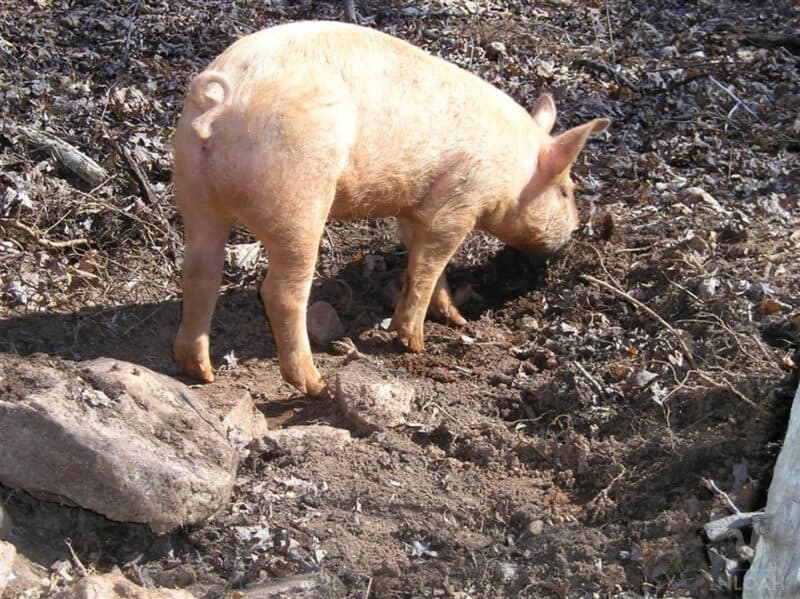
Free-range pigs tend to be happier and healthier, and yield pork of far better quality compared to those produced in a factory setting or even in crowded indoor or outdoor pens.
Plus, what could be more appealing than watching your own herd of pigs trot around on a perfectly green pasture? If that doesn’t say “homesteading,” I don’t know what does!
Well, it turns out, there are upsides and downsides to free-ranging these animals. It’s a great thing to be excited about the good, but you’ll need to tend to the bad and also be prepared for the ugly side of free-ranging your own porkers. I’ll tell you what you need to know in this article.
The Good
There is a lot to like about free-ranging pigs. The things we’ll discuss in this section are what make the experience a pleasant one for many owners. No matter what breed you are raising, and where, the following perks are something to celebrate.
Pigs are Largely Self-Sufficient
Compared to most other livestock, hogs will need relatively little interaction from you. Assuming you’ve done what you need to do to contain them and give them what they need, they are unlikely to get tangled up, get stuck, get hurt, or cause problems amongst themselves.
These are pretty intelligent animals, and they’ll be more than happy to meander around looking for food, rooting, relaxing in the wallow, or hanging out in the shade.
It seems like there’s always something going wrong with sheep, goats, cows, and horses, but pigs can be a remarkably straightforward experience compared to those other specie.
Pigs Can Eat All Kinds of Plants and Roots
When it comes to your pasture providing food for these animals, you’ll find that they’re nowhere near as picky as most other animals. They can, and will, eat nearly anything. And I do mean anything!
They won’t nibble any choice bits off of a plant and leave the rest, or turn their noses up at grass that isn’t their favorite. They will eat everything they can find and eat every part of it, even digging through the soil to eat roots and shoots.
When it comes to pure grazing efficiency, pigs are hard to beat. As long as you make it a point to remove any dangerous plants from your pasture, they’ll be just fine…
Pigs Will Happily Eat Old Crops and Gardens
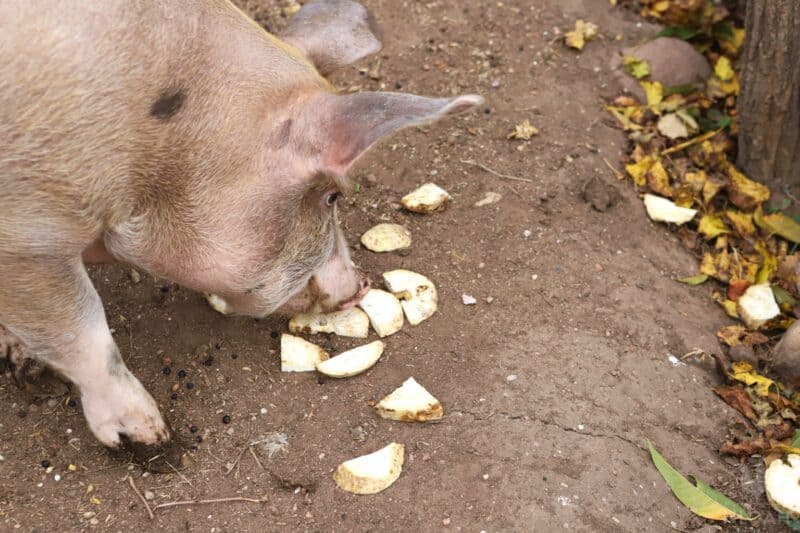
One of the best attributes of swine is that they will happily forage on old crops and garden plots.
Every kind of grain, veggie, and fruit is on the menu, and especially if you have inherited some neglected cropland, or you just had a harvest that went bust for whatever reason, you can give your porkers a boost of nutrition and also save a bundle on feed by letting them forage on it.
They’ll enjoy access to a new and interesting source of food, and turn the land with their rooting and digging; it will soon be ready for additional processing or just replanting.
But, as you probably already know, this can be a double-edged sword: if your hogs get out onto any other cropland or into your garden, it will be history in short order!
Most Breeds Will Free-Range Fine
No matter what pig breed you have your eye on, you can rest assured it will do fine if free-ranged, assuming they have enough space and enough food.
Breeds like the Large White, Black Devon, Berkshire, Tamworth, and Kunekune are all popular for various reasons, and all of them do just fine in a free-ranging setting as long as their other housing and containment requirements are met.
You don’t need to fret over which pigs show the best gain efficiency, have the best weather resistance, or anything like that unless you are absolutely committed to maximizing your returns: any breed of pig is a fair choice for free-ranging.
Free-Range Pigs Can Produce Excellent Pork
And this is the major reason why folks want to free-range pigs in the first place: free-ranged pork just tastes better across all variables, and I will die on that hill.
When allowed to free-range they typically enjoy a more varied diet but also more exercise, lower stress, and a better overall lifestyle that translates directly into superior cuts of meat. It’s true that they don’t gain weight quite as quickly, but this is a small price to pay.
There’s just no comparison in terms of taste, and allowing heritage breeds that are already known for producing superb quality pork, like the Berkshire, to free-range will yield meat that is of sublime quality.
The Bad
There’s a lot to recommend pigs for free-ranging, but also some distinct shortcomings that you must plan for if you want the experience to be a happy one for you and your herd.
You’ll Need to Rotate Pastures Regularly
Anytime you’re letting animals graze in a pasture you’ve got to rotate it. This is important for the health of the animals, but also critically important for that of the pasture! It’s especially necessary when keeping swinewhich can obliterate grasses and other plants entirely, roots and all.
This means that the pasture basically won’t regrow after a certain time without your intervention. Assuming you have no more than 25 adults on an acre, you should plan on rotating them into a new pasture no later than every 2 weeks.
The longer you wait, the worse it will get and the worse off your pasture will be! If you can stick to the schedule, though, you’ll find that your pasture should regenerate just fine.
Pigs Need More Room than You Think
When you compare your average pig to a cow or horse, they can look like a value proposition of sorts when it comes to space requirements. After all, the latter two are definitely huge animals, and even the largest pig is considerably smaller.
But the fact is that adult pigs, even medium-sized breeds, still need lots of space in order to thrive when free-ranging, around 1,700 square feet per head at the absolute minimum.
This doesn’t take into account extra land needed for proper rotation, management protocols, and more.
If you have even a modest-sized herd of 25 adult pigs, that is pretty much all a single acre is going to support. If you want to properly rotate your land and implement proper pest control strategies, you’ll have to cram them into an even smaller space. At a bare minimum, you’ll need a second acre.
Fencing Must Be Very Durable or Electric
When it comes to animals that are unstoppable escape artists, pigs are second only to goats…
They are powerful, intelligent, and extremely curious, and they are very keen to get out, under, or through obstacles to find food. They care very much about the greener pastures that lie beyond their own!
Any and all fencing that you are even thinking of employing with pigs must be absolutely durable. Stout woven wire fencing panels are the bare minimum, and all posts, or corner posts at the least, should be sunk in concrete.
Also, keep in mind that piggies are expert diggers and will easily slip under most fences in very little time. This means you need to bury them (the fence posts, that is!) at least a foot in the ground to stop these digging attempts, and even then repairs and refilling will be frequent chores.
A better option for most owners is electric fencing which gives these stubborn critters a powerful psychological incentive to stay inside the bounds.
Most will only test it once, twice at most. Even then, if you have a herd of mixed size, you’ll need multiple strands to keep smaller breeds and piglets from just dashing under the wire.
A strand 4 inches off the ground will keep piglets in place, and for most other adults anywhere from 1 foot to 16 inches off the ground will suffice.
In any case, all of these fencing types are expensive to buy and install.
Shade is Critical for All Pigs, Even in Hot Weather
There are a lot of urban legends flying around when it comes to pigs, mainly when it comes to the color of their skin and hair. Some folks say that as long as the pig is dark-skinned, it will do fine in intense heat, whereas your lighter-skinned ones are better in colder climates.
There may be a grain of truth to both of those assertions, but all I know is that no matter what kind of pig you have, of any breed, they must have shade from direct sunlight.
Keep in mind that in the wild these animals tend to inhabit wooded areas that can provide them with a more or less constant canopy to retreat under. There’s a reason for this!
Pigs are very vulnerable to overheating and can get sunburned. Accordingly, you must provide them shade one way or the other.
If you have plenty of trees growing on your property, that will do the trick. If not, you’ll need to provide overhead cover for them if you want them to actually stay out in the heat of the day when it isn’t overcast.
This could be something simple like a lean-to or A-frame shelter, or a purpose-built overhead canopy. We’ll talk more about that in the very next section…
Dedicated Shelter is a Must
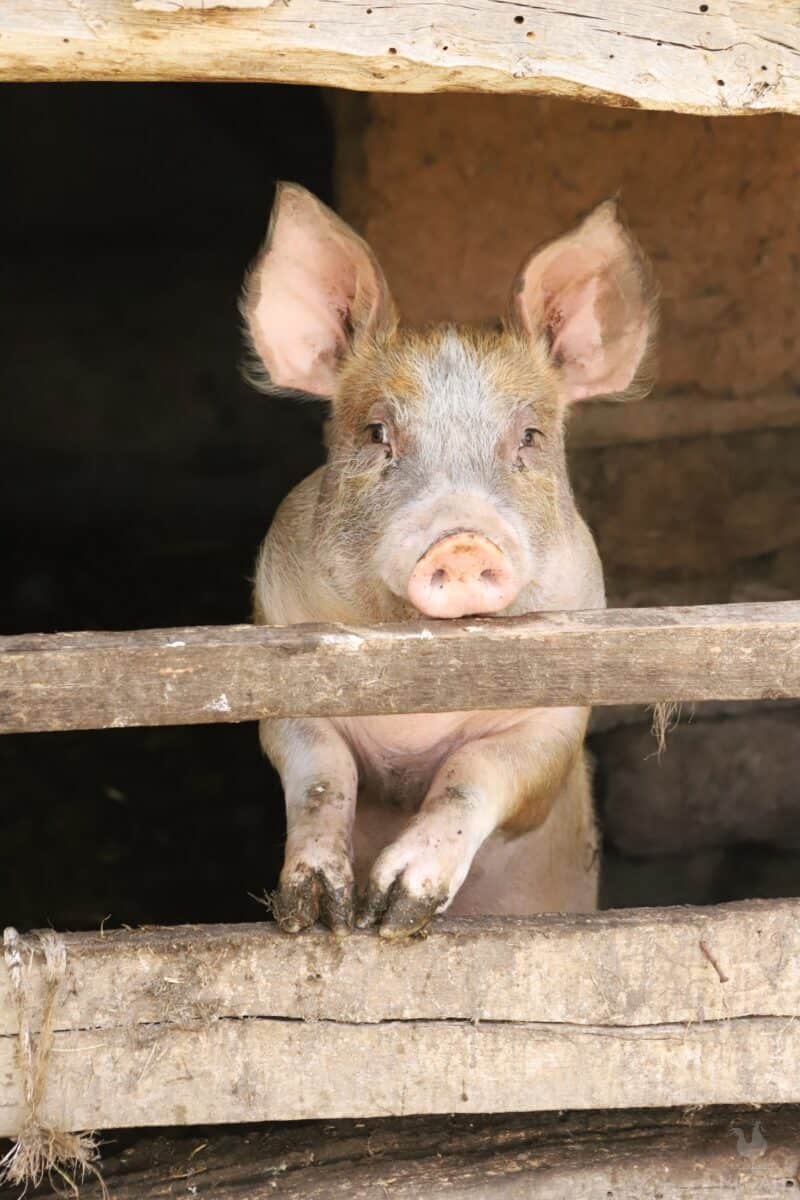
It’s easy to look at a pig, as fat and stout as they are, and think they are pretty well invincible against cold, wind, and rain. But you’d be wrong. Like all animals, pigs must have shelter from harsh conditions.
This means you have to provide them with a shelter, a real one, when they are allowed to free range. A hollow in the ground or a ring of bushes just won’t do.
The good news is that a pig shelter can be quite simple, and a sturdy and reasonably portable A-frame can work, as can a three-sided goat shelter or even an unused chicken coop if the door is large enough and you just have a few pigs.
For short-term use against inclement weather, you can get by with as little as 8 square feet per pig. If you will be housing them in a shelter for longer durations, plan on at least 25 square feet per pig.
Pigs Must Have a Wallow or Bathing Area
You know that old expression, “as happy as a pig in mud”? There’s a reason why it is an old expression! They need a “bathing” area, or wallow, for them to cool off in.
If there’s a low-lying area on the pasture that will regularly fill with water, but not be too deep, this will work nicely but if not you’ll have to make one for them.
I say you’ll have to, but that’s not entirely true either: if there isn’t a wallow, your pigs will make one for themselves instinctively, rooting and digging up a wide, bowl-shaped depression that will hold water.
Obviously, this is an eyesore and might create problems for you when it’s time to restore and tend to the pasture.
The Ugly
Before you pull the trigger on getting your own herd of free-range pigs, you’ll definitely want to consider these nasty truths most people won’t tell you…
Pigs are Intensely Destructive
Out of all the different livestock animals you could own, even large ones, pigs are the ones that will tear up your land the most.
These animals are remarkably capable and enthusiastic diggers, and they can root up anything in their quest for tasty morsels of food. This is part of the reason why feral hogs are such a big problem; they are genuinely destructive to land.
Letting your herd free range means you’ll be dealing with the unsightly wallows described above but also great furrows that are torn up in their wake.
Your land will heal if you rotate appropriately, but it will also start to become scarred. Fitting them with a ring in their snout will limit, but usually not eliminate, digging.
More than this, they will lean on and push over fences, and tear up buildings and anything else they can reach in time. Anything you leave behind in their enclosure or pasture will get thrashed.
Parasite Vulnerability Goes Way Up Without Lengthy Pasture Rotation
These animals have a reputation for good health and that reputation is deserved, I think, but they are far more vulnerable to parasites than most people think.
One of the worst and most prolific porcine parasites is lungworm. Part of the lungworm life cycle exists in earthworms, which pick up lungworm eggs from burrowing through and eating pig feces.
Pigs then, of course, will eat the worms when they’re rooting around in the ground! Now they are infected, and pass on lungworm eggs in their poop. Lice and mange mites are other constant menaces for pigs that are free-ranged.
These issues will be persistent unless you can rotate them out of a pasture into a fresh one while implementing good treatment protocols.
Depending on the parasite, this can take several weeks or longer. By doing so, you’ll break the necessary life cycle at a given point in the parasite’s life cycle, causing them to die off.
Keeping your pigs in a single large pasture, even one with more than enough room, isn’t good enough from a pest control perspective since you can’t guarantee your herd won’t be recontaminated or infested.
Consider the installation of a paddock or a second, enclosed pasture mandatory for the health and wellness of your pigs.
More Than One or Two Small Pigs in Your Backyard Gets Ugly Fast
You know what’s all the rage in homesteading? Backyard chickens. Chickens are compact and efficient enough to live a great lifestyle, free-ranging the entire time, in a large backyard. Heck, a few people even keep goats the same way.
You know what you definitely can’t do though? Raise pigs like that. I know it seems silly, but I have to bring it up because certain kinds of piggies make very popular pets, like potbellies and minis. A single pet pig is one thing, but even 3 or 4 in a small herd is another thing entirely.
The destruction to your yard, landscaping, and typical backyard fencing is going to be immense, and it’s only a matter of time until your porky pals break out and cause havoc for your neighbors.
Not for nothing, do not discount the notion that pigs are large and powerful, and have extraordinarily capable jaws and teeth. Injuries to people and pets or serious property damage are not out of the question!
Outside of a small pet pig, if you want to truly keep a herd and allow them to thrive while remaining safe, you need actual acreage, not a suburban backyard.

Pigs Sometimes Don’t Get Along With Other Animals
Many domestic animals, including livestock, can be allowed to commingle more or less as long as they all have plenty of room and their other needs are met.
Goats and sheep tend to get along, and cows don’t seem to bother any other animals as long as bulls aren’t a factor and calves are not threatened.
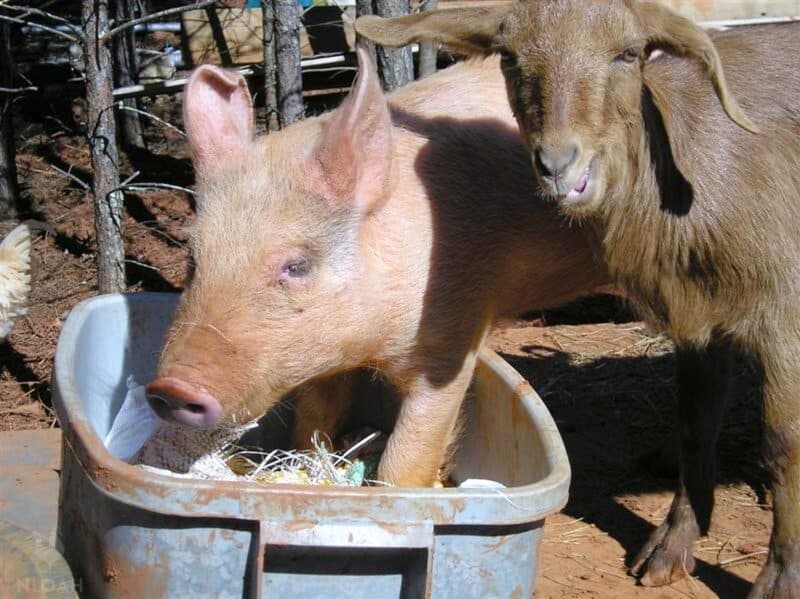
But when it comes to pigs, I’ve seen decidedly mixed results. Sheep and goats tend to be very wary of them, and that’s because they are, at the end of the day, omnivores; they eat meat!
You must never, and I mean never, trust them around kids or lambs. I would likewise be very cautious generally if I had smaller-breed goats or sheep.
Horses also tend to be pretty skittish around them especially bigger ones.
If your idea of free-ranging is turning all of your animals out into one massive parcel and letting them tend to themselves, it’s highly likely that the pigs will cause stress for at least some of them – and negative encounters with bad outcomes are not out of the question…

Get your gift and learn things like:
- how to make this really quick pest spray
- how to prevent egg waste
- two cheap automation devices that will make your life easier
Tom has lived and worked on farms and homesteads from the Carolinas to Kentucky and beyond. He is passionate about helping people prepare for tough times by embracing lifestyles of self-sufficiency.