
If you’ve owned chickens for any length of time, you already know that these plucky birds are eating machines. Food, truly, seems to be the only thing that motivates them. But feeding them is a lot easier in warm weather. With cold weather comes challenges…
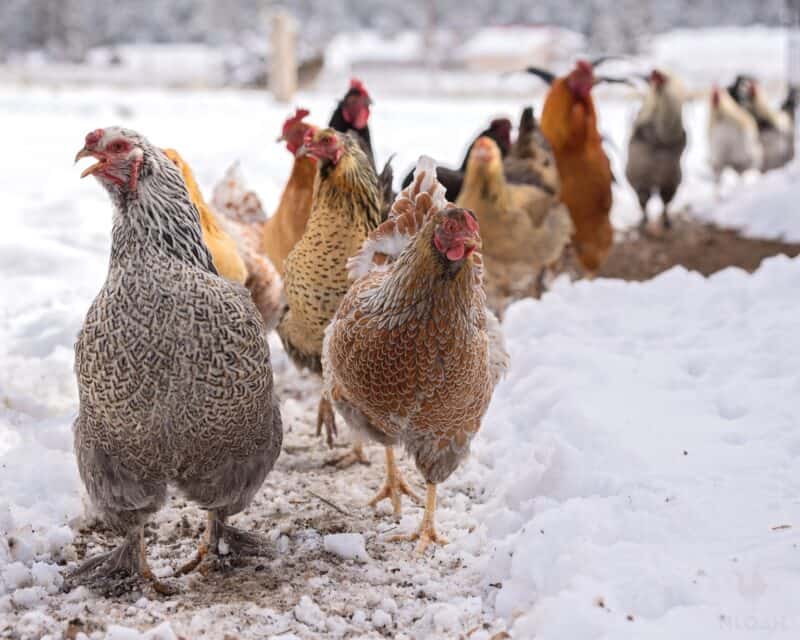
For example, chickens won’t be able to peck and scratch at the ground to find choice morsels. Deep snow means you can’t scatter food like you do normally. They might not even want to come outside where they normally eat. Your chickens will be burning more energy, too, and need even more food than usual. That, and elevated stress levels means that proper nutrition is more important than ever to prevent illness.
Today I’m bringing you a guide that will tell you everything you need to know for properly feeding your chickens in the winter, or any other time it is very cold out.
Chickens Just Need More Calories in the Winter
The very first thing you need to know about feeding chickens in the winter is the simplest and the most important: your chickens need more calories in the wintertime.
But how many more do they need? A good rule of thumb is that your chickens should get one and a half times the usual amount of food. Said another way, they should get a 50% increase in their total amount of calories that they consume daily.
No, it isn’t just to help them beat the boredom of being cooped up more often and unable to chase bugs and enjoy the sunshine.
Extra Food is Essential to Help Chickens Stay Warm
These extra calories are critical for helping your birds stay warm and healthy in the wintertime. That’s because they need the extra energy to, very literally, act as fuel for their own little biological furnaces.
A chicken’s metabolism is overwhelmingly responsible for keeping them warm.
Yes, those wind-resistant and mostly waterproof feathers are marvelous insulation, and trap a large amount of body heat. But there has to be body heat being generated for the feathers to trap!
This is where those extra calories come in; your birds’ metabolisms are going to be in overdrive during periods of cold weather, particularly when they’re outside.
Even if your birds are getting their baseline normal amount of calories, they can still start to suffer from malnutrition, illness, and potentially even death in the cold season due to a lack of calories!
This is also important when budgeting for your flock’s food: make sure you know when the real cold weather starts to kick in, and understand that their food consumption is going to go up 50% during those months.
Protein Intake Should Also Increase
It isn’t just extra calories that your chickens need. They need extra protein too to help maintain their muscles and also provide them with long-lasting energy. Of course, adequate protein is crucial for their overall health generally.
Just like people, if chickens are getting nothing but carbohydrates and empty junk food calories, they might keep them alive for a time, but their overall health and wellness will start to suffer.
Extra high-protein feed, or mixing in a little layer of feed with their usual stuff, is one good way to give them more protein in the winter, and one that won’t take any extra work from you.
An alternative is to increase protein-rich whole foods like mealworms, other insects, some meats, and certain kinds of vegetables.
“Warming Feed” is Great in the Winter
A concept you should familiarize yourself with for your flock’s winter menu is warming feed.
No, it isn’t cinnamon-and-clove pellets. Warming feed refers to any food that chickens can eat that is especially energy-dense and will give them a great return on total calories and plenty of nutrition for a relatively small serving.
A few favorites in this category include corn, seeds, mealworms, and other grains in moderation. These foods also happen to be very convenient, and if the weather is turning especially nasty or if your birds are already under stress in cold weather, warming feed is just the thing to help them stay ahead of the curve and stay healthy.
Just as a reminder, this doesn’t mean you should give them a diet of nothing but these foods in the winter! They are still supplements, and must be fed in accordance with their nutritional requirements as usual.
Can You Scatter Food for Chickens in the Wintertime?
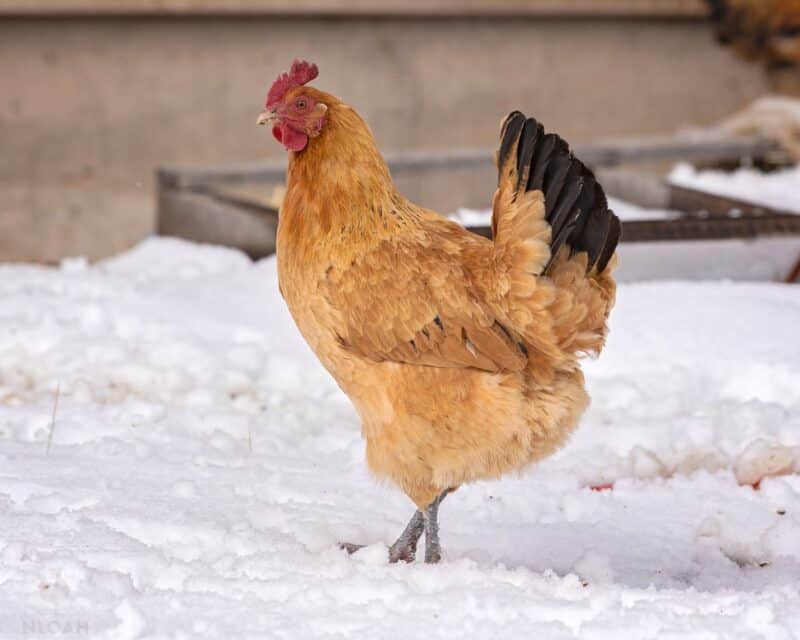
People ask me all the time if they can still scatter feed for their chickens as usual when it’s cold outside. The answer is, “it depends”.
If it’s just cold outside, but the ground is dry, you can scatter a little bit for them as normal. However, if the ground has been getting frosty and is now soggy and muddy, or if there is snow or ice already on the ground, you want to hold off.
That’s because your chickens are going to have a harder time since that food will be getting soggy, or freezing solid, in turn. This will make it less appealing to them, and eating cold, muddy food isn’t good for and it will rob them of more body heat, something to be avoided.
A much better way is to use a feeder, even if it’s just a simple trough or multiple large bowls that they can eat from.
Any sort of feeder will keep the food clean and protect it from freezing, or at least it will take much longer to freeze, and make it more appealing to your birds. It’ll also make it a whole lot easier for you to clean up.
Pull Back or Clear Snow and Ice Around Feeding Areas
Even if you’re going to give your chickens their food, whatever it is, in a feeder or container of some kind you still want to make it a point to pull back snow and ice from the area where you’re going to feed them, assuming it’s outdoors.
Chickens that stand in snow can develop hypothermia and eventually frostbite in pretty short order, and breeds that have feathered legs and feet are very vulnerable to it.
That’s because those feathers tend to get matted and messy and wet, and they basically freeze into a shell around their legs which will kill them to the bone very quickly.
Yes, the ground might still be a little money and nasty if you get rid of the snow and ice, but it’ll be a whole lot better for them than standing in the stuff.
Also, consider building a small raised platform using pallets or scrap wood they can get them up off of the ice and snow by just a few inches. That’ll make a big difference.
Caution: Scattering Food Can Drastically Increase Rodent Activity in Winter
Another major and unexpected problem associated with winter feeding time is a serious increase in rodent activity around the coop. Any rodents that are nearby and struggling to get food themselves we’ll go to great lengths to lay paws on an easy source of it, and one of the easiest is from your chicken coop and run.
This is part of the reason why you don’t want to scatter it on the ground, because it will invariably stay there where it will certainly be detected by mice and rats that will then come looking for it.
From there, it’s just a hop, skip, and wriggle into the coop itself or they will eat eggs and potentially injure your birds.
Staying on top of your food security and hygiene in the run, coop, and feeding stations will keep mice and rats away because they’re less likely to be attracted in the first place.
Hanging Foods Can Keep Them Off the Ground and Make Cleanup Easy
A great cold-weather choice for feeding your flock, particularly if they have a nice run fence or a covered run is to hang up certain kinds of food for them to nibble on. This is great for a little bit of winter entertainment, and has the added advantage of keeping the food itself off of the ground and out of the mud.
Fresh heads of lettuce and cabbage and “chicken blocks” consisting of seeds, mealworms, suet, and a little bit of molasses are wonderful, as is anything else that you can easily and safely hang to let your birds peck on for a little while (assuming you’re letting them stay outside).
Hanging food in this way is often a good idea whether or not it’s wintertime, just for the record, but it’s especially useful when temperatures are low, and conditions are nasty. Just make sure that it’s low enough for all the chickens to reach!
Will Chickens Free Range in the Winter?
Another question that I get asked all the time. The answer here is more straightforward, happily: Yes, your chickens will continue to free-range in the winter, though this is dependent on a couple of factors.
Your birds will free range if there’s anything for them to find and they have some success. If they’ve got easier sources of food, and it’s really hideous outside, they won’t waste a lot of time.
Likewise, if it’s just too cold, chickens will not want to move around so much to conserve energy and, as we’ve learned, energy equals heat and heat equals life for them in cold weather.
Deep snow is obviously a major impediment to foraging and free-ranging, though most birds are more than happy to nibble and eat from plants that are above the snow line.
Likewise, if snow is thin or melting, any food that they do find must not be frozen, or at least not fully frozen, for them to eat it.
It’s okay to let your birds free-range when it is cold, even snowy, but you shouldn’t encourage them to stay out or, worse, force them to stay out if the conditions are really bad for them.
Warm Meals and Snacks Can Help Your Birds Keep Warm, Too
Believe it or not, your birds are bound to enjoy a nice, hot meal the same as us on a cold winter day. No, this doesn’t mean you should bust out a bowl of beef stew and a big hunk of cornbread for them.
Instead, make them chicken-safe hot meals: Gently warmed fresh fruit and vegetables are a great treat, as are warm “porridges” made from grains like oatmeal, corn mash, and similar offerings.
You can get these foods good and warm and your chickens will like them, but they should never be piping hot or they can potentially cause injury.
Likewise, now is not the time to give them any foods that you ordinarily wouldn’t give them. People foods, really salty stuff, highly acidic things like tomato soup, etc, are all going to be bad for them.
If the temperatures are really low and your birds seem stressed or reluctant to move around, a warm meal or snack will improve their attitude and also warm them up.
A Water Heater Will Be Needed Outside
Don’t forget about water, either. Your chickens must have unlimited access to fresh, clean water at all times. Fresh water, and also unfrozen water!
A waterer inside the coop might be okay, depending on the arrangement of the coop and how good its insulation is, and it will almost certainly stay warm enough to avoid freezing at night when the chickens are inside, but during the day or for outdoor water sources you’ll likely need a heater.
These specialized devices are available online and from any livestock retailer or chicken supply shop that is worth its salt.
They draw very little power, are totally safe when properly installed, and will keep your flock’s water liquid and at a comfortable temperature, which will likewise help their body temperature to stay high.
Keep a Sharp Watch for Signs of Illness or Cold Injury
Winter is a time of illness, injury, and death, and that definitely applies to your chickens. You should always keep a close eye on them for any signs of distress, injury, or sickness but be sure to keep a doubly close watch during cold weather, especially prolonged, intense cold.
Even if they get plenty of food, the stresses can make them more prone to illness from any source, and the aforementioned problems with feeding that are likely to occur, even if you are diligent, means that if they are going to get sick it is very likely going to be in times of intense, sustained cold.
One major warning sign is any chicken that shows a reduced or total lack of appetite, in addition to other signs of illness or depression-like pale combs and wattles, standing on one leg, sluggishness, discharge from the nostrils or beak, and so forth.
Want my advice? Focus on breeds that are cold-hardy and you’ll have much fewer headaches when temps start to drop.


Get your gift and learn things like:
- how to make this really quick pest spray
- how to prevent egg waste
- two cheap automation devices that will make your life easier
Tom has lived and worked on farms and homesteads from the Carolinas to Kentucky and beyond. He is passionate about helping people prepare for tough times by embracing lifestyles of self-sufficiency.