
For most of us chicken keepers, the major appeal of having a flock of our own has got to be the eggs. Fresh eggs that you raised yourself, with a little bit of help from our birds of course, taste better than anything you can buy in the grocery store…
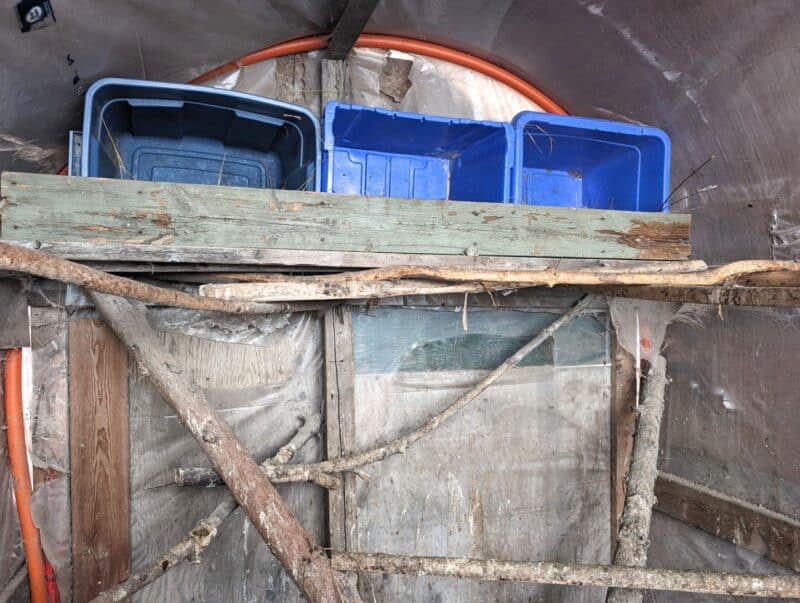
But if you want to collect those eggs on a regular basis, and keep your hens laying happily, you’ve got to give them nesting boxes so they can take care of business. And if you’ve looked at the prices of pre-made nesting boxes, you might still be in sticker shock!
There’s no need to panic, though, because it turns out that with a little bit of ingenuity, you can repurpose almost anything into a comfortable, safe, and secure nesting box that your chickens will love – and save a small fortune in the bargain.
I’ve got 20 great and proven designs from around the internet for you waiting below.
Cardboard Boxes
Sometimes, you just need a nesting box right away, or you don’t have the time or inclination to try repurposing anything else that you’ll find on this list. That’s okay! It turns out that most chickens are more than content to use a cardboard box that’s the right size and shape.
With a few extra minutes, you can even turn it into a rollaway-style box that will make your collection duties even easier and quicker.
Obviously, cardboard will break down and get too nasty to use over time, but there’s no shortage of these things and you can just throw it out when that happens.
Kitty Litter Trays
You don’t want your birds sharing a box with your cat, but you can use a new or repurposed kitty litter tray, cleaned of course, as a great nesting box.
Sometimes hens will be content to nest in one that is in the open, but you can make it more appealing to them by sticking it in a cubby hole or even placing a cardboard box on its side to give them a little privacy.
Kitty litter pans are designed to hold up to repeated, heavy-duty cleaning, and this makes them a great choice for nesting boxes for the same reason: you can thoroughly sanitize them and still expect years of reliable service.
Kitty Litter Buckets
Speaking of kitties, if you, a friend, or a neighbor has a cat or two and buys kitty litter in large quantities, hang on to those big, square pails when they are empty. They make ripping good nesting boxes with just a little bit of modification.
You can use them in two ways depending on the size of your birds, how much room you have in the coop, and your preferences.
Either cut a hole in the side a couple of inches above the bottom for your birds to enter, and be sure to leave a little lip to hold in the nesting material.
Or you can lay the bucket on its side and do the same thing by cutting through the top to make the nesting box deeper than it is tall.
Large Paint Buckets
Large 5-gallon paint buckets work very much like the kitty litter buckets for our purposes and can be modified in the same way. Very cheap or free, super tough, and easy to clean, these are a mainstay in my coop.
However, be sure that you thoroughly clean the inside of the bucket or buy them brand new so there’s no trace of any dangerous residues that might hurt your birds or their eggs. You also need to keep these from rolling away if on their side.
Dish Trays
Sometimes simple is best, and a dish tray might be just the thing to entice one of your girls to settle down to business.
Convenient, easy to carry, and very easy to clean, there’s a lot to like about a dish tray as a nesting box. However, you might need to set it in a partition or give it some overhead cover or other enclosure to entice some birds to use it.
Again, setting it in a cardboard box might prove to be enough or if you want to build permanent partitions in the coop and then use these as an easy clean liner it will work perfectly.
Old Drawers
Now here’s an old timer’s trick that has been around for a long time! If you’ve got an old junk piece of furniture or if you pass a dresser or something like it sitting out on the curb waiting for trash pickup, you can snag the drawers and put them all to use as nesting boxes.

These are typically going to be wood but are sometimes particle board or other materials. In any case, all of them will be sturdy enough to screw together, mount to the wall, or do something like that. This makes them one of the most versatile DIY options.
Bookcases
A medium-sized bookcase can be the perfect foundation for making four, six, or potentially even more nesting boxes with just a little bit of elbow grease.
All you’ll need to do is add a rail to the front of each compartment, easily done with a furring strip, and a couple of vertical dividers if needed. Bolt to the wall and you are in business!
One word of caution: carefully inspect any old bookcase that is being thrown away or given to you for stability. These pieces have to endure very heavy loads and might be weakened, so make sure they’re safe.
Cupboards
Just like using a bookcase as detailed above, cupboards make for perfect ready-made racks of nesting boxes with just a little modification.
Check out the video above for one idea, and another method I like is to cut holes in the back of it to serve as the entrance and exit, but leave the doors intact so you can open up the cover on the outside for easy access to the eggs.
Tires
Ask any homesteader that’s been keeping chickens long enough and they will confirm this: sometimes chickens will nest in the strangest places! One that I consistently hear over and over again is inside unused old tires, specifically large tires off of tractors and other heavy machinery.
But leaving one of these big tires lying around is not an efficient way to collect eggs. Instead, first cut the tire into quarters and then cut away about a third of the tire in profile to make a shape that looks a bit like an open macaroni noodle.
In my experience, chickens can’t resist these, and they are so durable they will hold up forever.
Milk Crates
Ah, milk crates. These supremely useful containers have 101 purposes, and now it’s 102 since you can use them as nesting boxes.
Two options here: you can lay them down on their side so the top opening serves as the entrance, and you’ll need to add a rail across the bottom to keep in eggs and nesting material.
Alternately, leave them upright so they can stack and then cut out one side, leaving the strip at the bottom, to serve as the entrance. You can stack them as said, bolt them to the wall, or move them around according to your needs!
Shallow Storage Trays and Totes
Plastic storage trays, crates, and totes also make terrific nesting boxes. They are usually cheap, light, and easy to clean, and many of them are designed to stack.
The only thing you need to worry about is making sure your birds have enough overhead room if you’re going to stack them.
A clever approach when using these is to take two of the same type and then invert one, stacking it on the other to make a compartment for your chicken.
Plywood Boxes
You don’t need to reinvent the wheel with nesting boxes if you’re handy with a drill. A little scrap plywood is all you need, and a couple of hours out of your day.
The great thing about a bespoke approach, even a very simple one, is that you can craft it to perfectly work with your situation in the coop.
Wood Barrel “Box”
Hands down one of the cutest nesting box designs is made from an old wooden barrel.
Wooden barrels are all the rage these days for decoration and other purposes, and even if you find an old wooden whiskey or wine barrel it might cost you a pretty penny. But ask around and you never know what someone will be willing to part with.
As with buckets, there are several ways to use a barrel to make a functional nesting box, but generally speaking, you can get two boxes out of one barrel whichever way you go. This is another DIY solution that is easy to stack, too.
Big Plastic Bowls
One of the most portable designs around, and a great choice for girls that aren’t too picky about where they lay.
Those big, cheap plastic bowls that are used to hold Halloween candy, centerpieces, and other stuff are the perfect size and shape to appeal to chickens, and even the biggest breeds can snuggle down comfortably in them.
You might consider cutting down one side a little bit to make it easier for your bird to get in and out, though.
Pet Carrier Nesting Spot
For the ultimate in portable convenience, you can repurpose a pet carrier as a snug, secure, and durable nesting box. I prefer the plastic type that has generous windows or air holes on the sides to improve circulation.
Like the other plastic solutions we’ve talked about, these are tough enough to stand up to the most demanding regimen on the homestead and designed to withstand pet messes, so they are easy to open up, clean out, and sanitize when needed.
Hanging Nesting Box
If you are out of floor space or just have a couple of girls that like to get up high before they lay, consider making a hanging nesting box.
This is a great opportunity to let your creativity really shine as you can use bins or boxes, crates, even hanging planters for the job. Just don’t put it so high where it’s hard for you to get the eggs, and make sure your girl has an easy way to get up and down from it safely.
Mailboxes
Another cute and cheerful design, an oversized mailbox makes a very surprisingly ideal nesting box! You can leave the door open as the entrance or cut into the backside of it and use the door as your access point for grabbing the eggs.
Both metal and plastic designs work fine, but I prefer plastic for ease of care and the fact I won’t have to worry about any sharp edges or jaggies maybe hurting my chickens.
Small Doghouse
A small dog house, with a little bit of work, can be repurposed as a nesting box condo as shown in this video:
Ultimately, if you have a dog house for small breeds, it might make a perfect standalone nesting box. Chances are it will only accommodate one hen at a time, but if you have multiple you can always line them up.
Clean Beehive Box
A clever way to reuse an old beehive box for sure! Designed to be quite sturdy and also easy to open up, you may only need to put it in position and leave it open so your girls can climb inside.
Many designs are tall enough that they could accommodate two or possibly even three hens with some easy modification.
Just one thing to keep in mind: thoroughly clean out the inside of all traces of wax, propolis, and honey! Aside from this sticky stuff playing hell on your birds’ feathers, leftover traces of honey will quickly attract insects and rodents that you don’t want around.
DIY Pallet Boxes
Pallets are another item that have seemingly infinite uses for savvy homesteaders, and here is another one you can add to that list.
Pallets are easy to break down and reconfigure in open cube shapes that are picture perfect for our egg-laying operation. You’ll even be able to reuse a few scrap pieces to make rails across the front.


Get your gift and learn things like:
- how to make this really quick pest spray
- how to prevent egg waste
- two cheap automation devices that will make your life easier
Tom has lived and worked on farms and homesteads from the Carolinas to Kentucky and beyond. He is passionate about helping people prepare for tough times by embracing lifestyles of self-sufficiency.
Thanks for all your great ideas. I built my cage with a sloped, slatted bottom to roll eggs out the front, but the hens weren’t having it. They lay their eggs where there are level floors for feed and water. Perhaps if I cut out a portion of the bucket bottoms, so the eggs will roll out where originally planned and into an indoor rain gutter?
Anything to get clean eggs for glassing.