
There are many varieties of ducks out there. Big and small, black, white, brown, and every color in between. If you are a duck fancier, there is a lot to love. But if you want an especially fancy duck, you might want to look at a crested variety.
All crested duck breeds have a spray of feathers on the top of their heads. Sometimes just a handful that gives them an elegant and graceful shape. Others have a big plume that looks like a hat or fancy hairdo!
If you want a duck that will stand out in a crowd, or I should say in a flock, you need to check out these 11 crested duck breeds to consider raising.
A Note on Crested Breeds
One thing to keep in mind about crested ducks is that most of the common breeds you’ll find on the market, specifically crested domestic breeds, only have crests as the result of a mutation or selective breeding.
Sometimes a mutation in the genes linked to the growth and shape of the feathers will cause a few upturned feathers on the head or sometimes the neck of a duck.
More pronounced crests are usually the result of a serious genetic defect concerning the duck’s skull. Both are inheritable, and the latter can cause serious health problems or even death, including stillborn ducklings.
Accordingly, you should think twice and perform your own due diligence when investigating any potential seller or breeder of crested ducks, no matter the breed.
You must consider the health and welfare of the animals, and also your own well-being: you’ll be paying for and taking care of them.
With that in mind, let’s get to our list…
Swedish
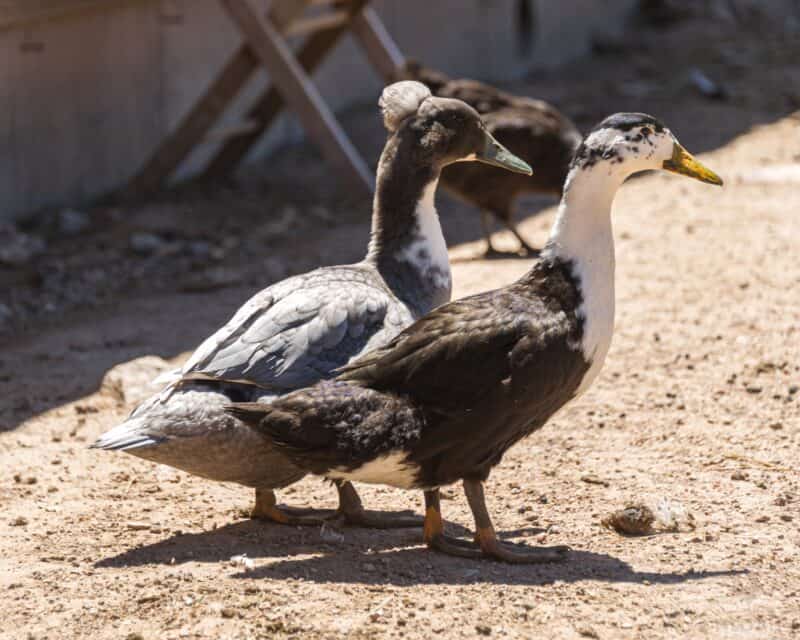
One of the most popular and important dual-use European breeds, the Swedish is an active, vigorous, and inquisitive duck known to have great foraging skills. Sometimes called the Swedish Blue for their most iconic color, these ducks can provide a lot of their own food if you have a large property. They especially love insects, worms, snails, and slugs.
Meat yield is above average for their size, and they regularly lay up to 150 eggs a year, though females can be somewhat variable in their production.
Crests are, again, not standard but feathering mutations are the most likely cause of crests in this breed assuming they have not been crossed with the Crested breed.
That’s good news because it means health problems are unlikely to arise from their having a crest!
Crested
The most common and well-known domestic crested duck breed is just called… the Crested!
Although the exact origins of these ducks are murky, it is known that they were first brought to Europe, and later to America, by Dutch ships.
They are closely related to the Pekin, the most popular domestic breed around, but are instantly recognizable by their huge, topknot-like crests.
A larger medium breed, weighing up to 7 lb in the case of drakes and 6 lb in the case of females, they’re surprisingly good layers of eggs and also fairly popular for meat production.
But, naturally, they are quite popular as pets though not as popular on show circuits as you might think.
This is because, sadly, the crest of the Crested duck is a result of a severe heterozygous mutation that will invariably result in a deformed skull, and often the accumulation of a fatty tumor inside the cranial vault.
This tumor puts pressure on the poor bird’s brain and can cause seizures, a loss of coordination, and death in these poor ducks, and problems often intensify with age.
Crossbreeding Cresteds with other domestic breeds might result in the offspring having a crest for the same reason, and also the attendant health problems. Buyer beware if you’re looking at hybrids!
South American Crested (Lophonetta specularioides)
A common and wild South American duck species, and one that is sometimes raised domestically, is unimaginatively called the South American Crested Duck, not to be confused with the domestic Crested we just talked about.
These ducks have a small, subtle crest of feathers on their heads, it being more prominent on the vividly colored and patterned males. These ducks are fiercely monogamous, with mated pairs living strictly by themselves and avoiding other ducks, even of their own kind.
These dabbling ducks tend to root through mud and silt looking for amphibians and other small creatures to eat. It’s unlikely you’ll find or lay your hands on any here in the U.S., but the farther south you go in the Western hemisphere the better your chances.
Rouen
A popular heritage French breed, and one that comes in smaller production and larger show varieties, the Rouen is often confused for a Mallard due to its colors, but these birds are considerably bigger.
Known for their good looks, extremely flavorful dark meat, and ample egg production that tops out at about 180 a year, they are also popular pets aside from being great utility birds.
They sometimes have a small crest on their head as a result of genetic variation, the same as mallards. Males are considerably more likely to have a crest than females.
Khaki Campbell
One of the most admired egg-laying breeds in the world, the tan and brown Khaki Campbell can produce an astonishing 330 eggs every single year while in their prime. Even when they start to slow down, 300 eggs or more are possible!
You’ll rarely see them with crests unless breeders decide to start making hybrids, and that’s because they have been carefully selected for their traits over many decades.
Every now and then, as with most Mallard descendant ducks, you’ll see males or females with a few small, upturned feathers on their head or neck.
Generally friendly with people if raised with lots of interaction, Khaki Campbells otherwise tend to be flighty, anxious, and quick to run away. Give them plenty of attention so they’ll bond with you and trust you.
Pekin
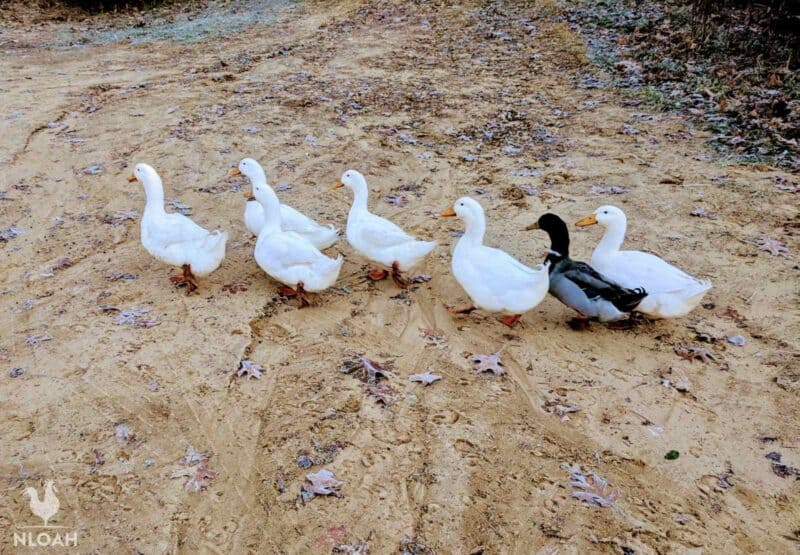
The undisputed champion of domestic ducks in the United States, and many other parts of the world, is the Pekin.
Big, broad, and often seen in iconic pearly white plumage with orange bills and feet, they are the very picture of what a duck is supposed to look like to most people.
Pekins lay lots of eggs, between 200 and 300 a year, and also produce a big carcass with lots of good meat.
As mentioned above, they are closely related to the Crested duck and occasionally exhibit a crest themselves as a result of the same skull mutation, rarely, or more often one affecting the structure of the feathers themselves.
Hybrids that are selected for crests are common among small breeders and backyard outfits. Calm, people-friendly, and easy to handle, they make great pets and homestead ducks.
Muscovy
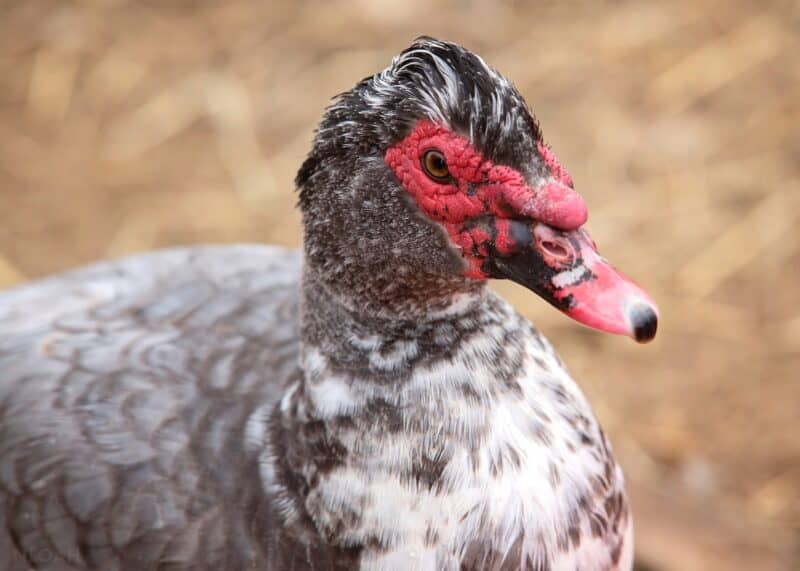
Some of the biggest domestic ducks out there, and one of the only domestic breeds that is not descended from Mallard stock, these instantly recognizable birds have lumpy, fleshy red growths on their heads and necks, called caruncles.
Maxing out at around 15 lb, these birds are imposing and physically powerful, and they can give you a good scratch with the long talons they have at the end of each toe, so be careful.
They spend most of their time on land, and like most other breeds on our list that aren’t Cresteds they will only occasionally have a crest of slightly upturned feathers on the back of the head, assuming they have feathers left there!
Muscovies are typically kept for their meat, which is considered a delicacy in many parts of the world, as they produce generally few eggs.
Indian Runner
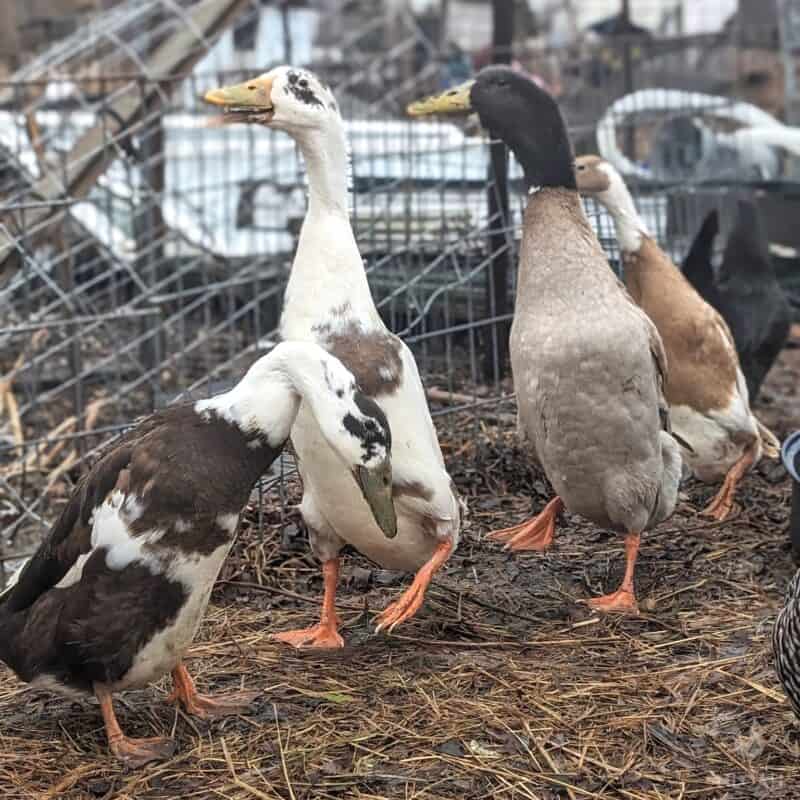
The Indian Runner is one of the most unique ducks on our list because of its upright, penguin-like body. And the name is truth in advertising: they really do run, and they are shockingly fast! If they spook, the flock will “stampede” and they are very hard to catch!
Again, Indian Runners do not typically have a crest, but crests are not unheard of, and some folks have crossbred them with other ducks to produce strains that will have a small crest fairly reliably.
Others have selected the rare crested mutation for permanence and produce boutique varieties that will more regularly yield crested offspring.
Despite how funny they look, they are capable egg layers if that’s what you are after, with healthy females producing anywhere from 200 to 250 a year.
Saxony
Although not particularly common in the United States, the Saxony is a favorite throughout Europe. Best known for its typical tan and blue plumage, this dual-use utility breed is kept for meat and eggs.
Uniquely, these ducks are really calm and very tolerant of cramped conditions, making them easy to house in a small coop or transport in a crate for whatever reason. Good overall health and quick weight gain make them an inspired choice for a meat breed.
Like the other domestics we’ve looked at, crests aren’t a common feature but not unheard of, and a few specialist breeders have developed crested Saxonies and other crested hybrids.
Mallard
Mallards, the domestic variety anyway, are not the most common ducks in North America; that honor goes to the Pekin above. Wild Mallards, on the other hand, are the most common wild species.
Recognizable by their small size and, in the case of males, that gorgeous, shimmering green head, both males and females will sometimes have a tiny crest that naturally occurs, though this is somewhat rare.
As mentioned elsewhere in this article, all domestic ducks are descended directly from Mallard stock in one way or another.
Crested Call
Tiny, adorable, and one of the most popular pet ducks in the world. Believe it or not, the Call duck was once used as a living decoy to call in wild ducks so hunters could shoot them down.
They’re extremely vocal and surprisingly loud for their size, and often quack and quack all night long. Do keep that in mind before you rush home with one!
Crested Calls aren’t common, but they’re not rare either. Unfortunately, irresponsible breeding has resulted in the aforementioned and potentially deadly skull mutation giving these little birds their crest. That means neurological and other health problems are a possibility.
I urge you to thoroughly check out any seller or institution that is advertising crested Call ducks before you commit.


Get your gift and learn things like:
- how to make this really quick pest spray
- how to prevent egg waste
- two cheap automation devices that will make your life easier
Tom has lived and worked on farms and homesteads from the Carolinas to Kentucky and beyond. He is passionate about helping people prepare for tough times by embracing lifestyles of self-sufficiency.