
Chickens offer homesteaders tons of advantages when it comes to livestock. They are cheap, versatile, highly productive, and very easy to keep in a relatively small space compared to most other animals. Besides, chickens are just lots of fun! Having your very own flock of yardbirds running around is always entertaining for you and your family.

But choosing the right kind of chicken is important: every breed is a little bit different when it comes to size, best use, temperament, health, and a whole lot more.
Picking an ornamental breed when you want lots of eggs is going to be a disappointment, and if a beginning keeper chooses an aggressive bird, the stage will be set for tears!
To help you find the perfect chicken for your flock, I’m bringing you an in-depth guide for the most popular and interesting breeds in the US.
Today, we’ll be looking at the Barred Rock, one of the most beautiful and well-regarded dual-use breeds in North America. We’ll get straight into it below.
| Breed Name | Barred Rock (Plymouth Rock variation) |
| Origin | US, mid-19th century |
| Breed Type | Dual-purpose (meat and eggs) |
| Standard Size | Roosters: 7.5 – 10 lbs; Hens: 6.5 – 8 lbs |
| Bantam Size | Roosters: 3 lbs; Hens: 2.5 lbs |
| Plumage | Barred (black and white stripes) |
| Temperament | Friendly, even-tempered, good with people, adaptable |
| Egg Laying | Around 200 large light brown eggs per year |
| Start of Laying Age | 4-5 months |
| Broodiness | Moderate; some hens may go broody; can be encouraged to sit; good mothers |
| Lifespan | 6-8 years, potentially up to 10 years |
| Health | Generally very healthy with few known issues; watch for parasites and frostbite on combs |
| Noise Level | Relatively quiet, except for occasional egg-laying calls |
| Foraging Ability | Excellent; adept hunters and foragers |
| Cold Tolerance | Good, but susceptible to frostbite on combs and wattles |
| Common Predators | Dogs, coyotes, foxes, raccoons, birds of prey, and small predators like snakes and rats |
| Known Health Issues | Few; mainly standard chicken diseases and parasites |
What are Barred Rock Chickens?
The Barred Rock is a variation of the Plymouth Rock, a well-regarded American heritage breed first seen in the mid-19th century. One of the most widespread domestic chickens in the US until World War II broke out, it was and still is raised for both meat and eggs. And thanks to its extraordinarily good genetics, the Barred Rock has long been used in the production of industrial broiler hybrids.
Today, they are slightly endangered, though recovering according to the Livestock Conservancy, with thousands of new registrations yearly. As of 2023, there are estimated to be about 33,000 Barred Rocks worldwide, though many, many more Plymouth Rocks of other colors and patterns.
History of the Breed
The Barred Rock has a well-known and codified origin, though the specifics of its development remain somewhat murky.
These birds first showed up in the middle of the 19th century at an 1849 poultry exhibition in Boston, Massachusetts, being shown by a Mr. Drake and Mr. Spaulding.
You might think of this original showing as prototypical of the breed; they didn’t garner any attention and fell out of public sight for the next two decades.
In 1869, the birds “officially” reappeared in grand fashion in Worcester, Massachusetts, thanks to the efforts of a breeder, Mr. D.A. Upham.
I put the emphasis on “officially” in that sentence because this is where things get confusing: there are several other folks who claim to have developed the Barred Rock, and furthermore, this complicates the exact lineage of these birds.
According to the official story, they were created as a cross between Black Javas and Dominiques. If you believe other accounts, they sprang out of a combination of White and Buff Cochins, Brahmas, and Spanish chickens, along with Black Javas and Dominiques.
So, like many heritage birds, their actual lineage is a little bit murky. But what we do know is that the APA accepted Upham’s version of the Barred Rock as an official breed in 1874 and set its characteristics accordingly. It has been with us ever since.
Barred Rock Breed Standard
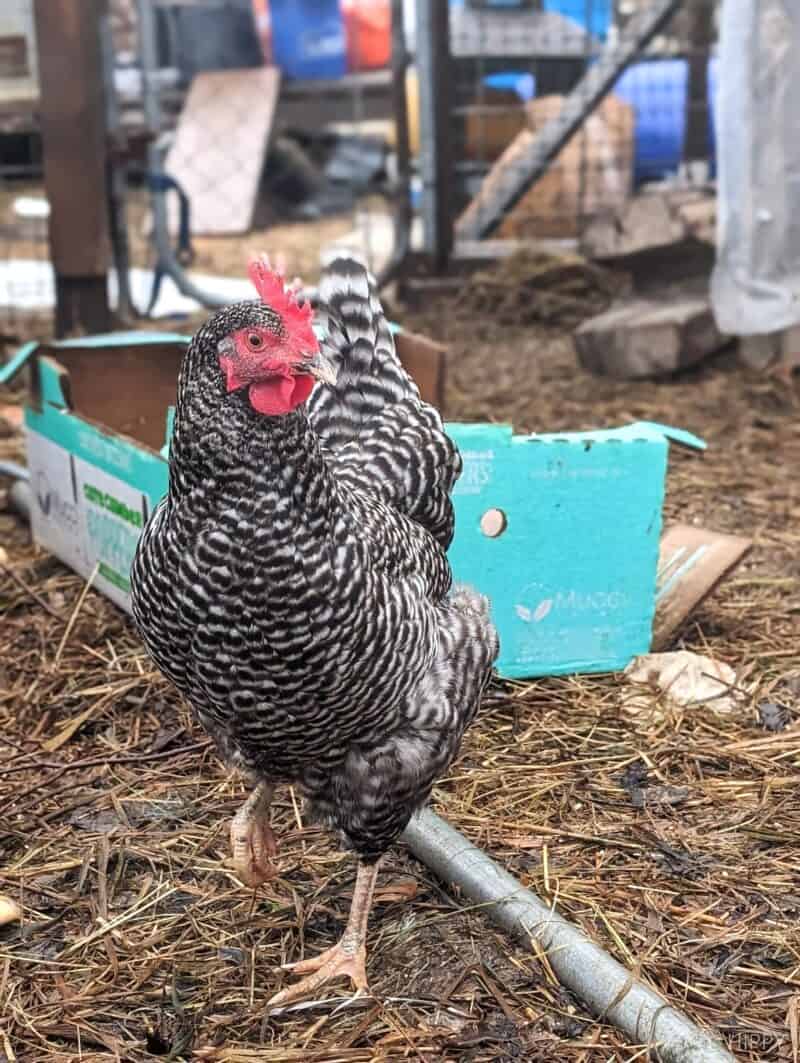
The Barred Rock will have distinctively barred feathers consisting of interlocking, alternating patterns of black and white. The eyes are bright and clear, and they have a single five-pointed comb.
Faces and wattles are red. Breasts are full with a modest keel, and the overall body shape of these birds is large with a triangular or cone-like shape.
Feathers are soft and heavy, and their yellow legs are bare and clean, as are their four-toed feet. Their skin is also yellow.
Size, Weight, Build
As mentioned, the Barred Rock, and all Plymouth Rock varieties, are a heavy breed, though they are far from the biggest around.
Roosters have a minimum weight of 7 1/2 lbs (3.4 kilograms), hens slightly lighter at 6 1/2 lbs (3 kilograms). The boys can be substantially larger, though, topping out at just under 10 pounds as a rule and hens rarely clearing 8 pounds.
They are hefty, no doubt about it, but not quite as heavy as they look owing to their puffy, soft feathering. Barred Rocks definitely have a stocky appearance but have a distinct J-shape when standing upright thanks to their relatively short tail feathers.
Bantams
Barred Rocks are also available in a bantam variety if you are space-limited – or just like these small and plucky chickens. Bantam roosters max out at 3 pounds / 1.3 kgs, hens only a little bit smaller at 2 1/2 pounds / 1.2 kgs.
Otherwise, all of their essential characteristics are the same as their larger kin.
Plumage
The most distinctive and recognizable feature of the Barred Rock is their plumage. “Barred” refers to the color and pattern of the feathers themselves, not the breed specifically—Plymouth Rock.
I should note, though, that even among chicken fanciers the two terms are often used interchangeably: the Barred Rock was the first and original variety! All of the other colors and patterns came later.
Anyway, as the name suggests, barring is alternating patterns of black and white stripes, closely spaced and interlocking.
Some folks say this gives these birds an appearance that is almost owl-like or bark-like, while others think they look a little bit like zebras. They always reminded me of the old dazzle camouflage you used to see on seagoing military ships!
And indeed, this pattern does have a practical benefit for these birds since it can confuse predators as to their facing and overall size, and even help them blend into the background.
Aside from the most known barred variety, other officially recognized colors and patterns include silver penciled, white, blue, buff, Columbian, and partridge.
Typical Uses for Barred Rock Birds
The Barred Rock was and is a dual-use chicken, one raised for its dependably good if unexceptional egg production and also for meat.
Historically, they were also used as breeding stock for the development of commercial broiler varieties, a practice which continues today with specialist breeders.
This is thanks to the remarkably good genetics of these birds, as they often breed true and contribute to the development of other lines which will be almost invariably free of disease and defects.
Compared to the hyper-inbred commercial strains used today, the Barred Rock enjoys extraordinary health and success in breeding. If you want an excellent all-purpose backyard bird, the Barred Rock is a fine choice.
Temperament
These chickens are amazingly even-tempered, and are famous for being friendly with people if given even a little bit of care during upbringing. They are not prone to infighting or bullying other birds, though if they are cornered or pushed, they can fight with vigor.
Personable and friendly, they make great pet chickens and will quickly grow fond of affection and treats. This makes them a superb choice for beginning keepers or families with children both because they are easy to handle and unlikely to get upset.
Another great attribute is that Barred Rocks are seemingly just as content to be confined as they are to roam and forage. These are steady birds that don’t get stressed out easily whatever the conditions.
When the time comes to transport them or put them up in their coop for an extended period of time, they will do better than most.
However, roosters, as ever, can be unpredictable and very territorial; something owners should definitely keep in mind.
Likewise, mother hens with their chicks in tow would sometimes prefer that people keep their distance, although this may be attributed to the temperament of individual birds.
Are Barred Rock Roosters Aggressive?
Moderately. They are not as ferocious as some other breeds, but roosters must always be handled with care, especially if they were not hand-raised. Barred Rock roosters are large and powerful birds, and if they peck or flog you, scratches and other injuries are likely.
Also, roosters will fight among themselves to determine dominance in a larger flock, especially if there aren’t enough hens to go around.
The ideal ratio of hens to roosters is anywhere from 7 to 10 to 1. Squabbles will persist until the pecking order is established, and sometimes even that will not suffice.
Be prepared to exile, sell, or cull surplus roosters to establish peace… 🙂
Noisiness
Barred Rocks are semi-famous for being among the quieter domestic breeds out there, with one notable exception: hens tend to sing out with joy, excitement, or surprise when they lay an egg!
In fact, they do it so reliably that you can learn to recognize this call as an egg alarm, and that’s your cue to go and collect.
Assuming they aren’t fighting or being hassled by a predator, you’ll likely only hear the occasional crowing of a rooster or the clucks, coos, and chirps of hens as they communicate with one another.
If you have nearby neighbors or are raising them in a suburban area, they are a solid choice.
Egg Laying Output
A Barred Rock hen in her prime will lay about 200 large eggs a year, or around 4 a week. For a long time prior to the 1940s, the Barred Rock was a gold standard for egg output, kept commercially and by private keepers especially for the purpose.
Note that Barred Rock lineages which have been selected for maximum egg output, the so-called production strains, will lay 200 eggs or even more for the first couple of years of life, then output will sharply decrease.
The original, or heritage, strains will usually lay a maximum of 200 eggs or a little less, but they can lay steadily for the first three or four years of their lives.
Both are entirely adequate for small-scale egg businesses or families, but you should seek out one type or the other based on your needs and wants.
When Do Barred Rocks Start Laying?
These birds will start laying eggs, like clockwork, between 4 and 5 months of age. Many pullets will start laying right at 16 weeks, but as with all breeds, this isn’t a guarantee. In any case, don’t worry about it until at least 5 months have gone by.
Egg Color
Barred Rock chickens lay light brown eggs. Depending on the age of the bird, the lineage, and the individual, some will be a little darker or a little lighter, but all will have a smooth, even color without speckles.
Broodiness
Moderate. Hens don’t always go broody, but some will show a marked tendency to. You can also encourage them to go broody by leaving eggs in the nest. If you don’t want that to happen, you better make sure you stay on top of egg collection!
Something worth noting is that their motherly instincts remain quite strong even if they aren’t hell-bent on hatching every single egg like Orpingtons or other breeds. They will take good care of the eggs, keep them turned, and watch out for their chicks once they hatch.
Barred Rocks can be a great breed if you intend to expand your flock naturally.
Average Lifespan
Their average lifespan is between 6 and 8 years, pretty normal for a domestic chicken. However, because of their exceptionally good health and genetics, many owners report that their birds, with good care, live to 10 years or even a little beyond.
Usual Diet
Barred Rocks eat the same things that all other chickens, and that means that if you’re keeping them, you should be giving them a diet that’s primarily a nutritionally complete chicken feed.
This can be supplemented with whole foods in the form of seeds, mealworms, other insects, nuts, veggies, a few fruits, and so forth.
Folks who have a larger property will also be thrilled to learn that Barred Rocks are excellent foragers and adept hunters. On a rich, lush property, they can provide a lot of their own food in the form of grass, buds, shoots, worms, grubs, snails, and more.
Plus, even though these birds tolerate confinement quite well, they will always be healthier and better off if they are allowed to roam around and get plenty of exercise.
Known Health Issues
Almost none! Like I said several times already, Barred Rocks are rightly beloved for their extraordinarily good health.
They don’t really suffer from any genetic defects or abnormalities, so aside from the usual roundup of chicken diseases and parasites you’ll have to watch out for—influenza, avian cholera, worms, lice, etc.—there’s not too much to worry about…
I would, though, pay close attention and inspect them regularly for fleas, ticks, mites, and the aforementioned lice; they have heavy, thick feathers that make for perfect cover for these blood-sucking critters. Their legs, though, are bare and easy to check for scaly leg mites and other infestations.
One more thing: even though Barred Rocks do quite well in colder weather and harsh conditions owing to their larger size and great insulation, their prominent combs and wattles are fairly vulnerable to frostbite, so put them up or take protective measures before the mercury dips too low.
Common Predators
The usual suspects: you’ll always have to be on guard against domestic dogs, coyotes, foxes, bears, bobcats, raccoons, and similar critters in your neck of the woods.
Birds of prey are also something to watch out for, especially larger hawks, eagles, and owls. Barred Rocks are bigger birds, and that will afford them a measure of protection against smaller birds of prey, as does their striped camouflage, but they are still vulnerable.
And don’t forget the eggs and chicks need protection against snakes, mice, and rats. Make sure you keep your coop closed up tightly.
Is the Barred Rock the Perfect Chicken for You?
The Barred Rock is truly a chicken lover’s chicken: they have a wonderful temperament, are very easy to care for, amenable to confinement and free-ranging, healthy, and highly productive.
Whether you want to stay loaded with eggs or harvest them for their ample carcass yield of meat, these birds can do it all. And, for enterprising breeders, their superior genetics can turn out some wonderfully productive, and likewise healthy, hybrids.
Not for nothing, the Barred Rock is also a truly gorgeous bird. To many others, that distinctive striped plumage is just what a chicken should look like! Productivity, health, temperament, and classic good looks—there are no downsides to these chickens for the typical owner. They get my highest endorsement!


Get your gift and learn things like:
- how to make this really quick pest spray
- how to prevent egg waste
- two cheap automation devices that will make your life easier
Tom has lived and worked on farms and homesteads from the Carolinas to Kentucky and beyond. He is passionate about helping people prepare for tough times by embracing lifestyles of self-sufficiency.