
Owning livestock, of any kind, entails a lot of calculation. How much food to get, how much they will cost, etc. If you plan on free-ranging your animals and allowing them to live or eat on a pasture, figuring out how many your acreage can support is one of the most important calculations of all. Let’s look at goats for instance. How many goats can you get per acre?
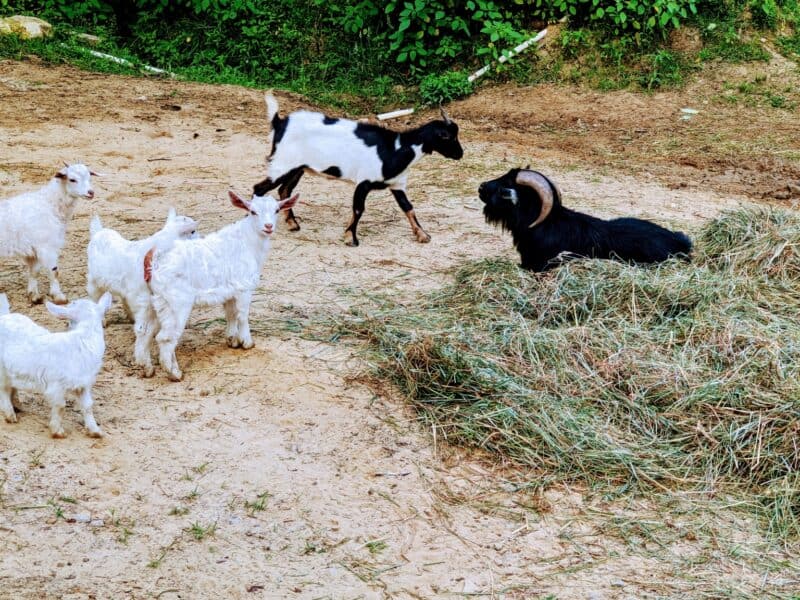
A good rule of thumb is that an acre of land with ample forage can support between 6 and 8 adult goats. Smaller goats mean that you can have a few more per acre, whereas larger goats mean a few less. The quality and availability of forage also play a part.
Figuring out the carrying capacity of your acreage, and for how long it can support a given number of animals, and at what times of the year, is a highly involved process. But no matter how much figuring you do on paper, you’ll always have to be ready to make adjustments one way or the other…
Following basic guidelines and staying flexible are the two best ways to go about it if you want goats. Keep reading, and I’ll tell you more.
Your Acreage Might Not Fully Support Your Herd’s Nutritional Needs
Something to keep in mind is that the rule of thumb for keeping between 6 and 8 goats on an acre assumes that you’ll be giving them supplemental feed in the form of hay and other food.
Chances are, unless your land is absolutely ideal for goats, it won’t have enough food, and enough variety, to fulfill all of their caloric and nutritional needs.
A better stocking rate for land to fully satisfy their need for browse and forage is between 1 and 3 adults per acre. Even this smaller rate isn’t guaranteed guarantee of indefinite carrying capacity. Goats deplete forage pretty quickly, and land that starts out lush will become less and less so over time, even with regular rotation.
But, assuming you are going to feed them hay and other food in addition, you can still trust the guideline of between 6 and 8 adult goats per acre. There is, after all, more to consider about their health and wellness than just food!
Goats are very curious animals that have a strong urge to explore and get exercise. Giving them plenty of room to roam around on, looking for choice bits of food, and following their own schedules is great for them mentally and physically.
Letting them meander around any sort of pasture is far better for them compared to keeping them cooped up in a plain and basically featureless pen or a barn that doesn’t have anything for them to do or interact with.
Keeping between 6 and 8 goats on an acre allows them plenty of room to be by themselves if they want to and alleviate conflicts and flaring tempers that can sometimes happen, even among related goats, in closer confines.
How Many Goats Should You Get if You Have 2 Acres?
If you have two acres of land, plan on it accommodating between 12 and 16 goats with supplemental feeding. Ultimately, this will allow you to keep between 6 and 8 goats more easily and take better care of your land by instituting paddocks, strip pastures, or regular rotation to let the land rest and regenerate.
How Many Can 4 Acres Support?
Four acres can support a lot of goats, anywhere from 24 to 32 according to the usual rule of thumb already established.
If you have very large goats (Boer, Kalahari Red, Saanen, Alpine) that need lots of food, this much land might be better utilized with an intensive rotational plan. It will service fewer goats overall, but you can take much better care of the land and even institute a regular regimen of fertilization and potentially even transplantation of edible plants to maximize yield year over year.
Your goats will surely thank you for this!
If You Have on 10 Acres…
If you’ve got 10 acres of land, you can support a truly huge herd with supplemental feeding: anywhere from 60 to 80 goats running around all over the place and having a ball! This much land will provide a lot of food in most regions, but you’ll be astounded at how fast goats can reduce it when it’s left to their own devices.
Despite the temptation, do not, and I repeat, do not, assume that it will regenerate on its own because goats will naturally move on to other areas they haven’t nibbled on. Your assistance will always be required to make the most of it.
Numbers on Acreage by Breed
Different goat breeds, naturally, are larger or smaller and have different nutritional requirements. Some are highly efficient grazers, others less so, and that can slightly impact your stocking rate based on the rule of thumb we’ve been using.
Consider the following info for the most common and popular domestic goat breeds below.
Nigerian Dwarf
One of the tiniest domestic breeds around, Nigerian Dwarfs are so small and such efficient grazers you can keep more of them on the same amount of land. 9 or potentially even 10 goats per acre is not out of the question.
Boer
This popular meat breed is raised around the world for its ample yield and hardiness. However, these are larger goats that have big appetites, so you want to limit them to 6 adults per acre at the absolute most. They need more room and more food!
Pygmy
The pygmy goat is another small breed and an efficient grazer, though not quite to the same extent as the Nigerian dwarf above. 8 or 9 per acre is a good estimate.
Alpine
One of the world’s most popular and well-respected dairy breeds, the large Alpine needs lots of food to support continual milk production, and also room to move around since they are so active and athletic. I strongly recommend you keep no more than 6 per acre.
Saanen
Another dairy goat, and one of the most athletic and agile around, it’s always a great idea to keep Saanens on a larger parcel for space requirements as well as food. Again, I would go with 6 per acre and no more.
Nubian
The dual-purpose Nubian is a beloved heritage breed that is famous for its friendliness and people-centric personality. They’re also famous for the richness of their milk.
As with most dairy breeds, ample and varied food is important, so keep no more than 6 or maybe 7 on a single acre.
Toggenburg
This ancient dairy breed hails from Switzerland and has a lengthy lactation period. To support that, plenty of forage and low stress, made possible by ample room and exercise, is a good idea. A medium-sized goat, you can keep between 6 and 8 on an acre.
LaMancha
With the distinction of being the only American-developed dairy goat, LaManchas are instantly recognizable by their near-total lack of ears and very short, glossy coats. One of the most curious goats, they are prone to escape attempts if they get bored. Giving them a large pasture and plenty of room will help suppress but not eliminate these urges. In my experience, 6 to 7 is the right number of LaManchas to keep on an acre.
Oberhasli
A distinctive and striking goat thanks to their rust-red and black coats, they are friendly and easy to handle. Another breed known for producing high-quality, creamy milk, you can comfortably keep between 6 and 8 on a single acre.
Kiko
This relatively new breed hails from New Zealand and was developed in the 1980s specifically for meat production. 6 or 7 per acre at most is advised.


Get your gift and learn things like:
- how to make this really quick pest spray
- how to prevent egg waste
- two cheap automation devices that will make your life easier
Tom has lived and worked on farms and homesteads from the Carolinas to Kentucky and beyond. He is passionate about helping people prepare for tough times by embracing lifestyles of self-sufficiency.