
We got the funniest surprise in our nesting box today. Jada went out early to collect the first of the morning eggs. I was in the kitchen getting a snack together for baby Elias when she came bursting through the backdoor, “Mommy! Guess what I found!”
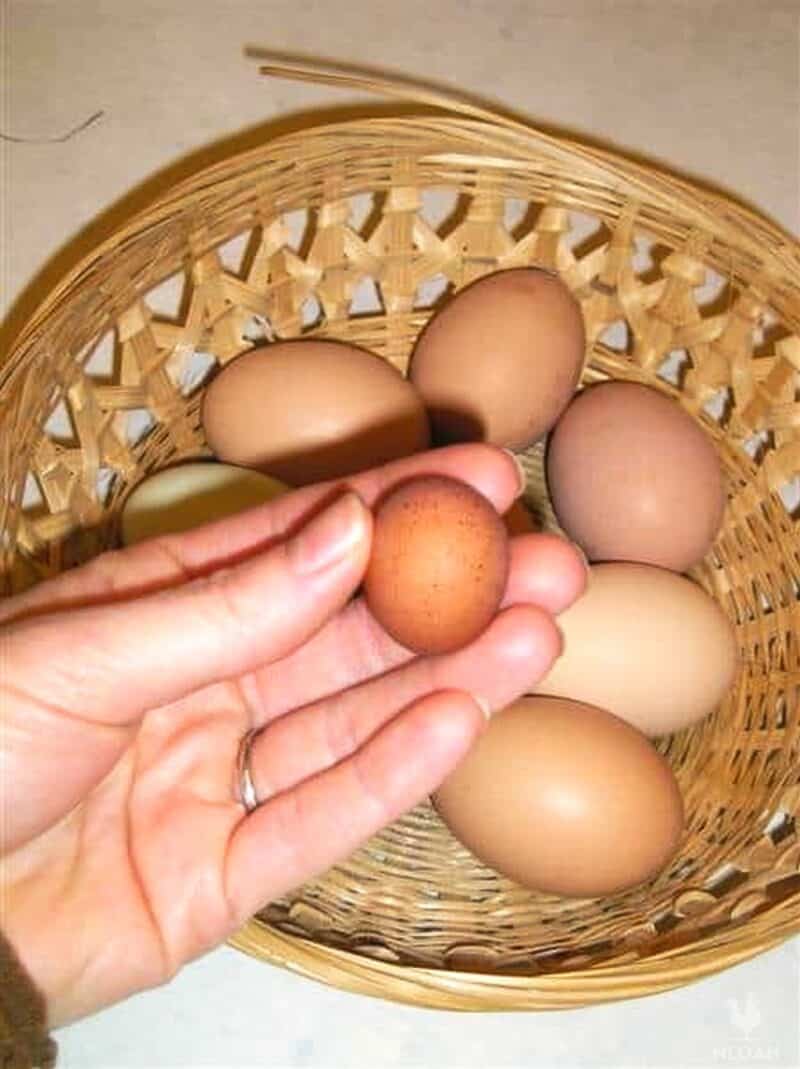
She opened her palms to reveal two regular eggs, and one teeny tiny one. Her eyes were wide with wonder as she continued, “Where do you think this came from?”
I looked at the egg for a moment, and was suddenly overcome with the humor of what I realized she was thinking. As I laughed hysterically, she vocalized what I’d suspected, “Do you think another bird might have flown through the wire and laid an egg in the nesting boxes?”
When I was finally able to compose myself, I explained, “No baby. Sometimes chickens will lay a very tiny egg when it’s their first time laying. We probably just have a hen who is beginning to lay for the first time.”
Excited by her discovery, Jada carefully carried the little egg around to show it to her brothers and sister, who all laughed when they saw it.
Jada then asked me a very good question. “I wonder what the yolk looks like!” To our surprise, there was no yolk at all!

Instead, there was a only a small pea-sized blob of flesh inside. Though Jada accepted my answer as to what it was, I decided to do a little more digging on the subject. I discovered that one of our girls layed what’s called a “wind egg.”
If you keep a flock for any length of time, it’s only a matter of time until your girls lay one. I’ll tell you what you need to know about these weird little eggs below, and what you should do if they appear.
Just What is a Wind Egg?
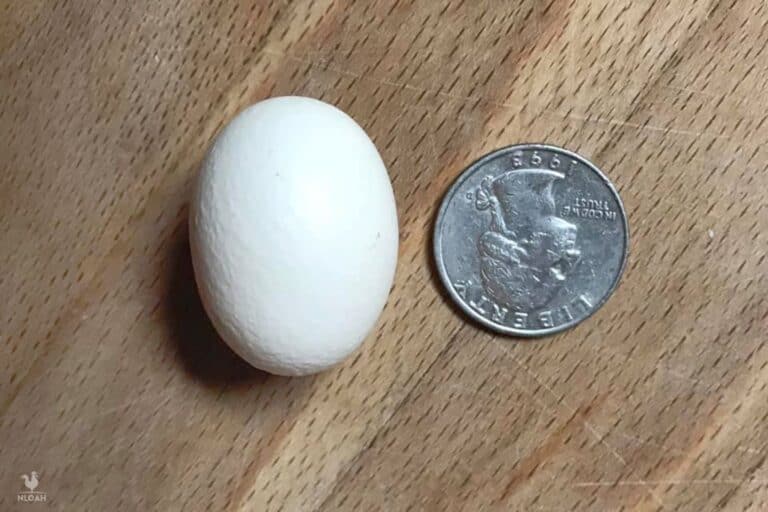
Sometimes called no-yolkers, cock eggs, fairy eggs, fart eggs or dwarf eggs, with many other folkloric names besides, a wind egg is an egg that is usually much smaller (but sometimes larger!) than a hen’s typical lay, and occurs for one of two reasons, typically: either the hen’s ovarian system passes a fragment of tissue through, which is then treated like a yolk and wrapped in a membrane and shell, or a young pullet’s reproductive system starts before all the inner workings are properly synchronized.
What comes out varies a little in size and composition, but is always consistent in that it is a too-small egg with very little or no yolk on the inside.
Root Causes of Wind Eggs in Laying Hens
It’s honestly difficult to say. In the case that the chicken’s oviduct should wrap albumin and calcium around something that isn’t a yolk, it could be a simple misfire, or timing issue, as detailed in the previous section, or it could be an indicator of a more serious health condition.
Cancer is one possibility, as are all injuries and illnesses that can result in tissue somewhere in the oviduct degrading and breaking down, specifically in damage to the epithelium of the magnum. Illnesses like Newcastle, infectious bronchitis, avian pneumovirus and chronic complications thereof can also interfere with the proper and whole formation of the albumen itself, leading to a very similar outcome.
Another fairly common, and thankfully less worrisome, cause is a wind egg forming due to a little bit of residual albumen called a nidus being present in the magnum. A shell is wrapped around it, but there is no yolk inside as normal.
In short, if you have a hen or two that lays a wind egg every once in a blue moon, or if a very young hen does it when she first starts laying, you probably don’t have much to worry about. Even a tiny and otherwise harmless error could cause it. Should you notice a consistent, even if infrequent, output of wind eggs, your bird could be in trouble.
Not All Deformed Chicken Eggs are Considered Wind Eggs
One thing that complicates diagnostics of deformed or flawed chicken eggs is the tendency of keepers to call all such eggs “wind eggs” or similar names. That may be fine in casual conversation, but smart keepers know that different defects signal different kinds of health threats, nutritional deficiencies, and sicknesses. Below are some of the most common egg deformities, and their likely causes.
Double-yolked: a fairly common issue in older, large breed hens and one you’ll certainly encounter if you are collecting and consuming your flock’s eggs. A double yolk egg occurs when two yolks travel through the oviduct together. This may happen when the chicken experiences two ovulations at once or if one yolk is retained while another is ovulated.
Soft-shelled: eggs that have a very thin, slightly flexible shell that is almost papery in consistency and reliably caves from fingertip pressure are said to be soft-shelled. Mycotoxins from moldy feed are a very common cause, as is excessive phosphorus in the diet or ongoing consumption of salty water. Sometimes exhibited by older hens outside any other trigger.
Shell-less eggs: also known as a rubber egg, this is an egg that has no shell to speak of, with the yolk and other contents being held in place only by the flexible membrane. Typically caused by a pronounced lack of calcium, manganese, vitamin D3 or phosphorus in the diet, or in very young hens with an underdeveloped shell gland. This may be a symptom, too, of bird flu, Newcastle disease or bronchitis.
Checked: sometimes called a body check egg, this is an egg that has been repaired while still inside the chicken. They usually have a notable ridge or bulge where a crack occurred, and fresh calcium gets deposited over it during shell formation. This is most likely to occur if the laying hen gets startled during shell formation. If you notice one or more birds consistently turning out eggs like this, something is disturbing them in the late afternoon or evening! Check for predators or aggression from other birds.
Banded: if two formed eggs collide during development, the more developed egg, being pressed on by the arriving, less developed egg, will show a distinct band of heavier mineralization from the pressure of contact. This is what’s known as a banded egg.
Slab-side: also concerning a collision of eggs inside the chicken, the less developed egg will be affected also, flattening on one side and typically remaining quite thin.
Starburst/Sunburst: this is considered a severe case of checking. If a shell cracks severely it will usually show a radiating pattern kind of like stained glass. It will be visible to the eye quite often, or readily apparent during candling if not. However, this will sometimes occur even if no physical damage takes place inside the bird, being caused by salty water, a deficiency of calcium, heat stress or exposure to specific mold toxins.
Wrinkled: eggshells that exhibit a twisting, dimpled pattern or even full-blown corrugations like cardboard are said to be wrinkled or ridged. Causes vary. On the less severe end, it can be caused by stress or overcrowding. A specific bird might have a simply defective shell gland, meaning there is no correction or cure possible. Infectious bronchitis can cause this as a symptom, and sometimes as a chronic condition.
Pimpled: AKA gritty or pebbled egg. Eggs that look normal otherwise but have a rough, coarse, raised texture are said to be pimpled. They feel a little bit like sandpaper. The texture is caused by raised nodes of calcium deposited on the exterior of the shell. It typically occurs when eggs remain in the shell gland just a little too long, and this trait is thought to be partly hereditary, so it might arise even in disease-free flocks.
Odd-shaped: many eggs that just look a little wrong in terms of shape, be it too narrow at the narrow end, too wide at the wide end, round, or something else, often have no specific cause but know that it could be a sign of an infectious disease. Newcastle is very common, as is bronchitis, among others.
“Lash Egg”: should one of your chickens ever lay a firm, rubbery nightmare egg that looks like it’s made of pus, with a very distinct smell, she’s laid a lash egg. These are not true eggs, but if you’re brave enough to cut the thing open, it will have a strange, layered, and liquid filled interior. This is often an indicator of infection, specifically of the oviduct itself, but it may be non-infectious in nature. Common infectious causes include Salmonella, Pasteurella, E. coli, Streptococcus and more. When caused by physical trauma, it is usually the passage of a too- large egg that causes tissue damage.
If Your Hens are Laying Abnormal Eggs, Get Them Checked ASAP
Again, aside from an isolated bad egg every once in a while, any egg abnormalities beyond speckling or light pimpling are causes for investigation, especially if multiple birds are exhibiting a similar pattern. Signs of infected warrant intervention at once.

Get your gift and learn things like:
- how to make this really quick pest spray
- how to prevent egg waste
- two cheap automation devices that will make your life easier

A city girl learning to homestead on an acre of land in the country. Wife and homeschooling mother of four. Enjoying life, and everything that has to do with self sufficient living.
I have had many chickens in the past but never seen a wind egg until I rescued 4 chickens from a motorway accident last year up till now I was getting 4 normal size eggs until the other day when I went to feed them and lock them up for the night to my shock I find 3 normal eggs and 1 very tiny egg I was amused at the size of it and so was my wife and neighbours I even took a photo of it and showed it to a lady who looks after thousands of hens and she told me what it was and she also told me she has about 10 of these eggs
ALL my eggs are that size. The only hens I have right now are bantams and that’s about a normal sized egg for them. It takes 10-12 of them to scramble for just my hubby and me. But they eat very little, take up very little room and are so much easier to care for than large chickens. Besides they are soooo stinkin’ cute.
I have had lots of “pullet” eggs, which is all I have ever heard them called. But never one without a yolk! So cool. I love learning new things. I think a wind egg is a better name anyway!
We are going to get tiny eggs from our serama chickens…they are the smallest chicken in the world and it takes 3-5 of their eggs to equal a typical egg….of course the seramas are just for fun…we have 4-8 typical birds too…depending kn who’s a rooster
Jaci,
How cute!! That does sound like fun 🙂
We got a super tiny perfectly round one recently that was without a yolk too. We had a great time exploring it and the kids carried it around all day just for fun. Chickens just never get old do they? 🙂
Oh, that’s so fun, Steffanie 🙂 Maybe I’ll get a yolkless egg one day, too.
We had one once and I thought it was the cutest thing ever. 🙂 Upon searching about what it was online, I found a name for it to which I call them now: fart eggs.
“Wind” eggs sound so much better, but we still call ours fart eggs.
Meg,
I came across that term also, but wasn’t gonna go there, LOL! Thanks for keeping it real 😉
It’s been awhile since I’ve had one of those 🙂 Last year, just a week or 2 before Easter, I had several. Our homeschooling friends were coming over for a visit, so I placed my little Easter bunnies in the center of the table with the little eggs. Everyone was amazed when I told them the eggs were real and cracked one open for them to see!
I love how excited your children were 🙂 My son is 17 and rarely gets excited by stuff like this anymore.
We have had a couple of wind eggs on our farm. One was completely empty! I commented that it was very lightweight, and when my daughter cracked it, it contained nothing but air. A true “wind” egg, if I ever saw one!
Oh, that’s funny, Kari!
I have gotten a few now in the past 3 or 4 years I’ve had chickens & my friend Penny at backtobasicliving.com got me started in keeping chicken calls them itty bitty eggs. She saves hers by putting them up some were to dry out. (it takes a few months for them to dry out all the way) I so do it now too and have 5 out of all I’ve gotten so far from my hens. They are all so cute and fun to find.
My chickens have been laying a tiny egg in lite blue at least once r twice a wk I have eight chickens all same age they are reg size but the roaster is a bantam so I been wondering oh never a yolk inside so today I desided to look it up (in Texas )
Cool! We have gotten some tiny ones, but they have had a yolk. I love how raising some small creatures at our house has taught us so many “lessons” that we would have never experience otherwise.
I just saw your post and it is such a coincidence that just moments ago I posted a picture of the “teeny tiny” egg I got today! And reading what you wrote about it being a first time layer is interesting. I only have 4 girls and have been getting approx. 2-3 eggs a day. Lately it’s been 1 every other day. Does this mean one of my girls hasn’t been laying the 6 months I have owned her?
These are my first chickens, we are just starting our little hobby farm and I’m learning learning learning!
That’s so funny, Tina! It could mean that your hen is just beginning a new cycle. Although, this could be her first. You never know!
Never seen one before. We get really small eggs on the first time layers but never that small.
Doug,
Yeah, we’ve had small eggs, but this one was TINY, lol!