
What do you think you need to live off-grid? Your own power sources like solar, biofuel, or hydroelectric? A shed full of the latest and greatest power tools?

Not hardly! Our pioneer ancestors did a whole lot more with a whole lot less than we have today, and it turns out they really did know a thing or two about getting the job done in and around the home with a minimum of fuss.
Having the right pioneer tools can make all the difference on your homestead, too. Below, I’ll be telling you about 30 such items, from kitchen gadgets to manual tools, that can help you get more done living off-grid. Let’s dive right into it.
This post contains affiliate links. If you click them and buy, I may earn a commission. Read my disclosure policy.
Percolator
Let’s get real: for most of us, it’s really hard to get anything at all done without a steady supply of coffee!
Unfortunately, modern coffee makers are surprisingly power-hungry little devices. Cut the cord entirely or save the drain on your own power supply by switching to a traditional percolator.
On the stovetop or over a fire, a traditional percolator still makes a great cup of coffee and quickly. Best of all, these things last basically forever with a little care.
Hand Grinder
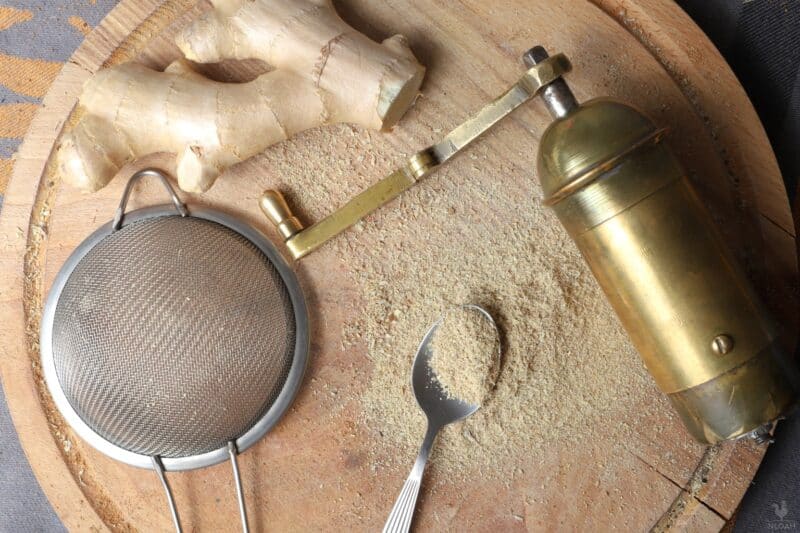
Speaking of coffee, if you’re going to get that piping hot cup of joe, you’ll need to grind the beans. Electric grinders are sort of a one-trick pony and accordingly pretty wasteful on an off-grid homestead. A much better bet is a hand-crank grinder, sometimes known as a burr grinder.
It’s the picture of simplicity: dump in your beans, close the lid, and turn the crank. Depending on the model, you’ll grind until you reach the desired fineness, or you can switch out plates inside for better consistency.
Canner + Jars
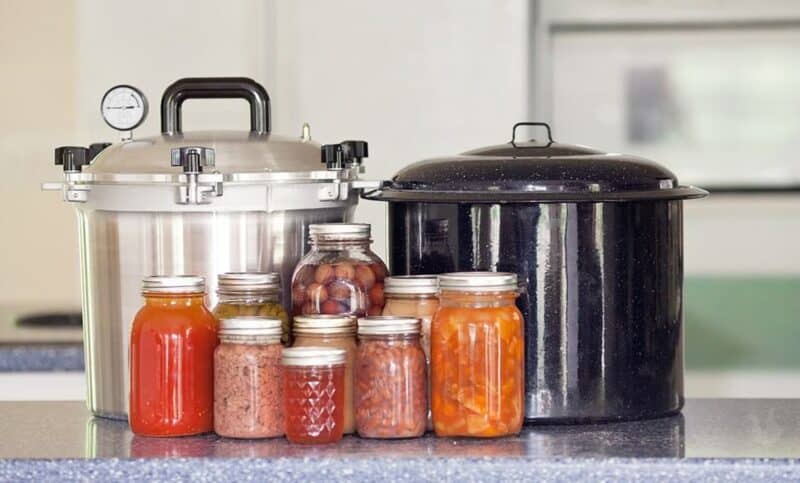
You just knew this was going to show up on this list. At-home canning is one of the best ways to preserve a harvest, stretch your dollars, and improve food security.
It’s a process you’ll have to master, and you’ve got to strictly follow proper procedure for safety, but once you get the hang of it, it’s pretty easy and you can can everything from fruits and veggies to meat, soups, and even water.
Note that there are significant differences between water bath and pressure canning, and some foods can only be safely processed in a pressure canner. Do your homework!

Cast Iron Cookware
An oldie but a goodie, cast iron has been around forever and is still beloved today, even in modern kitchens, for its awesome combination of easy care, natural non-stick surface, and awesome thermal density. This stuff is versatile, works on a stove or over a fire, and it just gets better with use.
From various skillets and pots to cookie sheets and the always useful and multi-purpose Dutch oven, even a small cast iron collection can replace cabinets full of other, lesser cookware.
Fermenting Crock
A fermenting crock is just the ticket for fermenting all kinds of foods, from cucumbers to cabbage and lots of other stuff.
Fermented foods are nutritious, tangy, and naturally long-lasting, and a fermenting crock facilitates this process by creating an environment where certain friendly bacteria can live and do their work to convert the food.
You can track down a vintage model for the purpose or buy a new one, but whatever you get, stick with an earthenware version for best results.

Crank Peeler
An old-fashioned hand-cranked apple peeler is one appliance that sticks out brightly in my mind. My great-grandma always had this thing going when making the fresh apple pies that my family loves so much.
The great thing about a crank peeler is that they can be set up to slice the fruit as it is being peeled, greatly speeding up prep time or allowing you to whip up fresh and healthy snacks for your family in a jiffy.
Plus, they are far easier to sharpen when the time comes compared to a handheld peeler.
Apple Press
An apple press is exactly what it sounds like: a mechanical press designed to crush, pulp, and juice apples.
Now, you might not like apple juice that much, but an apple press is still an indispensable part of your off-grid homestead because it will allow you to make apple cider vinegar.
ACV, as you probably know, is a useful ingredient, healthy, and it makes for a great, natural cleaning solution.
Accordingly, you’ll really want one of these gadgets to save time and labor.
Butter Churn
Hand-churned butter is one of life’s great pleasures. I think it just tastes better than the store-bought stuff, but it might be all in my head because of the amount of labor required to get it!
Hand-churning is simple but pretty labor-intensive, and historically, family members would take turns putting in time on the churn until the butter was ready.
You can find older but still functional butter churns at antique and second-hand stores, at Amish markets, and sometimes online.
Drain Board
One thing I missed most of all when going off-grid was the dishwasher. It’s a small thing, I know, but I really hate doing the dishes! Happily, a drain board can make the process a little quicker and less messy when you’re doing a load yourself in the sink.
It saves space and helps you drain and dry your dishes with less work and with fewer towels used, saving you even more effort and resources on the back end.

Mortar + Pestle
If you don’t know what a mortar and pestle is, it’s nothing more than a stoneware bowl with a vaguely mushroom-shaped hammer, or grinder, of sorts.
It’s used to break down all sorts of things, from fresh and dried spices to fruits, veggies, and a whole lot more. Think of it like a manual blender and you aren’t far off.
It’s an ancient tool, but one that’s surprisingly effective in this context. You’ll find dozens of uses for it in the kitchen.
Millstone
More than anything else we buy at the store, flour is the most taken-for-granted. The road from growing grain to transporting it to a factory and then finally processing it into flour is incredibly convoluted, not to mention polluting.
Our ancestors relied on millstones to do the job themselves. And note I’m not talking about a giant mill here, one that’s powered by wind or water.
A small, single-family mill is little bigger than a coffee table and needs nothing but muscle power to operate.
Kitchen Timer
Not much of a surprise here: off-grid or not, precise measurement of time is still paramount for all sorts of operations in the kitchen.
You might have your own electricity when living off-grid, and that’s fine, but for my money, I prefer the simplicity and reliability of a mechanical kitchen timer.

Oil Lamp
Even living off-grid, the preponderance of super-efficient and bright flashlights, lanterns, and other lighting solutions might make old-fashioned oil lamps seem positively obsolete.
You can make a great case for the former, but oil lamps are simple and versatile enough that you can, in many situations, create your own fuel for them. This versatility and ease of maintenance make them a mainstay for all off-grid homesteaders.
Water Barrel
No matter the homestead and no matter what you do on it, extra water storage is mandatory. Wells can dry up or become contaminated, so it always pays to have a usable supply on hand.
Our pioneer forebears relied on wooden water barrels for catching rain or stashing well water, and you can do the same. A better option for most of us, though, will be water barrels made from modern, super-durable, and easy-to-clean plastics.

Manual Water Pump
Speaking of off-grid water, when most folks think of a well these days, they think of one serviced by an electric pump. That’s still an option for you if you’ve got the electrical infrastructure, but pumps are also power-hungry devices.
For centuries, pioneers and even folks living just outside of cities relied on manually powered pumps to bring water to the surface.
The basic design is unchanged today and just as useful. Whether you are pumping water from your own tanks or bringing it out of a well, they still get the job done with a minimum of fuss.
Washboard
Yet another modern appliance I hated to lose, at first, was the washing machine. I’ve never been a big fan of doing laundry. But needs must, as they say, and so I switched to an old-fashioned washboard.
A washboard and a bucket or two of water are all you need to manually give your clothes a good scrubbing.
It’s not as hard and doesn’t take as long as you think, and combined with drying out on a clothesline, your clothes will feel and smell wonderful. I’ve also noticed that they last longer!
Anvil + Blacksmith Tools
This might be a contentious option for some, but I stand by it. Having a good anvil, some blacksmith tools, and even basic know-how of how to work metal will allow you to conduct repairs on and craft simple but durable metal goods that will always be useful around your homestead.
From hinges and fence components to nails and other fasteners, it can save you a fortune compared to running into town and searching for the things you need, or ordering specialty components. You’ll also find that it can be a lucrative side gig and rewarding hobby!
Spinning Wheel
Whatever sort of natural fiber you have on hand, be it cotton, wool, or something else, if you want to turn it into useful thread, you’ll need a spinning wheel.
Yes, you can just buy the stuff ready to use. Yes, you can send it off to be processed and sent back to you. That’s not the point; the point is being more self-sufficient when living off-grid.
If you or someone in your family is already seasoned at sewing, knitting, or other seamstress work, this is the ideal tool to add to their repertoire so they can continue to make use of raw materials.
Treadle/Crank Sewing Machine
Another indispensable piece of gear for folks who know how to sew, a sewing machine can make short work of repairs, crafting clothing, tarps or covers, and a whole lot more. But, once more, the pressing problem of power rears its ugly head.
No need to fret, though, because manual sewing machines were getting the job done for a long time prior to electricity becoming ubiquitous. Manual versions are operated either by a hand or foot crank, the latter being called a treadle.
There’s a trick to getting started with them, a tempo if you will, but it’s easy to learn if you already know how to use a sewing machine.

Axe
The quintessential tool for processing wood, and one that no true homesteader should go without. Using nothing but an axe, you can chop down a tree, cut off the limbs, buck the trunk into sections, and then take care of splitting those sections down even further.
It’s a workout, but if you keep the axe sharp, you can do a lot of work with it and faster than you might think. Take care of it, and it will take care of you.

Splitting Maul
If you are like me and most other modern off-grid homesteaders, wood heat probably figures into your lifestyle heavily, both for in-home heating, heating water, and maybe even cooking.
Having properly sized firewood is going to be really important in that case, and to make processing wood quicker and more efficient, you’ll need a splitting maul. Basically a specialized axe, it can pop apart even stubborn pieces with ease.
Crosscut Saw
Another woodworking tool and one that will make cutting logs or boards to length simple—you’ll still need to supply plenty of muscle, though! Crosscut saws remove lots of wood with every pass, meaning that if you keep them sharp, they can be surprisingly speedy even on hardwoods and large sections.
Note that these come in many different sizes and varieties, from small handyman or toolbox saws for basic jobs to the huge, two-man saws used for bucking huge, mature tree trunks. You can make a case for any of them based on your needs.
Hand Drill
Just what it says. A hand-powered drill consists of a chuck for a drill bit, a crank, and a handle. Set the point, start turning, and soon you’ll have a hole in just about any surface.
These are surprisingly precise tools, and so long as you bring a little patience to the equation, you’ll find it’s a lot easier to keep your holes square and plumb compared to a handheld power drill.
Obviously, they do fall short when working with larger, thicker stock, but it’s possible to go with a larger hand auger that excavates more wood but leaves a rougher hole if needed.
Chisels
Chisels come in all kinds of shapes and forms, and are intended for all kinds of jobs. From wood chisels that can be used to create intricate joinery or delicately remove just a little bit of material at a time, to stout masonry chisels that can help you shape and break stone, concrete, and more.
Trust me, the longer you live on a homestead, the more often you’ll find you need these for various purposes. Get a good set and take care of them, and you’ll be a lot more capable when it comes to repairs and crafting.
Sickle
Not to be confused with the next item on our list, a sickle or harvest sickle is a crescent-shaped, sharpened blade used for quickly and effortlessly harvesting grain and pruning other plants.
In use, you take hold of the plant or plants with one hand and then you make a sweeping or pulling cut with the sickle in the other.
The shape of the blade makes it much easier to control, and produces a quick, clean cut with a lot less effort compared to shears, pruners, and other tools. Learning how to sharpen them properly does take practice, though!
Scythe
Scythes are often confused with sickles, and they have a similar purpose, but differ greatly in operation.
A scythe is a large two-handed cutting tool that’s intended to cut down tall grass, cereals, and similar plants close to the ground. Basically, this thing is a manual lawn mower, and it was well before the advent of the push reel mower.
Assuming you’ve got mostly level ground that’s free of shrubs, stumps, and other obstacles, you can sail through grass with ease once you have a little practice with one of these.
Pitchfork
You know what a pitchfork is. Why do you need one? Because it’s the perfect tool for handling loose but clumpy material like straw, hay, and even manure.
The design makes it easy to pick stuff up and then pitch it to get it where you need to go, be that into a new pile, a wheelbarrow, wagon, or something else.
Flint and Steel
One of mankind’s oldest, and still one of our best, fire-starting implements. A good piece of high-carbon steel, a stout piece of flint, and a flick of the wrist are all you need to produce a blazing hot shower of sparks that can get a fire going in a flash—quite literally!
Whether you’re starting a fire in the fireplace, a fire pit, or anywhere else for any purpose, you can free yourself from liquid-fueled lighters using these.
Wagon
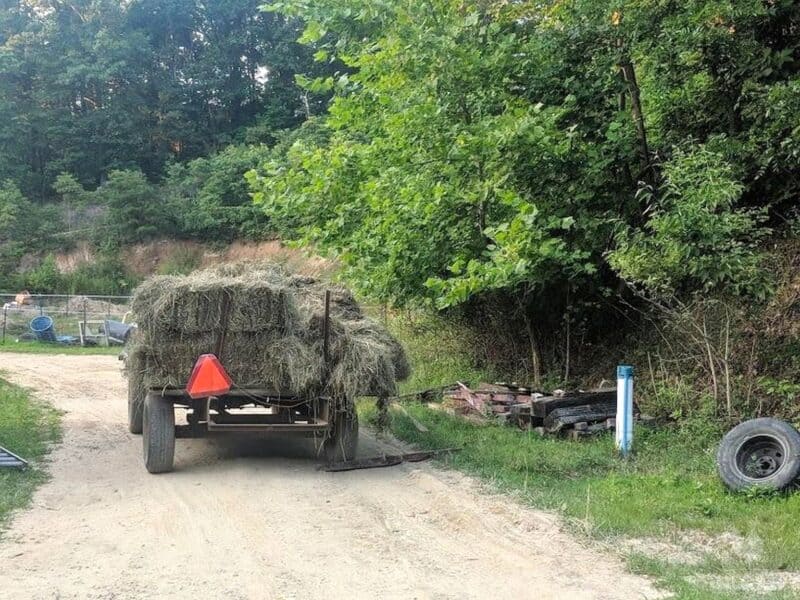
For countless ages, the humble wagon helped pioneers, homesteaders, traders, and everyone else move goods and materials over distance with greater speed and efficiency than was ever possible carrying it by hand or even by beast alone.
Different-sized wagons all have a place on your off-grid homestead: so-called garden wagons are perfect for toting tools and materials for chores and repairs on the property. Larger wagons, usually drawn by draft animals like horses or oxen, can replace tractors and trucks!
Tack
Last but not least, you’ll need tack on your homestead if you want to make use of the aforementioned beasts of burden. Sometimes called tack and harness, this is the collection of gear that includes saddles, stirrups, reins, bits, bridles, and more.
Together, used with skill in fitting the animal and with handling, it allows you and your animal companion to get a lot of work done.
Learning to select, use, and maintain tack is an entire skill unto itself, so don’t assume you can just get this stuff and then go to work. Nonetheless, it’s indispensable for staying truly self-sufficient when off-grid.


Get your gift and learn things like:
- how to make this really quick pest spray
- how to prevent egg waste
- two cheap automation devices that will make your life easier
Tom has lived and worked on farms and homesteads from the Carolinas to Kentucky and beyond. He is passionate about helping people prepare for tough times by embracing lifestyles of self-sufficiency.