
If you’re nervous about washing wool blankets, garments, and other things that are made of delicate materials I can’t blame you. Wool blankets can be expensive but if you know how to take care of it a wool blanket can last a lifetime.
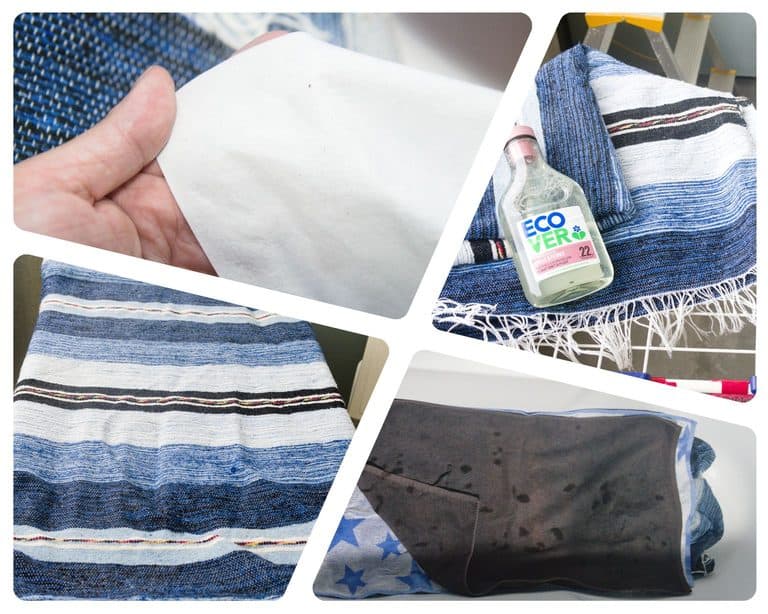
On the one hand, wool can shrink and stretch and easily lose its shape if you don’t clean it the right way. You really need to be careful with wool blankets because even though they may seem sturdy, they can actually lose their shape very easily when washed vigorously either by hand or in the washing machine.
Now, I have this gorgeous wool blanket from Morocco but sadly it doesn’t have a label on it with care instructions. The good news is that all I need to do is wash it in a bathtub with warm water, and some wool detergent. The detergent is kind of a sticking point because most of them just won’t do for wool. So go ahead and check yours to see if it’s good enough to be used.
If you do this right, the process is actually easy and there is little risk in damaging it. I’ll also show you how to do to use towels to use rolling towels to to take the wall out to dry it and
What to Do Before Washing
Before you get started there are a few things you need to check… First, you need to carefully inspect the blanket for holes and for loose threads. If these are an issue, you should pay attention to how you wash it and how you agitate inside the bathtub…
The second thing you need to do is to test for colorfastness. Pick a hidden area on the blanket, one that you don’t mind testing, then take a white cloth or towel. Soak the towel in the same water at the same temperature you intend to use and add a bit of detergent.
Press the cloth firmly against the wool for about 15 seconds. Try not to rub it, just leave it there to see what happens.
If you see any color on the white cloth, it can mean a few things:
- the water temperature is wrong
- the detergent is at fault
- or that the blanket itself is not sufficiently colorfast
You can do the test again without the detergent to see if you get the same discoloration – but only if the color loss during the first test was small. If the second test fails, you may need to drop the temperature. And if that doesn’t work either, there is not much you can do at home; you can take it to a professional to see if they can help.
Any Alternatives to Wool Detergents?
Sadly there aren’t many detergents you can use instead of a specifically formulated one for wool, and you definitely don’t want to improvise! You also want to avoid classic / regular detergents whether they are powder capsules or something else and obviously heavy duty detergents bleach fabric softeners and strong stain removers
I’m not saying that a detergent will completely ruin your wool blanket but they are not specifically formulated for wool, I wouldn’t take my chances…
You also want to avoid dish soap unless you have a greasy spot on your blanket and even then you need to be really really careful. Bottom line: if you don’t have a wool detergent I highly recommend you take it to a professional.
Check the Label
If you do have a label on your blanket, consider yourself lucky: it will tell you a great deal about how you can and cannot clean it.
If it says machine wash you can go this route but you can probably hand wash it as well. But if it says “dry clean only” I would avoid using this tutorial and just take it to a professional dry cleaner.
Lastly, if there is no care label on it (my case), then you need to be you need to be really cautious and do the test that I mentioned above (which I’ve also included in the steps below).
A Word On Water Temperature
You’ll see a lot of recommendations when it comes to temperature for washing wool, ranging from 77 ºF or 25 ºC to 86 ºF or 30 ºC. Given that my own blanket does NOT have a label to guide me as to which temperature to use, I’ll be extra cautious and wash it at the lower 77 degrees Fahrenheit.
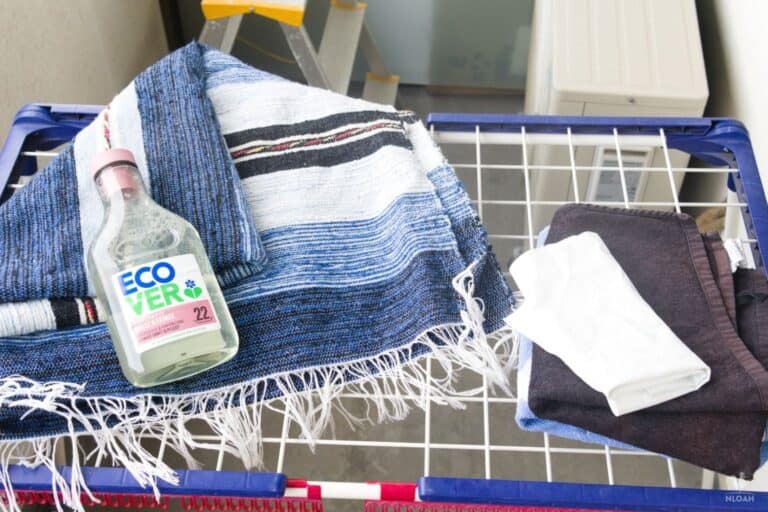
What You’ll Need
Clean bathtub. This obviously needs to be big enough to fit your blanket. You also need to make sure you clean it first to avoid any debris or other substances from getting into it.
Wool-specific detergent. You can find these on online shopping platforms, in specialty stores, and possibly even at your local supermarket.
Clean towels, x2. You’ll need these to help remove some of the water out before you air dry it.
White piece of cloth, white. This can be a third towel, but it has to be white. You’ll need it to do a small test to test the blanket for discoloration.
Thermometer. You obviously need one because you really need to be consistent about the water temperature both when you test the blanket for colorfastness, and when you wash it.
Steps to Hand Washing a Wool Blanket
Step 1: Shake Out Blanket
The first thing you need to do is to take it outside and give it a good shake. Make sure you shake every part of the blanket, because a lot of times we forget to shake the corners…
Step 2: Inspect Blanket
Look closely for loose threads, discolorations, and stains. If your blanket is stained you may need to use something to remove it depending on what you’re dealing with.
If you see any loose threads, you can still hand wash it; you just need to be more gentle with it. avoid pulling the threads out or rubbing and scrubbing the blanket in any way. Once it’s under the water keep the agitation to a minimum. You also need to be careful when you move it to air-dry: you don’t want any of the threads to come out.
Step 3: Inspect Drying Surface
Something else you should check at this stage: the drying surface. Whether it’s a rack or something else, it needs to be flat first and foremost and second, it needs to be large enough to fit most of the blanket.
So go ahead and do a small test: try to set the blanket on the rack to see how to best fit it at the end when it’s soaking wet. First, try to unfold it completely and see if the rack can support most of it. It’s fine if the blanket is hanging over the edges. But if more of the blanket is hanging, try to fold it in two. If it’s still hanging, you probably need a bigger rack or other drying surface.
Do this now: you don’t want to figure out the best position or fold for the blanket at the end, when it’s soaking wet!
Step 4: Check for Colorfastness
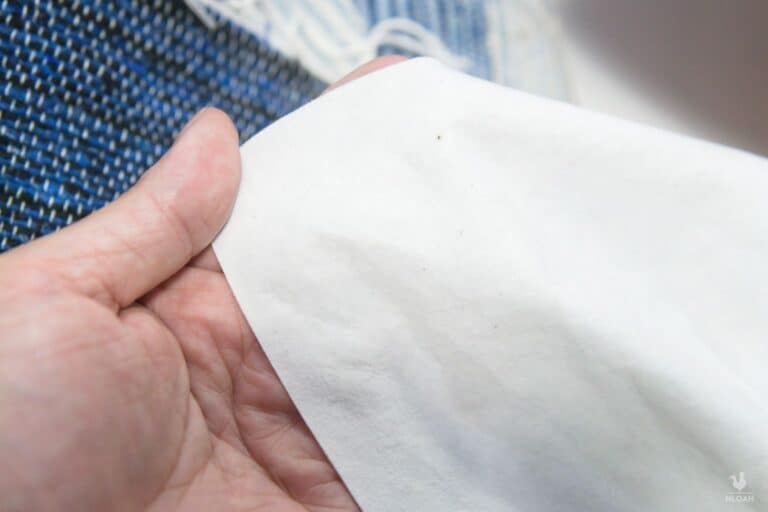
The moment of truth is here: take a white piece of cloth and dampen it in the water at the temperature you chose to use. I used 77 Fahrenheit (25 Celsius). Fill the bathtub with a little bit of water and rely on a thermometer to adjust it.
Next, dampen the cloth in the water and add just a drop of wool detergent. Rub the piece of cloth together to make sure that the mixture is spread throughout.
Find a hidden area on your blanket and press the white piece of cloth against it for about 15 seconds. Check the white cloth carefully and see if there’s any discoloration on it. If it’s still white you’re good to go to the next step…
Step 5: Fill Tub up With Water
Go ahead and fill the bathtub with enough water to be able to fully submerge the blanket. Use your thermometer and make sure the temperature is between 77 °F and 85 ºF (or between 25 ºC and 30 ºC).
Step 6: Add Wool Detergent
This is as straightforward as it gets. The rule of thumb is to use around 15 to 30 ml of wool detergent depending on how dirty and how big the blanket is. Better yet, check the bottle of the detergent for more info on how much to use. The label on the product I got says 30 ml, and given that the blanket is fairly large, I’ll go with that.
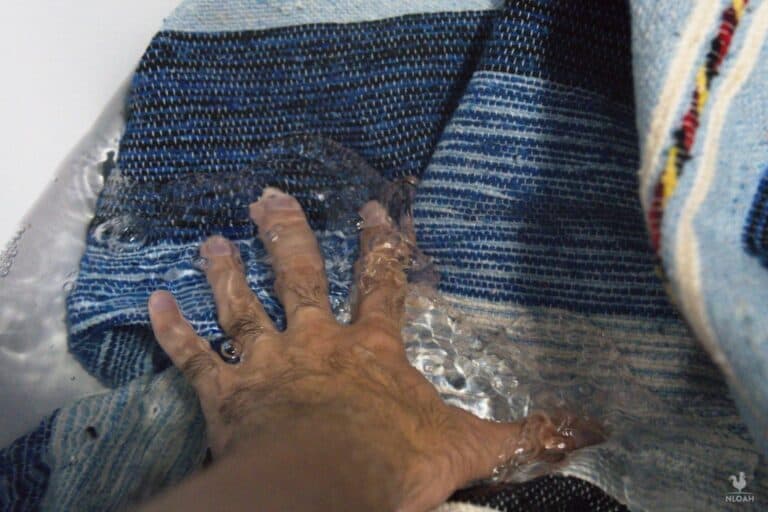
Step 7: Gently Submerge Blanket
Lower the blanket into the bathtub and make sure it’s fully covered in water. Press it gently – don’t scrub and don’t knead it like you would with a dough. This is really a soaking process not washing. You definitely do not want to be manipulating the blanket vigorously.
Step 8: Soak for 15 Minutes. Press for 2 Minutes.
First, let the blanket soak for about 15 minutes. Follow this by one to two minutes of gently pressing it under the water with your hands. Do not scrub, rub or twist it in any way!
Step 9: Drain Water
This is pretty straightforward without sub removing the blanket from the water drain the tab completely. This will take a good 3 or 4 minutes, but you don’t have to wait longer than that if you notice water is still dripping: go ahead and move on to the next step.
Step 10: Rinse
Fill the bath tub again to about the same level with water at a similar temperature as before. It’s important to use the same water temperature more or less. You don’t want to shock the wool with a change in temperature that’s too big.
The reason I caution you about this is because the second fill is being done with the blanket inside the tub. When you turn on the faucet, you’ll either get water that’s too hot or too cold, so I needed around 30 seconds to adjust it to the right temp.
The other issue is that the faucet will project the water directly onto a point on the blanket, and since we agreed we’ll be gentle with the blanket, I recommend you use the showerhead to fill the tub this time. Position it so that the water first hits the side of the tub, not the blanket directly.
There is no need to let it soak this time; simply press the blanket through the water for about a minute. Drain the water out one more time…
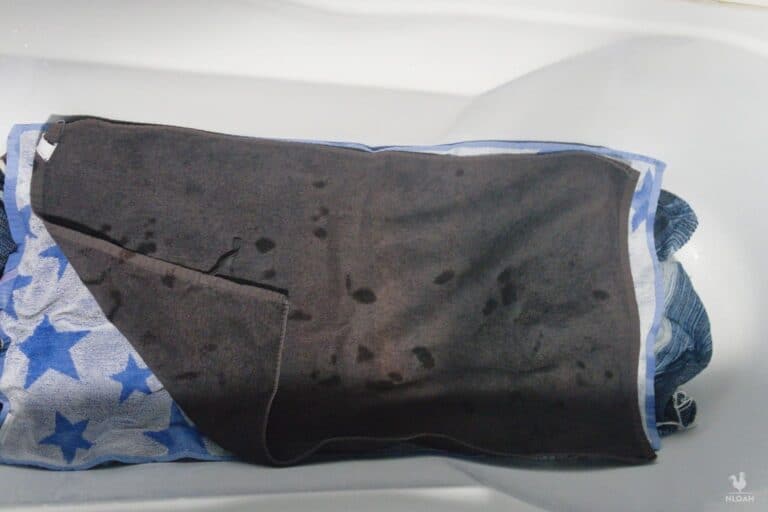
Step 11: Remove Excess Water
Before you can move it to the drying rack, you first need to remove as much water as possible. This is because soaked wool is very heavy which means that when you lift it, it’s going to deform.
First, give it about 4 or 5 minutes so as much water as possible drips naturally. Next, (gently) press the blanket against the bottom of the tub with your hands to remove excess water. Once most of the water is gone, go ahead and take the towels and place them over the blanket:
Starting at one end, roll the blanket and the towels together. Then, gently press on them to remove excess water. Unroll the towels and the blanket to bring them to the initial position now the blanket should be much lighter for you to carry outside to dry.
Step 12: Carry Blanket Outside
Roll the blanket a second time – this time without towels. Use both hands to carry the roll outside. You can have someone help you carry it, but do not fold it or pick it from one end.
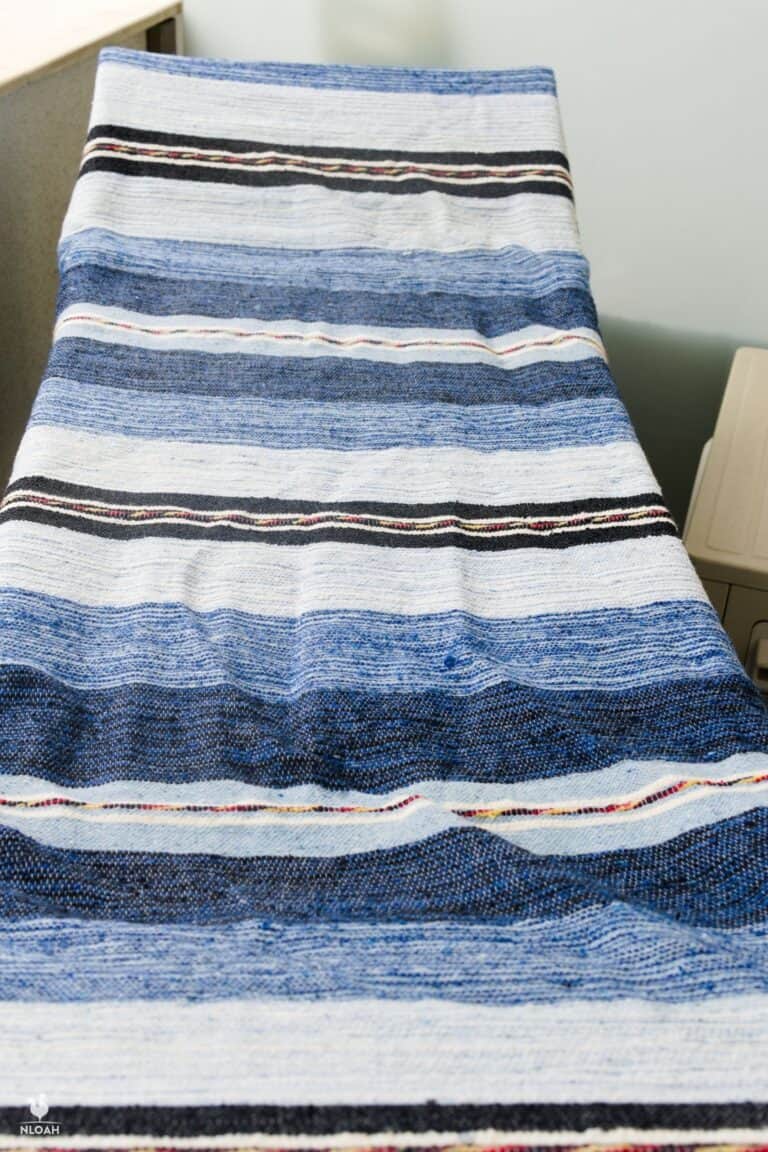
Step 13: Air-Dry Wool Blanket
For this you need a flat surface. never dry a wool garment by hanging it, because hanging can cause stretching, uneven edges and other changes in its dimensions or shape. So go ahead and take it outside and unroll it. You can dry it indoors too, but then you’ll need to open up the windows – maybe even use a small fan to improve air circulation.
Avoid putting it anywhere else like on a radiator or some other heat source, or in a clothes dryer. It needs to be fully flat and, ideally, you want to shape it back as much as you can by removing any creases.
Now, if the blanket is too big, you’ll notice the edges are hanging. This is fine so long as most of it is sitting flat on the rack, because as the water drips and evaporates, the blanket will become lighter and lighter, decreasing the odds of it changing shape or size.
But if that’s not the case and your drying rack is too small, consider folding the blanket in two. Ideally you should try this in the beginning, so you don’t fold and unfold the blanket too much while it’s wet. In any case, make sure the blanket is spread evenly on the drying surface.
Mistakes You Can Make
Let’s go over a few things you should avoid when washing a wool blanket:
- Never use hot water. Stick to a temperature between 77 and 85 Fahrenheit (that’s between 25 degrees Celsius and 30 degrees Celsius).
- Never wring, twist or scrub the blanket!
- Avoid using enzyme detergent or worse yet, bleach. Even with your wool detergent you need to be careful not to use too much.
- As a rule of thumb, never hang a wool blanket to dry when it’s soaking wet, and never put it in a dryer. Sure, some garments are explicitly allowed to be hung by the manufacturer… but with a heavy wool blanket, this is probably not the case.

Get your gift and learn things like:
- how to make this really quick pest spray
- how to prevent egg waste
- two cheap automation devices that will make your life easier
I’ve taken over this blog from Kendra Lynne around 2018, and turned it into one of the best an most comprehensive homesteading website out there. I was raised partly in the countryside living a very frugal life ever since I can remember.