
Domestic rabbits, almost literally, come in all colors of the rainbow. But sometimes the most interesting and beautiful colors are actually the least colorful! I’m talking about gray. All the many shades and tones of gray give this seemingly bland color a surprising amount of variety and vibrance.
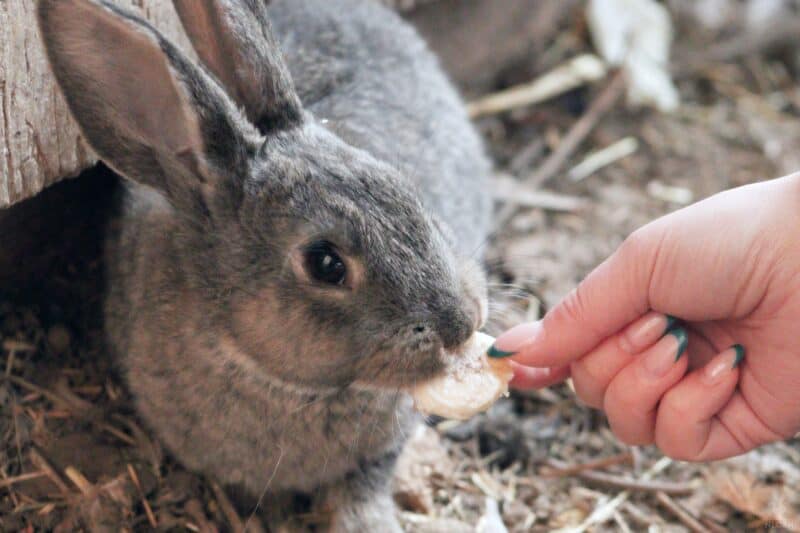
When it comes to rabbits, there are many breeds that have gray fur, from the light gray of a cloudy sky to the dark and majestic gray of a stormy sea. No matter what kind of rabbit you want, and what you want it for, there’s bound to be a variety that has magnificent gray fur sure to please you.
I’ll tell you all about them down below, but keep in mind these are all different breeds of the same species, Oryctolagus cuniculus.
1. Silver Fox Rabbit
If you couldn’t tell by the name alone, the Silver Fox is more of a black rabbit with silver with silver tipped hairs, one with a lustrous, speckled coat that looks very much like the fox of the same name. (Though bearing the same name, silver foxes are not to be confused with Arctic foxes, which are all white.)
Although their fur is incredibly beautiful, and their calling card, the Silver Fox is actually a popular meat breed, weighing up to 12 pounds and possessing sweet and succulent meat. They also make popular pets because of their beauty, as they are mild-mannered and typically docile.
2. Holland Lop
The Holland Lop is a lop breed that is known for its small, round and pudgy body. it is noteworthy for its friendliness and amenability towards people if they’ve been raised with proper socialization, making them a wonderful and beautiful pet.
Bred from French Lop and Netherland Dwarf stock specifically as pets and as show animals, these are among the smallest gray bunnies on our list, and it’s rare that you’ll find an adult weighing more than just 4 pounds. They’re commonly found with medium gray fur or else in broken with white spots although other colors are pretty common.
3. French Lop
This domestic breed is, as you might expect a cross, only this time between the English lop and the Giant Papillon. The French Lop is, of course, a lop-eared breed and one that was originally reared for meat – which makes sense due to its massive size. And since you’re probably wondering, they weigh around 10 – 15 lbs (4.5 – 6.8 kgs).
They’re still raised for that purpose in some places, but much better known and more popular as friendly, playful and sometimes rambunctious pets that need lots of room for exercise and play. The French Lop can sometimes be found with a dark gray coat, but white and black are more common.
4. French Angora
The French Angora is a French domestic rabbit that, like all other Angora rabbits, has long, luxurious and soft fur which requires regular trimming and brushing. But by Angora standards, you don’t need to shear the wool as often, around every 2.5 to three months. Because they have less wool on their ears, feet and heads, shearing is easier compared to English Angoras…
When these rabbits are found with gray fur, they look downright regal, almost like they have a cloak around them because their faces and heads don’t grow this long fur.
They’re very popular as pets for this interesting coat and also as show rabbits, but if you want to take the plunge with one you must be prepared for its extensive upkeep requirements or else it can cause health problems.
5. Jersey Wooly
The Jersey Wooly is a truly unique rabbit. Hailing from New Jersey in the US, this small breed was made from the beginning as a pet. This one was developed from several breeds, including Angora stock, Chinchilla, and Silver Marten – but the defining cross is French Angora × Netherland Dwarf. This last one is probably the most commonly used, and it’s what give these bunnies their small stature.
As far as maintenance and care go, the long, fuzzy fur of the Jersey Wooly, daily brushing is needed to keep their fur from getting matted (though some sources say you can do it less often). Like Angoras, they look truly awesome with a gray coat but they come in a huge variety of colors for any taste.
6. English Spot
A speckled heritage breed with roots going back to the middle of the 19th century, the English Spot is notable for its attractive and upright posture and various contrasting markings around its typically white body, including markings on the eyes, ears and nose that make it look like it has a monocle and a mustache!
The English Spot comes in many different color variations, however, with gray-ish color varieties including lilac (a medium gray with a pink tint), blue, and, of course, gray!
7. Harlequin
Yet another French breed, and probably not the last on this list, the Harlequin is what is known as a bicolored rabbit. Simply enough, this means they typically comprise varying bands or splotches of two different fur colors, usually running more or less symmetrically down their body.
Many color combinations are possible, including many shades of gray and lilac along with black, white, orange, tan, fawn, and blue. But ARBA only recognizes two varieties, Japanese and Magpie.
Their intriguing fur and their generally good attitudes make them really popular pets when they can be found from good breeders.
8. Lilac
A truly unique rabbit, the Lilac was developed in the Netherlands and in England separately in the early 1900s. What’s interesting is that the rabbits were developed separately in the two countries. But if you’re looking to pinpoints its origin, that’s not easy. It could be in Cambridge, England, early 20th century, but it might as well be in the Netherlands, where it was developed separately.
Typically a soft, satiny dove gray color, there’s a decided pinkish tint to the fur of the Lilac rabbit which gives it a completely unique luster and appearance. Sadly, the breed never really took off…
9. Chinchilla
No, another species didn’t sneak onto this list: I’m talking about the Chinchilla rabbit breed, a breed that was named because of the striking similarity between its fur and that other tiny, cute, fluffy animal.
There are actually several different chinchilla breeds, including the American Chinchilla, Standard Chinchilla and Giant – all recognized by the ARBA. All of them come in a lightly speckled, shimmering gray color that has a distinct fade along the length of each individual hair. These rabbits tend to be good-natured and make great pets, FIY.
10. Dutch
Dutch rabbits are an old and greatly admired heritage breed, one that makes an extremely popular pet owing to their small size, intelligence and gentleness. They make a great pet rabbit for families that have small kids as long as they’re raised properly. It’s also worth noting that even though adults rarely weigh more than 5 pounds this is not a genuine dwarf breed.
A lightly speckled white and gray is a common pattern, although gray varieties are reasonably common alongside other colors like blue, black, tan, and chocolate.
11. Rex
A large, stocky rabbit with thick fur that is known for its intelligence and even trainability, a popular pet as well as commonly raised for fur.
the Rex comes in a wide variety of different colors, several of them various shades and textures of gray. Notably, these bunnies have a unique undercoat in which the guard hairs (which are the same length as the undercoat) give them a plush, almost springy feel.
12. Mini Rex
The Mini Rex is developed from Dwarf Rex stock, but shares many of the same traits and most of the colors you might expect from a standard Rex. But, while they inherited many of the colors, fur and intelligence of the standard Rex they are significantly smaller, weighing about half as much.
Unlike the standard Rex, the Mini Rex is typically kept as a pet and show animal rather than being raised for fur and sometimes meat.
13. Havana
The Havana is, surprisingly, not a Cuban rabbit and originally hailed from Holland though it has since spread throughout the world. Havanas are small to medium size rabbits that make good and agreeable pets.
Known for its even, beautiful color and mink-like fur, Havanas got their name due to the resemblance of their mahogany brown fur to the dried tobacco leaves of Cuban cigars. Since then, though, other colors have been developed, lilac (which has a grayish appearance) included.
14. English Lop
The English Lop is a beloved heritage breed that’s thought to be the progenitor of all other lop-eared rabbits. Very popular as pets and show rabbits when they were first developed, these large, stocky and friendly rabbits still make great pets today.
These rabbits don’t just have floppy ears; they have huge, wide and long floppy ears that resemble a basset hound’s more than they do a rabbit’s. Many have ears with a tip-to-tip span of over 21 inches long, with the world record being an amazing 31.125 inches (79 cm)!
15. Flemish Giant
Pretty much everything you need to know about the Flemish Giant is in the name. These rabbits can grow to be absolutely humongous, and sometimes weigh over 20 pounds… That’s bigger than plenty of dogs! Chances are you’ve seen the Flemish Giant around the internet in various pictures and videos, and I don’t blame you for thinking they are photoshopped.
Commonly used as breeding stock to increase the size of meat-bearing rabbit breeds, they also make popular if expensive pets because they’re extremely gentle and friendly despite their size. Flemish Giants also come in a magnificent steel gray color that’s my personal favorite.
16. Netherland Dwarf
Without question, the single tiniest rabbit breed on our list, the Netherland Dwarf lives up to its name. These rabbits are genuinely itty-bitty, rarely, if ever, weighing more than just two and a half pounds.
Precious and precocious, they are raised only as pets and for exhibitions, and accordingly come in a wide variety of colors including several gray tones. Other colors include blue, chestnut, chocolate, and tan.
One thing you should know about the Netherland Dwarf, before you run out to buy a half dozen, is that they’re surprisingly energetic and require a lot of exercise. Certainly they need more playtime than most rabbits! Make sure you’re prepared for that if you think they are the ideal pet for smaller spaces!


Get your gift and learn things like:
- how to make this really quick pest spray
- how to prevent egg waste
- two cheap automation devices that will make your life easier
Tom has lived and worked on farms and homesteads from the Carolinas to Kentucky and beyond. He is passionate about helping people prepare for tough times by embracing lifestyles of self-sufficiency.