
Whether you keep ducks as pets or just as productive livestock on your homestead, I have little doubt that you care for your flock with all the love and diligence they deserve.

And that’s why it’s such a tragedy when you come out one day and find one or more of your precious feathered friends lying there dead and stiff…
It can be downright traumatizing, and the grief is only rivaled by the confusion you’ll feel in that moment. This is especially true if you just saw your birds earlier in the day or the previous evening and they were the very picture of health. How could they pass so quickly?
Sadly, it’s a fairly common occurrence, and one you’ll have to be familiar with. Not only so you’ll be prepared for the eventuality but so that you can act to potentially protect the rest of your flock.
Keep reading, and I’ll tell you about several causes of sudden death in ducks below.
Stress
Ducks are like most other birds in that they are surprisingly sensitive to environmental stressors of all kinds.
Inadequate shelter, living in an environment that’s too hot or too cold, a lack of companionship from other ducks, threats from predators, and other factors can all start to stress ducks out.
And so much of the time ducks don’t really show their stress level. They might seem fine, even happy and amenable, and then one day the stress is just too much, and they simply shut down and die. This might result from heart failure, stroke, aneurysm, or something else, but it does occur.
Keep changes in their environment to a minimum, treat them right, and give them what they need to thrive in order to keep stress levels low. That will help prevent sudden death…
Contaminated Food
This is a big one, and I myself have had more than a few ducks die suddenly because of contaminated food sources, and I know plenty of fellow keepers that have gone through the same.
Moldy duck food is a common culprit here, as certain mold strains, notably Aspergillus fumigatus, can can kill your poor birds in very little time. Pesticides, weed killer, and other chemicals are also major contributors to toxicity deaths.
You should only ever give your flock food that is fresh, dry, and wholesome. Never give them any feed that you don’t prepare yourself from known ingredients or get from trusted suppliers. Even a single bad serving or two might be enough to severely injure or kill your birds.
Toxic Plants
Related to the previous entry on our list, it’s not out of the question that your ducks might inadvertently or deliberately eat toxic plants if you allow them to roam and forage.
Ducks have a reputation for being pretty savvy about avoiding dangerous plants, but they are only animals and do make mistakes which can be fatal.
The bottom line is that you cannot trust your ducks to stay away from, and avoid eating, plants that are harmful to them.
Castor beans, azalea, honeysuckle, daffodils, lilies, all nightshade plants, pokeweed, oak trees, rhododendrons, and tulips are high up on the list of toxic plants that ducks are likely to try. Some of these plants are shockingly toxic and even a few small bites could be fatal!
Learn to identify and eliminate these plants from your property if you’re going to be keeping ducks, or take pains to ensure your ducks cannot get to them.
Internal Injury
This is another nasty cause of sudden death that can be tragically difficult to detect until it’s too late. Like I said above, ducks tend to be stoic, meaning they don’t necessarily cry out in pain or show obvious signs of discomfort until they are already feeling very bad.
If your duck gets injured, be it from an accident, something falling on them, improper handling, a predator or pet attack, or something else, the sand might be running through the hourglass and you may not know until it’s too late.
Keep your eye out for ducks that seem to be slowing down or acting depressed, or just acting unusually, especially in the aftermath of an incident where they seemed to come out okay at first.
If you have any doubts whatsoever, look the duck over closely for more obvious injuries but do not hesitate to rush them to the vet.
Egg Binding
Egg binding is an insidious cause of death in hens. If an egg physically gets stuck inside the oviduct, or if it breaks and blocks the oviduct it can quickly result in death.
Keep an eye out on your girls that have been laying eggs if they suddenly stop and seem to have a swollen, firm abdomen or stop defecation entirely. An upright, at-attention posture and fatigue are also possible indicators.
If you suspect a bound egg, put the hen in a calm, safe environment by herself and try warm water or olive oil in her vent to help lubricate the tissues and help her pass it.
You can’t afford to waste time though: whether it’s an intact egg or a broken one, you’ll need a vet to prevent a death or life-threatening infection in the case of a broken egg.
Heart Failure
Heart failure is a terribly sudden and tragic cause of death. When it strikes an affected duck, they can very literally fall dead in front of you with nary a squeak. Other times a duck might start to gasp, flap its wings, and then collapse.
Heart failure might be caused by injury, stress, genetics, toxins, or a combination of other factors, or it can just strike out of the blue with absolutely no warning and no precursors.
Once it strikes it is typically too late to save a duck, but you can reduce the likelihood of heart failure by giving your birds optimal nutrition and living conditions, and also breeding them responsibly to eliminate genetic lines that are predisposed to it.
Drowning
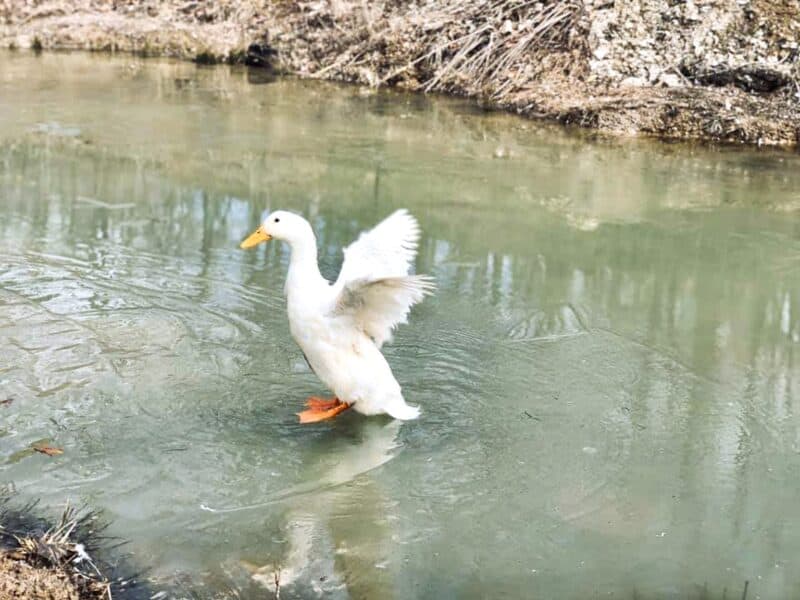
I know this is going to be a real shock to some readers, but ducks can indeed drown. Yes, they are excellent swimmers. Yes, they are basically waterproof. But they are air breathers. They can’t breathe underwater.
If a duck gets in trouble out on the water, either getting tangled up in something, caught on an underwater obstacle, or getting waterlogged and losing buoyancy, they can be in real trouble of drowning.
Likewise, male ducks and Mallards, particularly, often try to mate with females out on the water and these mating attempts can be quite rough, pushing the female’s head underwater. This can, and does, result in drowning both in captivity and in the wild.
Most duck breeds can hold their breath for between 10 and 30 seconds while underwater. Diving breeds can typically hold their breath for longer, up to a minute. Breeds that don’t spend much time on the water or only dabble can usually only hold it for 10 to 15 seconds.
This is a surprisingly long time in most cases for such small animals. And naturally, this capability facilitates the feeding habits and survival strategies of ducks.
Ok, so just to be clear: ducks cannot and do not breathe underwater!
Ducks aren’t fish, duh, but in seriousness ducks are air breathers. They don’t have gills and they can’t breathe out of their backside so there’s no way for them to keep their head underwater indefinitely.
As such, ducks that get trapped or stuck underwater can and will drown.
Drakes can get aggressive when mating with hens, very aggressive, and every once in a while, when mating on the surface of the water, a drake might accidentally keep her head submerged too long and drown her!
Naturally, ducks that get injured, caught on obstructions, or taken under by a predator like a large fish or snapping turtle will also drown if they can’t break free from the attacker.
Why Do Ducks Go Underwater, Anyway?
Ducks go underwater for really only three reasons…
The first is for food. Ducks eat all sorts of aquatic things, from plants to fish, amphibians like tadpoles and their eggs, insect larvae, crustaceans, and a whole lot more.
Again, depending on the breed and their lifestyle, they might get only a portion of their food from beneath the surface or most of it, with a few sea ducks getting the vast majority or even the entirety of their food from beneath the water.
Another reason might be is to escape a predator coming from above the surface. Diving ducks that are paddling out on the sea, in the middle of a lake, or on a pond that get attacked by a bird of prey will often dart below the surface to confuse them or escape.
Obviously, some threats come from below, too, in the case of larger fish or even reptiles like snapping turtles.
Ducks might still dive to escape these threats rather than take to wing because some ducks are surprisingly fast and hydrodynamic swimmers!
And, lastly, ducks might go underwater briefly to bathe and get clean, although this is less important for most breeds because they spend a lot of time preening and distributing oil from their glands.
Water Belly
Water belly is a curious and insidious condition that’s difficult to detect and even more difficult to treat.
As the name suggests, it causes a buildup of fluid in a duck’s abdomen, but not because they drink too much. It is specifically the result of hypertension and the failure of a ventricle in the duck’s heart.
When this occurs, a protein-rich fluid will start to accumulate in the belly, making it feel firm and eventually rock-hard. In conjunction, the affected duck will start to lose energy, then become downright lethargic, being unable or unwilling to stand and walk around.
In time, it makes it impossible for the affected bird to breathe and then they die. Genetics, age, and a diet that is too rich in calories and protein are contributing factors, especially if the ducks are being kept at high altitude.
It is sometimes possible to draw off fluid and prolong a duck’s lifespan, but this is rarely successful.
Duck Viral Enteritis (DVE)
This is it. The single most infamous cause of sudden death in ducks.
Duck viral enteritis, also known as SDS (Sudden Death Syndrome) for reasons you will soon understand, is a virus that your birds can contract from contaminated water sources or close contact with other infected birds, typically wild ones.
This is why so many responsible farmers preach and preach about fanatical implementation of proper biosecurity protocols. DVE is extremely contagious, extremely lethal, and can decimate your flock in hours or days.
Much of the time, infected birds give no signs of distress until they suddenly start gasping for air, trying to vocalize and frantically trying to flap or spread their wings. Seconds later, they fall over dead.
This is no exaggeration, and the disease strikes that quickly. Incubation time is a few days to a week at most, but then death is sudden and highly likely.
What’s worse is that some birds get infected and will not succumb in short order, but instead can transmit the virus for a long time.
Vaccines are available and can make your birds more resistant, but not immune, to this devastating cause of sudden death.


Get your gift and learn things like:
- how to make this really quick pest spray
- how to prevent egg waste
- two cheap automation devices that will make your life easier
Tom has lived and worked on farms and homesteads from the Carolinas to Kentucky and beyond. He is passionate about helping people prepare for tough times by embracing lifestyles of self-sufficiency.