
If you’ve ever seen bees flying around your yard before, you’ve probably thought that there has to be a hive somewhere nearby. Most of the time you’d be right, but not always!
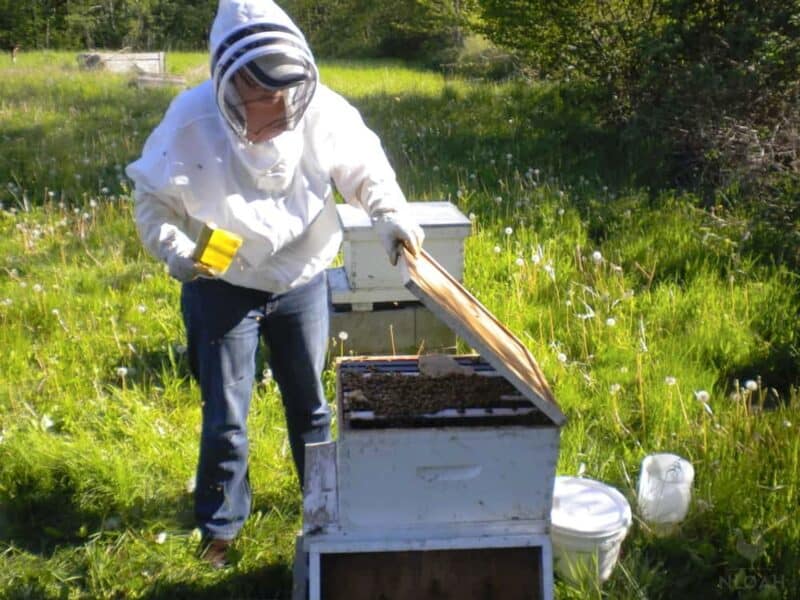
Turns out there might not be a hive anywhere close by, and the bees are commuting to do their work just like you and me. Come to think of it, have you ever wondered how far it can fly? Just how far will a bee travel from the hive?
Most bees will only fly a mile or two from the hive to collect resources, but they may fly as far as 5 miles. Different bee species have different typical ranges for gathering.
I don’t care what species it is, that’s downright impressive when you consider how small bees are and how many obstacles they must pass in order to do their work!
Even more impressive is how such a tiny creature can navigate that far, and accurately! I’ve said it before and I’ll say it again, bees are absolutely amazing. There’s so much more you’ll want to know on this topic, so keep reading.
Different Bee Species Have Different Average Ranges
The first thing you need to know about how far bees will fly from their hive is that all bee species are different. Yes, most species engage in broadly similar behaviors, but there are still many differences.
Of course, when we’re talking about bees the first kind that comes to mind are honey bees, naturally.
Concerning honey bees, they’ll typically fly anywhere from 1 to 2 miles away from the nest in order to collect pollen, nectar or water. They might fly a lot farther if they must, but they will only do this if they have no other choice.
But, looking at bumblebees which are larger, thicker and generally less acrobatic compared to their smaller cousins, they have a typical gathering range around their hive of about a half mile, extending upwards to one mile or a little bit beyond if they have to with 4 miles as the absolute maximum.
Just goes to show you that different species have drastically different approaches when it comes to long distance travel.
Bees Only Fly as Far as they Need to for Food
The rule of thumb concerning the distance that bees will fly from the hive is how far the food is. If you couldn’t tell already, bees are almost singularly focused on sheer efficiency.
Building a hive and laying countless generations of new young requires tons of resources, and wasting resources by wasting effort is always avoided.
Accordingly, as a rule a healthy and properly ordered beehive will only send workers as far as it has to in order to procure resources, whatever they might be. This means that nearby sources of food are always prioritized over farther ones.
Closer food sources means that an individual bee can make a trip much quicker before heading back, and that means more gathering flights in a given day. Bees don’t live that long, so these additional trips really add up when it comes to the prosperity of the colony.
As a Rule, They Usually Stay Within a Mile of the Hive
So, all things equal, you can count on your average bee always staying within about a mile of the hive one way or the other. But, there are some circumstances that might dictate a bee needs to fly far than average out of necessity or emergency.
We will talk about those instances in the next sections.
Scout Bees Fly Further than Workers on Average
When it comes to getting work done in, around and for the hive, bees naturally rely on worker bees. It is in the name, after all!
And while most workers concern themselves with tending to the queen, gathering resources, building comb or tending to various other tasks around the hive some workers are detailed to scouting duty.
Scout bees perform also as their name suggests, scoping out new and better sources of food that other workers can exploit.
An interesting quirk of bee biology and behavior is that these scout bees tend to fly much farther than the majority of the other workers, and do so deliberately.
A scout bee will readily fly more than 2 miles away from the hive on a scouting trip, and might fly five or more miles looking for food if typical food sources are exhausted or suddenly denied to the rest of the workers. This means that a single scout might have to make a round trip of 10 miles or more there and back. That’s incredible for such a tiny insect!
Even more amazing is that they do find their way home with minimal error, using a combination of visual landmarks and the position of the sun to find their way home as surely as you or I could using a GPS.
A Swarm Might Travel Many Miles Further
Sometimes when a hive of bees gets too big, a new queen will split off with some of the workers to form a new hive elsewhere. These nomadic bees will leave the hive all together and travel in a big clump known as a swarm.
Some of the time this swarm will settle down and make a new hive not too far from their original home, but other times they can travel many miles, upwards of 14 or a little farther to find the ideal spot.
How Many Miles Can a Bee Fly in its Life?
A bee usually has around 500 miles worth of flight in its wings before they wear down to the point that they are no longer airworthy. Most folks know that bees don’t live very long, typically anywhere from 1 to 2 months, but what you might not know is that a bee might be finished flying and working well before the end of its natural lifespan – depending on how hard it had to work.
If a bee is subjected to rough conditions, damage and long, repeated flights its wings will start to wear down. As the wings degrade, the bee’s flight becomes less efficient and finally they will lose the ability to fly entirely.
It’s sad because a bee’s wings do not regrow or regerate, and cannot be repaired.
Just How High Can a Bee Fly?
Believe it or not, bees are capable of flying at 30,000 feet. That is commercial jetliner altitude!
Of course, this is mostly academic because of bees do not need to attain such altitude, and are entirely capable of living out their entire life close to the ground.
In fact, most bees will never fly more than a hundred feet off the ground for any purpose, and this is typically only done for terrain avoidance.
Do Bees Fly in the Dark?
They can, but most don’t, with only relatively few species being adapted to fly at night for the purposes of gathering from certain typical food sources.
In fact, many bees that you’ll encounter in North America will land when it is very dark outside or when subjected to darkness. This is why most try to get home before sundown: remember that I mentioned the bees rely on the position of the sun for navigation, and if they can’t see the sun they cannot navigate effectively.
Can a Bee Fly Backwards?
Yes, they sure can! Bees are highly agile and adaptable flyers, and they can fly in any direction on all six axes, including straight up and down and backwards.
At What Temperature Do Bees Stop Flying?
Bees typically stop flying at around 50°F / 10°C. This is because they will quickly lose too much body heat at this temperature to sustain the proper movement of their flight muscles.
This is also the temperature commonly reported by most beekeepers when their bees become reluctant to leave the hive, although there is some variability depending on the precise species of bee and the overall weather conditions.
If you’ve ever seen a bee early in the morning that seemed like it couldn’t fly and was just hanging out on your railing, there’s no need to panic or feel sorry for it: as the temperature rises and the bee gets a little sunshine to warm up, it will soon be able to take flight again.

Get your gift and learn things like:
- how to make this really quick pest spray
- how to prevent egg waste
- two cheap automation devices that will make your life easier
Tom has lived and worked on farms and homesteads from the Carolinas to Kentucky and beyond. He is passionate about helping people prepare for tough times by embracing lifestyles of self-sufficiency.