
You can’t argue that ducks aren’t adorable. They absolutely are, and they will never be cuter than when they are ducklings. Those precious, fuzzy little darlings will just melt your heart. And when it comes to ducklings, there are none more adorable than yellow ones.
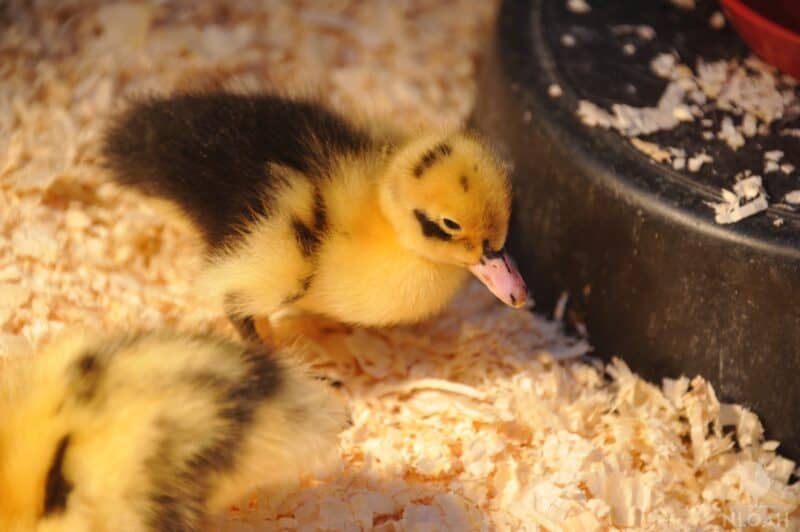
So adorable, in fact, that they are the very picture of what a duckling is supposed to look like to most people. How surprising it is, then, to learn that not all ducks hatch yellow. Some of them aren’t yellow at all!
If you have your heart set on seeing adorable yellow babies, be on the lookout for these duck breeds that have completely or partially yellow ducklings.
Wood Duck
Beautiful and instantly recognizable, at least in the case of males, Wood Ducks, also known as Carolina Ducks, have mating plumage and exhibit interesting nesting behavior, building their nests up in trees over water so that the ducklings, jumping out, will have a soft landing.
Males are a riot of different colors and patterns, ranging from black and white to rusty red, speckled brown and gray, buff, beetle green, and more.
Like most breeds, females are more subdued, being a mingled fawn, brown, and tan but also possessing indigo blue wing tips. Ducklings are half-yellow and black with light brown patches on the wings.
American Pekin
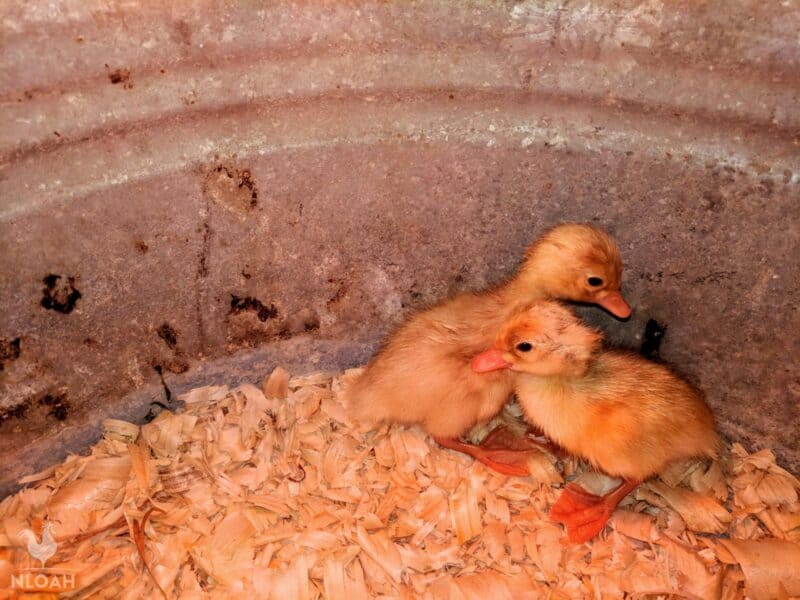
Chances are when most folks think of a duck, and domestic ducks particularly, they instinctively imagine the American Pekin. Big, brilliant white, orange legs, orange bill: you might say they look almost generic!
The most numerous domestic breeds in the United States and one of the most commercially important breeds kept around the world for the production of meat, they also make for a popular pet duck because of their availability, low cost, and good temperament.
Just keep in mind if you want them as pets that they are notoriously messy even by duck standards!
No surprises here when it comes to the little ones: ducklings are an even lemon yellow all over which will dim and then turn white as they grow their adolescent and then adult feathers.
Because they’ve been successfully bred for generations to facilitate rapid growth, you better enjoy those precious yellow babies while they last because they go away quite quickly!
German Pekin
A European variation of the Pekin that we all know and love, though they are identical in so many ways, the German variety is still considered its own breed.
German Pekins are especially remarkable because they are truly humongous, even compared to their already large American cousins. German Pekins can clear 12 pounds!
Ducklings look identical to the American Pekin- completely yellow, diminishing and turning white rapidly as they grow.
Saxony
Another big and beefy duck breed, the Saxony has long been raised for meat production and is famous for its overall size, height, and calm temperament. Compared to other breeds, which can be a little nervous or flighty, Saxonies seem to take everything in stride.
Pretty popular in Europe and especially in the UK, you don’t see them too often here in the US, which is a bummer if you ask me! A great duck for beginners because they’re famously easy to handle and rarely aggressive.
These beauties are instantly recognizable from their stone gray and chestnut brown coloration when they are adults, and somewhat surprisingly considering this adult plumage, ducklings are yellow all over save for a few sparse brown spots or patches.
You can tell Saxony ducklings apart from others because they have a light pink or fleshy-colored beak and dim orange legs and feet.
Magpie
One of the very best ducks around if eggs are what you are after, Magpies are known for laying more than 200, reliably, each and every year. Loved both for their striking black and white coloration, making them resemble the corvids of the same name, and also for their engaging friendliness with people.
They are active, curious, and a ton of fun to interact with, but they need lots of space because they really get around!
Like most of the other ducks on this list that have a combination of light and dark feathers, Magpie ducklings have patches of black and dark brown on their body, with the darker sections typically on their head, sides of the body, and down the back.
Though they might be confused for other ducklings, they are distinctive in their own way and easy to recognize.
Call
Among the most beloved pet duck breeds around, Calls are tiny, loud, and tend to be very affectionate.
Their adorable, oversized heads and puffy feathering make them look like ducklings well into their adult lives, and this has made them perennially popular with duck fanciers and on the exhibition circuit.
If you want an affectionate duck, it’s hard to do better, but be prepared for this noisy breed…
Like most pure white breeds, Call ducklings are an even, bright, and cheery yellow all over. As they grow into adolescence and start to develop their adult feathers, this yellow will turn pale and morph into that even white color they’re known for.
Muscovy
This impressively large and striking domestic breed is known for being quiet, producing rich dark meat, and coming in a huge variety of different colors.
They are instantly recognizable by the fleshy red growths on their heads and necks. Don’t worry, that’s normal, and not some weird disease or anything.
They’re also, fun fact, more closely related to geese biologically than true ducks, but Muscovies have been kept as domestic poultry for so long, and categorized accordingly, that you might say they are honorary ducks!
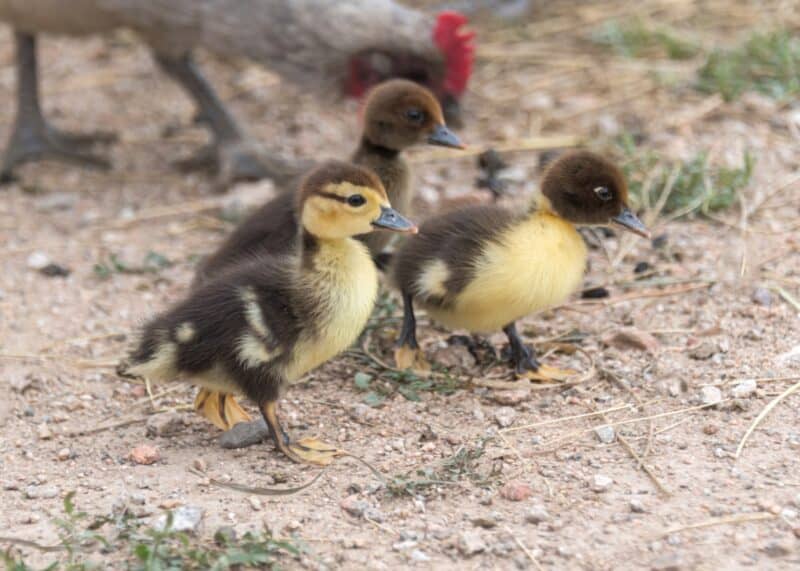
Jokes aside, the variety in plumage means that ducklings will likewise be seen in a wide variety of colors, though brown, yellow, or a mottled combination of the two is the most common by far depending on the color of the adult feathers.
Muscovies with more white feathers will have correspondingly more yellow when they are young.
Mallard
Considered by many to be the most ubiquitous duck around, Mallards are among the most common and popular domestic ducks, and also the single most common wild duck in North America.
They are so common, in fact, that the vast majority of domestic duck species have descended directly from them!
Mallard ducklings start out partly yellow with dark brown or black markings elsewhere on their body. Typically, the sides of the torso, wings, breast, neck, and part of their head are yellow but the rest of their body is covered by a dingy brown to dark black color.
You can sometimes easily identify Mallard ducklings by what is known as their eyeliner marking or masking; a black stripe above each eye. Enjoy these cuties while they last, because they don’t stay yellow for long and will start darkening quickly as they grow.
Rouen
An impressive and statuesque bird, Rouens are a utilitarian French breed raised for their impressive yield of delicious, rich meat. They’re also still kept for egg production, though they’re not particularly competitive compared to other high-output breeds.
These ducks are also notably popular at exhibitions and competitions because of their large size, poise, and beauty, looking very much like a super-sized Mallard.
And because they look so much like Mallards, that informs us what ducklings will look like: you’ll see the same patterns of brown on yellow that Mallard ducklings have.
But Rouen ducklings have one distinctive difference in the form of a second stripe beneath the eye on each side. Look closely, and you’ll easily be able to tell the two ducklings apart!
Aylesbury
An old heritage breed that has been around since at least the 1700s, they are rarely encountered today in the US and are considered severely threatened on many livestock conservation watch lists. Aylesburys are another big breed easily recognized by its long, curving neck and wide body.
Pure white all over, they’re sometimes easily confused for Pekins, which are similarly large and stout.
And like Pekin ducklings, Aylesbury babies are a bright and sunny yellow from tip to tail, with one distinctive feature to set them apart; their bills are pink and will slowly turn orange as they grow into adolescence.
Northern Shoveler
One of the most distinctive and fascinating breeds we will look at today, Northern Shovelers really live up to their name…
They are found as they are throughout the northern hemisphere and also relying on their wide and sturdy bills that they use as a digging tool to find food. They’re peculiar, no doubt about it!
Colors in adult ducks are somewhat variable, and so ducklings are hatched with down of various colors in kind. Mostly or even totally yellow is a possibility, but some babies are a mingled brown or brown and black depending.
Indian Runner
Indian Runners are another unique breed. Standing up perfectly straight, they are commonly compared to penguins in terms of overall proportions and posture.
Indian Runners are among the most active and fastest ducks on land as they really do run around everywhere like their name suggests. They also tend to be a little skittish, and they can really turn on the jets when they get scared!
They might look a little strange compared to other domestic breeds, but they are attractively colored, typically consisting of mingled shades of brown, gray, white, and black.
Their ducklings aren’t unique and remarkable because, despite this darker and uneven coloration, they tend to be yellow all over.
Despite being pure yellow, Indian Runners won’t be mistaken for any other breed when they’re babies: they come out of the shell standing upright just like adults – iif you can believe it!
Buff Orpington
Not to be confused with the chickens of the same name, the Buff Orpington is nonetheless quite similar to its cousin: they have a light, toasty tan coloration all over, though it is sometimes broken by light white patches. This is what is known as buff when it comes to plumage.
Buff Orpingtons are also one of the friendliest domestic breeds out there, and they tend to be calm and patient with people, meaning they are a cinch to handle and a lot of fun to interact with.
But also just like their chicken counterparts, Buff Orpington ducks are really good mothers. That’s great for raising ducklings, but it means they go broody at the drop of a hat.
Buff Orpington ducklings hatch with a patchy yellow and brown down that matches the disposition of their adult feathers. The yellow down will turn a light buff as they grow, and the darker down will darken in kind.
White Crested
Another instantly recognizable breed, Crested ducks got their name due to a genetic mutation resulting in a deformity of the skull, which correspondingly causes a plume or top-knot of feathers to form on the back of their heads.
Popular pets because of their unique appearance, and even making for a surprisingly capable utility breed kept for meat and eggs, they may be found in any color though only black and white are recognized in the US.
Likewise, ducklings will be pure yellow if they have white feathers as adults, or a dingy brown if black.
Black Swedish
One of the most distinguished but today rarest domestic breeds is the Swedish duck.
Long kept for their extraordinary good health, excellent carcass yield of meat, and even temperament, they remain a good general-purpose breed for homesteaders but also make wonderful pets and exhibition animals thanks to their stunning good looks.
They have roughly black feathers all over their bodies and heads with white chins and necks and white wingtips and leading-edge feathers.
Ducklings are born with a combination of yellow and dark brown feathers and kind, but are notable for turning much darker overall than their yellow patches would suggest.

Get your gift and learn things like:
- how to make this really quick pest spray
- how to prevent egg waste
- two cheap automation devices that will make your life easier
I’ve taken over this blog from Kendra Lynne around 2018, and turned it into one of the best an most comprehensive homesteading website out there. I was raised partly in the countryside living a very frugal life ever since I can remember.