
Chances are pretty good that if you have chickens, you got them for the same reason that I and everyone else did: you want those incomparably delicious, farm-fresh eggs!

If you’ve never had them, I’m here to tell you once and for all that the hype is real. The color, taste, and texture of eggs that are only a couple of days old blow all of the grocery store brands right out of the water.
But plenty of folks have justified concerns about storing their eggs for safety and longevity. It isn’t like bringing home pasteurized factory eggs and just popping them in the refrigerator for a few weeks!
Luckily, it’s easy to do, and I’ll tell you everything you need to know and a bunch of methods for doing so in this guide.
Storing Fresh Eggs is Not Quite the Same as Grocery Store Eggs
For starters, we need to clear something up about keeping eggs. As a rule of thumb, you don’t store freshly laid eggs the same way you store refrigerated eggs that you pick up at the grocery store.
I mean, you can, and you actually have a lot of options for storage, but there are some important distinctions we need to clear up to prevent confusion and ambiguity.
Any eggs that you purchase from a grocery store will be handled, washed, and pasteurized in accordance with USDA guidelines. That means you’ll get them out of the cold case and, if you’re smart, you’ll bring them home and pop them in the refrigerator.
To be perfectly clear: you should keep grocery store eggs refrigerated! They should stay safe in the fridge for about 4 weeks.
You do not have to do the same with your farm-fresh eggs. In fact, it’s possible to simply park your “homemade” eggs on your countertop and expect them to be delicious and completely safe for 3 weeks or even a little bit longer- no refrigeration needed.
Yes, really! You can choose to refrigerate them for even longer storage, at least two months and more likely three.
To emphasize my point:
- Shelf-Life of Fresh, Unpasteurized Eggs in the Fridge: 2 to 3 Months
- Shelf-Life of Commercial, Pasteurized Grocery Eggs in the Fridge: 1 Month
Account for the Cuticle When Storing Fresh Eggs
Why is it that untouched fresh eggs keep longer than pasteurized “safer” commercial eggs? It all boils down to the cuticle or the lack thereof on the eggshell. The cuticle, often called the bloom, is a wax-like coating that is naturally present on freshly laid eggs.
Eggshells are porous, and the cuticle seals the egg against the intrusion of air and bacteria, and also prevents the intrusion or loss of moisture, creating a stable environment. This coating is removed from commercial eggs during processing.
On your fresh eggs, as long as the temperature is around 70°F or just a little warmer and your house isn’t extremely dry, the presence of the cuticle means that they will store just fine at room temperature for weeks on end.
But if you wash the egg, or if conditions aren’t optimal, that calculus might change.
Don’t sweat that too bad, it’s simple to figure out and I’m going to take you through all of the factors you need to know in the next section before teaching you 10 proven methods for keeping fresh eggs safe, delicious, edible, and ready to use.
Factors of Fresh Egg Shelf Life
No matter what kind of egg you’re dealing with, your own or commercially bought, these factors affect storage life.
Washed versus Unwashed
This is the biggie for our purposes. As detailed in the preceding section, unwashed fresh eggs will last longer if kept at room temperature or refrigerated.
Washing your eggs removes the cuticle, which allows more moisture to escape and potentially germs to get in, which could cause the egg to rot.
The problem, of course, is that eggs don’t come out looking pearly white and perfect all the time. They might have debris on them, and by debris, I mean poop and other stuff.
You can wait to clean the eggs immediately prior to using them but most folks, myself included, won’t abide by this.
If you do need to clean debris off your eggs prior to storing them but don’t want to wash them and remove the cuticle, you’ve got to do so properly. I’ll tell you how to do that in the next section, so just hang on a moment…
Position
Believe it or not, the position of the egg impacts shelf life. Ideally, you will store eggs with the narrow end pointing straight down.
Eggs lying on their side won’t last as long, and neither will eggs with the narrow end pointed up, although the difference is less pronounced in this case.
Ambient Temperature
Ambient temperature is another huge factor for shelf life… For unwashed eggs kept on the counter, a temperature that is between 68 and 75 degrees Fahrenheit is ideal.
For washed or unwashed refrigerated eggs, 40°F / 5°C will achieve the maximum shelf life without special preservation methods.
Ambient Humidity
When it comes to keeping fresh eggs safe and tasty for as long as possible, humidity is the most commonly overlooked factor.
Remember, the cuticle of the eggshell wants to help keep moisture in, and dryer environments facilitate moisture loss and cause it more rapidly.
Fresh eggs are ideally kept in a high-humidity environment for this reason, generally anywhere between 72 and 85%.
That might be uncomfortably moist in the house for some people, but as a rule of thumb, the higher the humidity where the eggs are kept, the longer they will last.
Low humidity might accelerate spoilage by two to three weeks!
Refrigeration
As ever, refrigerating most foods tends to greatly extend shelf life and prevent bacterial contamination. Eggs are no different.
For unwashed fresh eggs, simply popping them in the fridge and keeping them around 40°F / 5°C will usually give them at least 3 months, and may give you 4 months or even a little longer!
To Pasteurize or Not to Pasteurize?
If you’ve dug into the topic of egg freshness at all, you’ve probably seen the question of pasteurization come up before.
As mentioned, all of your commercially available eggs at the grocery store are pasteurized, meaning they are heated uniformly to a high enough temperature to decisively kill any potentially harmful microorganisms before they are then refrigerated to maximize shelf life.
Some people claim that you can pasteurize your own eggs at home, but this is only partially true: there is no at-home, in-the-kitchen method for pasteurizing intact eggs safely to extend their shelf life.
It is possible, and in my opinion laborious, to pasteurize the yolk and white prior to storage, but this is not necessary for safety and good shelf life using the methods I’ll show you.
Bottom line? I don’t think it is worth pasteurizing fresh eggs at home.
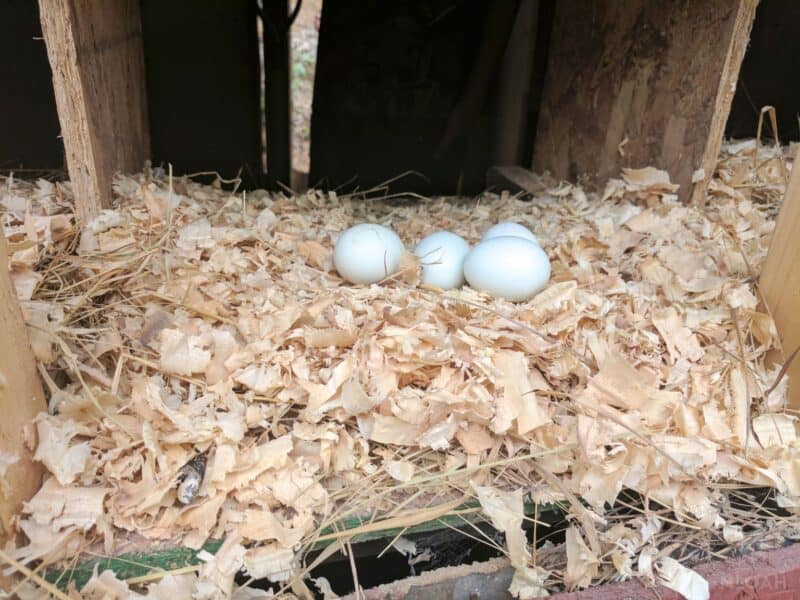
Keep Nesting Boxes Clean for Cleaner Eggs!
Don’t worry, I’m not getting too far off topic here. One of the best tips I ever got for maximizing the shelf life of my own fresh eggs was from my mentor who showed me the ropes with chicken keeping.
He taught me to always keep my nesting boxes as clean as humanly possible, even if the run is still a little messy.
That’s because a messy nesting box translates to messy eggs, eggs that are more likely to need washing. As we just learned, washing usually strips the cuticle, which accelerates spoilage.
The cleaner your nesting boxes stay, the cleaner your eggs will be, and they might need only a gentle wiping with a paper towel or a soft brush to remove the errant fleck of poop or other debris.
Proven Methods for Preserving Your Farm-Fresh Eggs
The following tips all work wonderfully for preserving your eggs, either intact or cracked and ready for use. Some methods keep them ready to eat.
Just remember that when storing any whole eggs for a long period of time, you should perform an egg edibility test prior to cracking them open for cooking; this will tell you at a glance whether or not they are suspect!
Countertop
- Expected Shelf Life: 3 weeks or a little longer in ideal conditions around 70°F and high humidity.
One of the best and most convenient ways to store your fresh eggs, assuming you use a lot of them, is simply keeping them on the countertop.
A clean egg holder that will keep them with the narrow end down will allow you to admire the fruits of your flock’s labors, and grab eggs for easy preparation whenever you need them.
As detailed above, though, you only want to keep them this way if you are sure the cuticle is intact. If you have any doubts, pop them in the fridge and check the eggs for freshness before you crack them open. More on that later…
Root Cellar
- Expected Shelf Life: 1 to 3 months depending on temperature and humidity.
Root cellars are coming back for homesteaders, even though they never technically left. Whether you want one for supplementary storage or because you are living off-grid, they can be a great place to keep your fresh eggs if you live in a cooler climate.
Unwashed, your fresh eggs will keep for 2 to 3 months in your root cellar if you can keep the interior temperature around 55°F. Just remember to store them with the narrow end down in their holders!
Refrigerated
- Expected Shelf Life: 2 to 3 months.
Refrigeration is always a good way to store eggs and has the added benefit of keeping them tasting much better and fresher for longer, whether or not you’ve washed them.
Expect your eggs to last at least 2 to 3 months in the refrigerator, but sometimes they can go a little longer than that.
Frozen
- Expected Shelf Life: about 1 year.
Before you ask, no, you can’t freeze whole, fresh eggs. The fluid inside will expand and invariably crack the shell, causing all sorts of trouble.

But the solution is a simple one: crack open your eggs and whisk the whites and yolks together or separate according to your preferences before placing them in silicone molds or ice cube trays.
Freeze them solid, then transfer the individual cubes into a freezer bag or other airtight container. They are quick and easy to use in recipes or for breakfast, and will last at least a year and taste great!
Water Immersion
- Expected Shelf Life: up to a year and a half, sometimes a little longer.
A really old-school method for preserving whole, fresh eggs is water immersion, sometimes referred to as water glassing.
By adding pickling lime to a container of clean, unadulterated mineral water, meaning no added fluoride or other creepy chemicals, fresh eggs that have the bloom intact will be effectively sealed shut and protected against moisture loss and contamination.

The result is an astounding shelf life at room temperature of up to 18 months!
But there’s definitely a trick to this method: any eggs that you choose must be extremely clean but also have the bloom intact; this means that if an egg is even a little bit dirty and you have to wash it, you probably don’t want to preserve it this way.
You also don’t want to preserve previously washed, commercially sold eggs because it just won’t work.
Oil Coating
- Expected Shelf Life: 4 to 6 months at room temperature.
Another old-fashioned technique, and one that seems downright crazy at first glance. But believe it or not, it’s possible to rub your fresh, unwashed eggs with a little bit of mineral oil to effectively seal them against air, bacteria, and moisture loss.
You’ll then be able to keep your eggs on the counter for upwards of 4 months. Not bad, especially considering how easy this method is.

All you need to do is gently brush off or wipe off any major debris and then carefully rub mineral oil all over the egg with a gloved hand. Make sure it’s totally coated, then set it in its holder with the narrow end down. That’s it!
But one quick warning: do not attempt to extend the shelf life of washed eggs with this method as the mineral oil will seep in through the shell and taint the white and yolk, giving it a nasty taste at best!
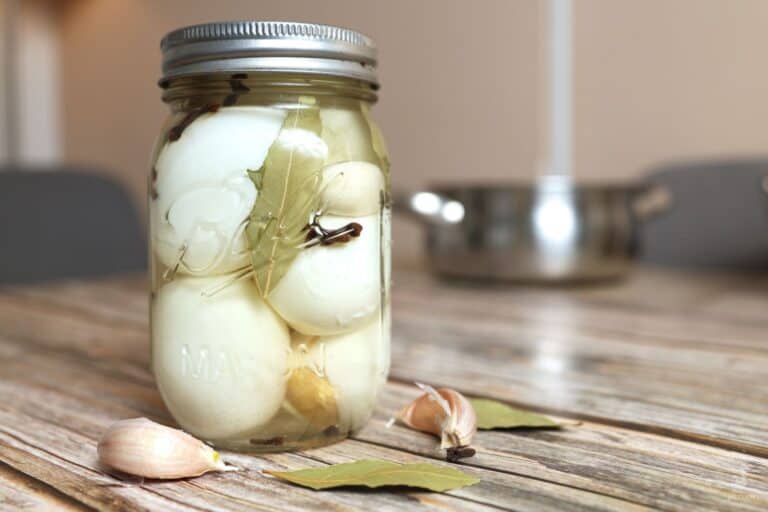
Pickled
- Expected Shelf Life: 4 to 5 months.
This is bound to be a love-it-or-hate-it method for most readers. If you love pickled eggs, you are in luck, because the pickling process can keep your farm fresh bounty safe and snackable for around 4 months.
However, if pickled eggs just aren’t for you, then this will be a method of desperation at best, especially considering other methods can give you equivalent or greater storage life without dramatically altering the flavor of the egg.
Cooked and Dehydrated
- Expected Shelf Life: several years in ideal conditions.
One of the most controversial methods for extending fresh egg shelf life is dehydration.
If you do any checking among authoritative sources on food preservation, you’ll see them caution you against dehydrating eggs because at-home processes and appliances just can’t do a thorough job without risking bacterial contamination.

But, there is a workaround that is safe and reliable: scramble and cook the eggs, then dehydrate them as soon as they cool down to room temperature.
It will take the better part of a day for the process to complete in your dehydrator, but once it’s finished, you can store them in a vacuum-sealed bag and keep them in a cool dark place to get a couple of years out of them.
I caution you, though, that the texture isn’t for everybody!
Freeze-Dried
- Expected Shelf Life: 10+ years.
The most high-tech, reliable, and long-lasting method for preserving fresh eggs is to freeze-dry them.
Freeze-drying first freezes the egg whites and yolks solid before evaporating that frozen moisture directly into a gas.
The result is eggs that are completely safe, ready to reconstitute, and very easy to store. Freeze-dried eggs, and many other foods, will last in excess of a decade.
But there is a major drawback with this approach, and it’s the fact that even consumer-level freeze-drying technology is complicated and very, very expensive.
Unless you’ve got a big budget, this method probably won’t be for you. However, you can buy commercially packaged freeze-dried eggs to pad your pantry for tough times…
Salt Curing
- Expected Shelf Life: 6+ months
Another ancient but viable method for keeping your eggs fresh and edible, and turning them into a delicious ingredient or topping, is salt curing.
Salt curing is exactly what it sounds like, and for most approaches, you don’t try to cure a whole egg. Basically, you create a thick layer of salt, a small depression for the egg yolk and white to rest in, and you crack the egg into the depression before covering it with even more salt.
Come back in a couple of months and the cured yolk will be deliciously salty, savory, and safe to eat. These are a common ingredient in various kinds of Asian cuisine!
Cleaning Whole Eggs for Best Results
If you are storing whole eggs by any of the methods in the previous sections, you may want to clean them first. But for room temperature or basic refrigerated storage, you need to avoid stripping the cuticle. This entails special cleaning methods.
If your eggs are reasonably clean, I recommend you put on gloves or wash your hands thoroughly before gently wiping off the debris using a clean paper towel.
For more substantial contamination, use lukewarm water that’s just slightly warmer than the egg itself and a very soft natural bristle brush to wipe it away.
Dry the egg immediately and the cuticle should still be intact. If you notice a kind of slime or residue coming off of the egg and onto your hands, the cuticle has been compromised and you’ll need to put your eggs in the refrigerator or use them very soon.
For eggs that are seriously soiled, use warm water, a brush, and gentle soap, then rinse with clean water, dry thoroughly, and put them in the fridge at a minimum; you won’t be able to keep them safely at room temperature for very long anymore.
To recap:
- Lightly soiled: gently wipe off with a towel, okay to keep at room temperature.
- Moderately soiled: gently wipe or brush with lukewarm water, dry thoroughly, okay to keep at room temp if no evidence of cuticle deterioration.
- Heavily soiled: gently wipe or brush clean with lukewarm, soapy water, dry thoroughly. Must be refrigerated or preserved by alternate methods.


Get your gift and learn things like:
- how to make this really quick pest spray
- how to prevent egg waste
- two cheap automation devices that will make your life easier
Tom has lived and worked on farms and homesteads from the Carolinas to Kentucky and beyond. He is passionate about helping people prepare for tough times by embracing lifestyles of self-sufficiency.