
One of the most common and prettiest wildflowers you are likely to see spring up in your garden or elsewhere on your property is Queen Anne’s Lace, a.k.a. the wild carrot.

Also known as the humble wild carrot, scientific name Daucus carota, it produces large, showy umbrella-shaped structures of tiny white flowers and is an important plant for pollinators.
Regrettably, one of the deadliest plants in North America, Poison Hemlock, also known as Conium maculatum, looks nearly identical to those of the wild carrot.
Similar growth habits, similar tiny, white flowers, and more. If you make a huge mistake and eat any part of Poison Hemlock, it’s likely to be the last one you ever make.
Even if you don’t plan on eating either plant, you must be able to tell one from the other: even coming into contact with Poison Hemlock can cause harm or severe illness.
To help stop that from happening, I’m bringing you a list of eight differences to look for so you can tell one plant from another. Let’s get right into it.
| Trait | Queen Anne’s Lace | Poison Hemlock |
|---|---|---|
| Height | Rarely exceeds 3 feet. | Can grow up to 10 feet. |
| Seasonality | Blooms early to mid-summer, lasts until the first hard frost. | Blooms in late spring, stops before frost. |
| Growth Habit | Basal rosette of small leaves in the first year, flowering stalk up to 3 feet in the second year. | Basal rosette of larger leaves, flowering stalk can reach up to 10 feet. |
| Stems | Densely hairy with vertical ribs, solid inside. | Smooth with purple blotches, hollow inside. |
| Leaves | Grayish-green, fern-like, lightly hairy, grows close to the ground. | Dark green, triangular, no hairs, denser vegetation. |
| Flowers | Tight clusters of white flowers, sometimes with a single maroon flower, turns into a clump resembling a bird’s nest post-bloom. | Clusters of tiny white flowers in separate units, does not form a clump post-bloom. |
| Bracts | Leaf-like strands beneath the flowers. | Lacks bracts entirely. |
| Odor | Fresh, grassy, carrot-like smell. | Musty, moldy, off-putting odor. |
Height
One of the most obvious differences between Poison Hemlock and Queen Anne’s Lace is that Poison Hemlock grows far taller.
Poison Hemlock can become downright impressive, topping out at 10 feet or a little bit beyond. Queen Anne’s Lace, in stark contrast, rarely reaches beyond 3 feet or a little over.
Good to know, and if you are staring at anything that appears to be one or the other, and it’s much over three and a half feet, it’s all but certain you’re looking at Poison Hemlock and you should act accordingly.
However, you must never, and I do mean never, make the mistake of assuming that a short or puny plant is Queen Anne’s Lace: every colossal Poison Hemlock starts out as a much smaller, juvenile plant and it’s a very easy thing to confuse them at this early stage of growth!
When dealing with any smaller plant, always rely on multiple points of identification.

Seasonality
Both plants are warm-weather bloomers. Look for Queen Anne’s Lace to mature and flower in early to mid-summer. Blooms will typically last until cold weather properly takes hold, or the first hard frost.
As a rule, Poison Hemlock blooms earlier than wild carrot, and it stops blooming sooner. Expect to see its deadly flowers late in the springtime, and it will usually give up the ghost when the nights start to get quite chilly, but not necessarily when frost appears.
This is a subtle difference, but one you can rely on if you have many of each type of plant growing in the area.
Growth Habit
Both of these plants are biennials, and their growth habit and overall appearance differ from year to year.
In the first year of growth, Queen Anne’s Lace will develop a basal rosette of small leaves. Troublingly, Hemlock does the same thing in the same way, but its leaves are much larger and longer, up to two feet long.
When cold weather closes in both plants will begin to die back and then return in the springtime. Here is when both take on their more notable traits…
Queen Anne’s Lace will send up a flowering stalk that will max out at the aforementioned 3 feet or just a little over. Poison Hemlock will shoot up, and quickly, to an intimidating 10 feet at most, and even if significantly shorter is likely to be much taller than Queen Anne’s Lace.
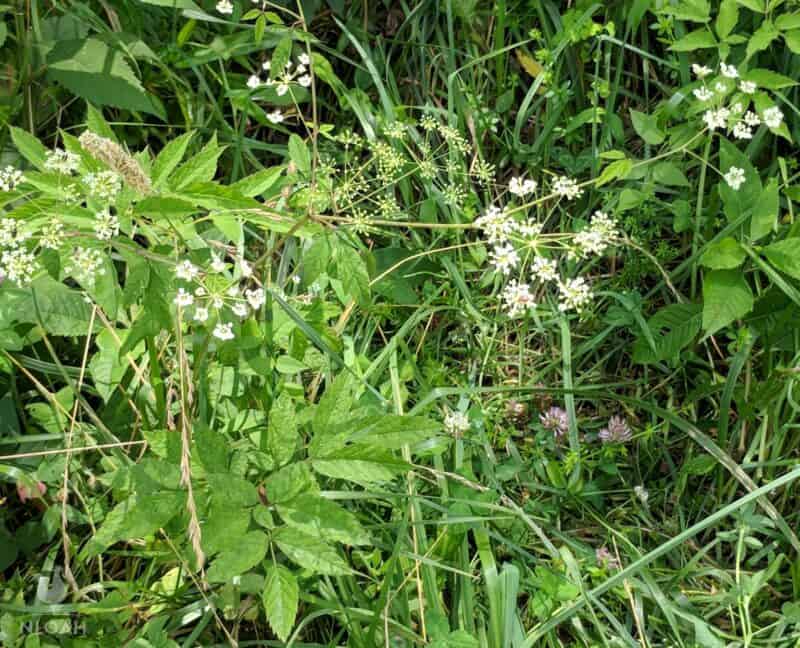
Stems
Now we’re getting to identifying characteristics that you can bank on. At first glance, the stems of both look highly similar. Close inspection will reveal several distinguishing characteristics that you can’t get wrong.
Queen Anne’s Lace has distinctive, vertical ribs and is profoundly hairy. This is what has given rise to one of the most popular mnemonics for telling these two plants apart: Queen Anne has hairy legs! A bit gross, but it works like a charm!
The stems of the wild carrot are also solid, meaning they don’t have a hollow cavity inside.
Poison Hemlock, on the other hand, has a smooth stem, considerably thicker, and has distinctive, sickly-looking purple blotches and speckles all over it.
Hemlock stems are also hollow, meaning if you see a broken one or can break one safely, you’ll be able to tell for sure which is which.
Leaves
Closely examining the leaves of both plants can be a good way of telling both plant species apart when they aren’t in bloom, but you need to be cautious since getting this close to Poison Hemlock could make you sick.
Queen Anne’s Lace has pale, grayish-green foliage and a distinct, fern-like appearance. Leaves have three lobes and are hairy, though not as hairy as the stem itself.
The leaves of Queen Anne’s Lace tend to grow close to the ground near the base and each stem will only have a few leaves on it. Also, keep in mind what a carrot top looks like: Queen Anne’s Lace, being a wild carrot, looks quite similar!
Poison Hemlock leaves are invariably a much darker green, growing in an alternating pattern, have no hairs whatsoever, and overall have a triangular or spearhead shape.
Leaves growing near the upper regions of the plant tend not to be as large as those growing near the bottom. Each leaf is also deeply divided.
Another general rule of thumb is that Poison Hemlock will show more leaves and denser vegetation overall compared to Queen Anne’s Lace, especially when mature.
Flowers
This is one of the most chronic, sometimes tragic, points of confusion between our two plants here. That’s because both Queen Anne’s Lace and Poison Hemlock display tight clusters of tiny white flowers. Both are pretty and appealing!
Both grow in dome-like or umbrella-shaped arrangements called umbels. So how can we tell them apart?
Look closely at the growth habit of the flowers. Queen Anne’s Lace flowers all grow in a singular tight cluster that looks like an upside-down hemisphere or an umbrella that’s been turned inside out.
Sometimes, you’ll see a single maroon or purple flower in the middle of this cluster on Queen Anne’s Lace, but this is not a sure thing so don’t count on it.
If you look at Poison Hemlock flowers, you’ll notice they grow in smaller individual units, not a single tight cluster. Note, though, that telling these two apart, especially if the hemlock plant is young, can be really challenging. Always look at the stem as detailed previously to be sure!
Also, once the flowers die and dry out, they will remain on the plant, but the flowers of wild carrot have a curious habit of curling up and closing tightly into a clump or ball that looks a lot like a bird’s nest or tumbleweed. Poison Hemlock won’t display this trait at all…
Bracts
More helpful than the growth habit of the flowers is the presence, or lack thereof, of bracts. These structures are the leaf-like strands that grow immediately beneath the flowers on Queen Anne’s Lace, radiating out from the individual stems.
Poison Hemlock lacks these structures entirely, so a good, close look at the clusters of flowers can tell the tale—just don’t look at the flowers themselves!
Odor
When in doubt, follow your nose but be careful about putting this method of identification to the test! Inhaling the toxin of Poison Hemlock if the plant is cut or crushed can cause injury or even significant poisoning.
Nonetheless, if you are downwind of either plant or want to cautiously waft some of their fragrance towards you, you’ll notice that Queen Anne’s Lace has a fresh, grassy, carrot-like smell. No surprise there!
Poison Hemlock, suffice it to say, does not: it has an off-putting, unsettling sickly odor that has been described as musty, moldy, or even like a funeral home. A good reminder, because that’s where you’ll be headed if you handle this plant carelessly!


Get your gift and learn things like:
- how to make this really quick pest spray
- how to prevent egg waste
- two cheap automation devices that will make your life easier
Tom has lived and worked on farms and homesteads from the Carolinas to Kentucky and beyond. He is passionate about helping people prepare for tough times by embracing lifestyles of self-sufficiency.