
For many homesteaders, free-ranging their animals is an increasingly attractive option. Most animals tend to be happier, healthier, and produce superior products when left to roam free, be that eggs, meat, or milk. But free-ranging requires considerable space in the form of a pasture, and cohabitating with different animals can make for additional challenges.
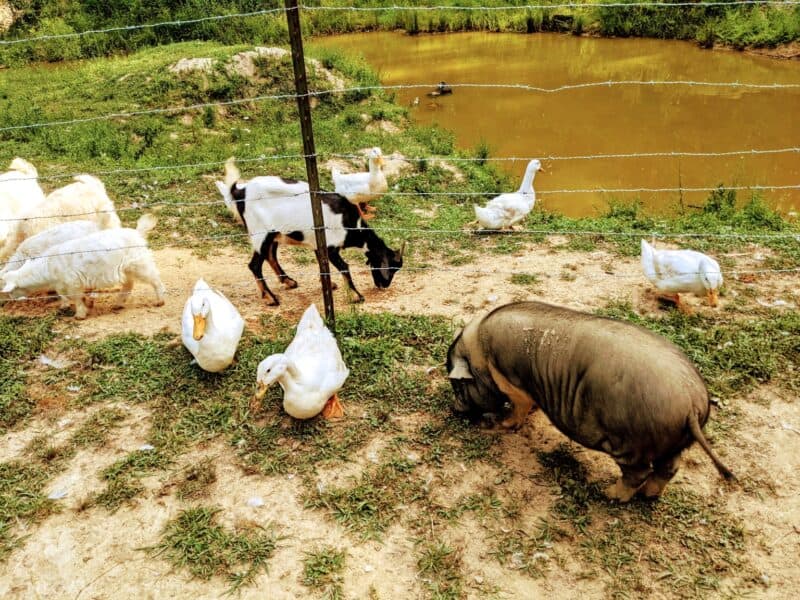
Take, for instance, goats and pigs. On the surface, these critters could not be more different, and there is plenty of truth to that assessment. Despite this, it is possible to free-range pigs and goats together as long as you take care of some special accommodations and the unique needs of both species.
I’ll give you some tips for free-ranging goats and pigs together in what follows…
Think Twice Before Free-Ranging Goats and Pigs Together
I know most people don’t want to hear it, but if you have any other option, you really should think twice before putting your pigs and goats together on the same pasture.
There are few benefits, many drawbacks, and the potential for some heinously bad outcomes. It doesn’t mean you can’t do it, or that you shouldn’t under your special circumstances, but if you have another option, I would encourage you to take it.
Pigs and goats are very different, and even if they’re both friendly with you and easy to handle, that doesn’t mean they’re going to get along with each other, even if they grew up together.
They are omnivores and that means they eat meat, including live prey from time to time. Goats are strict herbivores, and are naturally wary of anything that could be predacious.
Considering also that the body language and threat displays of both species are entirely different, one, the other, or both could be clueless about the emotional state or intentions of the other, and that can lead to disaster.
I’ll talk more about that in the following sections, but assuming you have your mind made up to house your goats and pigs together, keep reading.
Extra Space is a Must
If you plan on keeping goats and pigs together, you must allocate extra space for them. Preferably a lot more space! At all times, both species should be able to keep well away from each other. Having a buffer zone will make both animals more comfortable as a rule.
This doesn’t mean they won’t get close to each other and can do so amicably, and you’ll always see individual animals that are adventurous or get attached to their counterparts for whatever reason.
That’s just fine, and not necessarily anything to worry about, but I can guarantee you that you’ll have problems fast, and big ones at that, if you force your goats and pigs to stay too close to each other.
You can count on each adult pig needing about 1,700 square feet of space for free-ranging, and generally, you can keep about three adult goats on a decent acre. For cohabitation, I would calculate the net land needed for all heads and then increase it again by at least half.
Take Care During Feeding Time
Goats and pigs can eat some of the same foods, even though the way they eat is very different. Goats are browsers and eat lots of twigs, branches, bark, leaves, and other kinds of vegetation.
As omnivores, hogs will eat a wide variety of plant and animal matter, including some of the things goats eat. Pigs are also notorious for rooting through the ground to eat roots and shoots.
Chances are you’ll still have to supplement their diet when you allow them to free-range, and during feeding time, you must take care that goats are not able to access any specialty pig feed that has ingredients they can’t digest and potentially medications that can poison them.
Likewise, feeding time is also a likely occasion that can cause conflict and that can lead to injuries. Goats and pigs might not appreciate the other eating at the same feeder, trough, or even in the immediate area.
Keeping the two separated is trickier than you think even if you have separate feeders and feeding areas. Pigs and goats alike are highly motivated by food, and though goats tend to be wary of pigs, hogs usually show far fewer reservations about barging in on the goats.
Various Parasites and Diseases Can Affect Both Species
A major concern about housing goats and pigs together, or any other animals, is the possibility of interspecies disease and parasites.
The obvious ones are external parasites like fleas, ticks, mites, and lice. If the animals can come into contact with each other, or even move into each other’s spaces, infestation is all but certain.
Hogs also tend to suffer higher rates of infection from pathogenic E. coli which can then be spread to other animals and people.
Other nasty diseases that can infect both are tuberculosis, brucellosis, toxoplasmosis, salmonella, leptospirosis, and, most worryingly, pseudorabies.
Pseudorabies and leptospirosis can easily cause death in goats, and the former is asymptomatic in pigs. That means they can wipe out your goat herd once they contract it, and you won’t know until it is too late.
Staying on top of treatment, medications, hygiene, and instituting high standards of cleanliness will certainly help, but only go so far in managing cross-species sickness…
Never Let Pigs Be Around Kids or Lactating Does
I alluded to this earlier and now I’ll say only this: never, and I do mean never, let your pigs be around any kids or lactating does.
Pigs, as far as I can tell based on their behavior, are invariably drawn to the scent of lactating does, birth, and the kids themselves, and they will eat kids with very little provocation. This is gruesome beyond imagination and seriously traumatizing if your family should witness or hear it.
When does are pregnant or when you have baby goats in the herd, they must be removed and securely contained so that pigs cannot get to them, ever. Ignore this advice at your own peril.
Goats Can Hurt Pigs, Too
Now, considering pigs are the carnivorous ones and goats are prey animals, it seems like the antagonistic relationship could only ever end one way, with violence being done to the goats. But believe it or not, goats can put up a fight and sometimes put up a hell of a fight.
Larger goats with sturdy horns, and particularly billy goats, can inflict severe injuries on pigs in kind, including broken bones, internal injuries, and even goring them if their horns are sharp.
I had a neighbor once who kept a mixed herd of pigs with a billy goat so the billy goat could have company while separated from the female goats and kids… Things started out okay, even though the billy goat seemed very wary of the pigs and it kept his distance. In time, things seemed to calm down.
Then, one day, a fight broke out for whatever reason, and the billy goat ended up giving one of the pigs, a larger one, the business, inflicting severe and deep puncture wounds into the side. One thing led to another and that poor pig needed to be put down in the end.
Don’t write off any aggression or defensive action on the part of your goats just because pigs are stereotypically the aggressors or bigger and stronger.
Pick Cohabitate Breeds Known for Friendliness and Docility
Lastly, if you are still intent on keeping goats and pigs together, you can improve the chances of good outcomes, and minimize bad ones, by only housing breeds of both species that are known to be patient and friendly.
Among pigs, Berkshire, British Lops, and Large Whites have a reputation for being gentle and friendly, even with other animals. Among goats, Alpines, Nubians, and Boers are friendly, easygoing, and large enough to not be particularly attractive to pigs when they mature.
This is a good guideline to follow, but I must warn you that it’s not a guarantee, so you must still do what you can as detailed elsewhere on this list to make sure everybody gets along and stays calm.

Get your gift and learn things like:
- how to make this really quick pest spray
- how to prevent egg waste
- two cheap automation devices that will make your life easier
Tom has lived and worked on farms and homesteads from the Carolinas to Kentucky and beyond. He is passionate about helping people prepare for tough times by embracing lifestyles of self-sufficiency.