
If all you’ve ever done is buy honey off of the grocery store shelf, you might not have a true appreciation for what it takes to get that delicious, golden stuff in that little bear-shaped bottle. Of course you know that bees make honey, but if you don’t know a lot about the day in the life of your average bee you are missing out on their incredible, but tiny, lives.
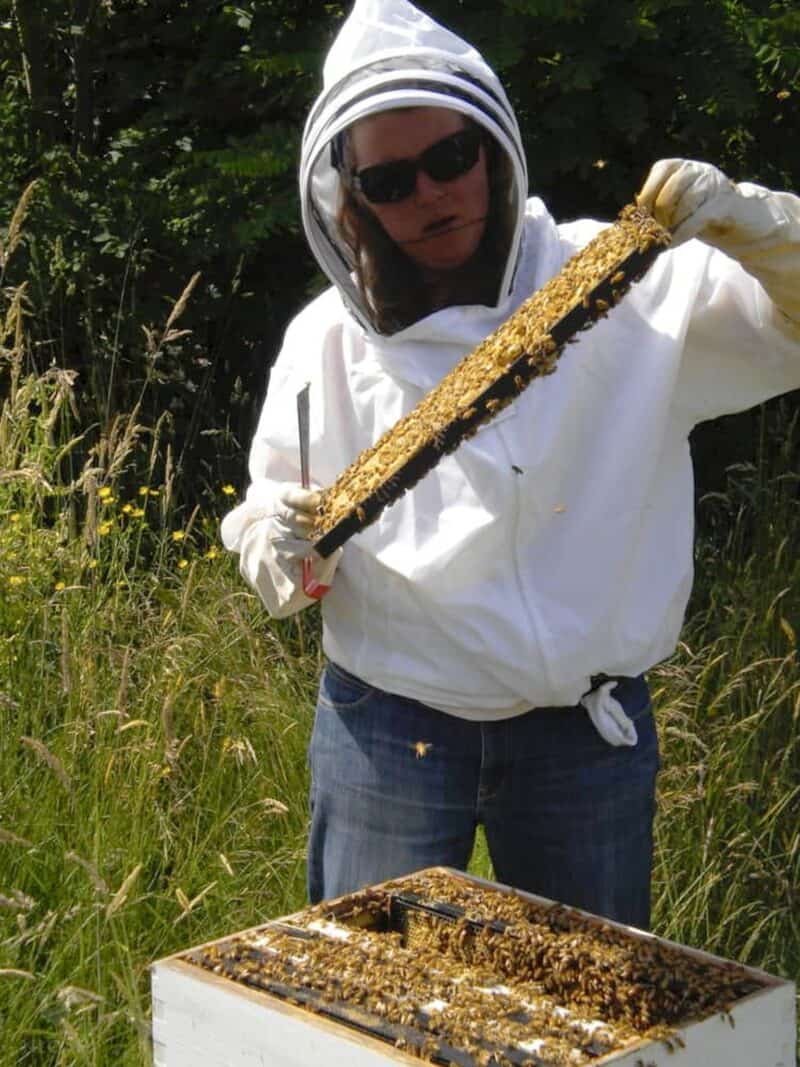
To help shed some light on the life of a bee I’m bringing you 28 amazing, fascinating, and sometimes downright unbelievable facts about them.
Queen Bees Might Lay Up to 3,000 Eggs Per Day
Queen bees are responsible for laying all of the eggs in the hive that will hatch into the future generations of bees. Depending on the weather, the season, the health of the hive, and her age, a queen bee might lay up to 3,000 eggs each and every day.
Even when times are slower, she will rarely lay less than 1,000 per day! And you might have thought you’ve got a big family…
Bees Might Fly 5 Miles from Their Hive Looking for Food
Although most bees will only ever fly about a mile or so at most from their home, it is possible that bees can fly up to 5 miles away, one way, to find food and other resources for the hive.
That means an individual bee might have to make a 10-mile round trip day in and day out to find nectar, pollen or water. That is quite the commute for such a little creature.
A Bee Uses the Sun to Navigate
So considering how far away bees can fly, how in the world do they find their way home? Bees navigate using a combination of visual landmark recognition and also the position of the sun.
Yes, these use the sun very much like an all-natural GPS, and by clocking its position as they travel, they can maintain a general bearing as they go to and from the hive.
Considering that bees have surprisingly good vision and can recognize landmarks, they rarely get lost. Or at least, they rarely get lost in the daytime!
Bees Can Fly in Any Direction
Everybody knows that bees are fast and nimble flyers, but what you might not know is that a bee can fly in any direction. These can hover, they can fly forward and backward, jink side to side, fly up and down, and at any angle.
Although you’ll rarely have time to appreciate it because they are so fast, bees really are amazingly acrobatic, beaten in the insect world only by dragonflies, wasps, and the like.
Bees Have Four Wings
Upon a casual glance, it looks like bees have two large wings, but they actually have four wings.
They have two larger wings in the front and two smaller ones behind, but the trick is that the smaller ones actually click into the larger ones to make a larger surface for flight.
Once a bee lands, the smaller wings unclip and all the wings fold up pointing directly to the rear to save space and allow a bee to squeeze into a narrow opening and to prevent damage.
Bees Actually Sleep
Bees sleep very much like you and I do, Most types of bees aren’t active at night, and they like to return to the hive and stay inside when the sun goes down.
While resting, they enter a low activity mode where they recuperate but, sometimes they are forced to take shorter, intermittent naps during the day.
Naturally, bees are always passively alert even when in this resting state, and can spring into action at once when called upon or when it’s time to get back to work.
Most Honeybees Have Top Speeds of 32 mpH!
Turns out the humble honey bee is pretty sporty when it wants to be! A honey bee can fly flat-out at 20mph for a surprisingly long distance, and that means there is little chance of getting away from them when they are ticked off at you. Interesting stuff, and also practical knowledge!
I’ve put together a quick table with the top speeds of most types of bees:
| Bee Species | Top Speed (mph) | Top Speed (kmh) |
|---|---|---|
| Sweat Bee, Mason Bee, Leafcutter Bee, Mining Bee, Digger Bee, Blue Orchard Bee, Long-Horned Bee | 15 mph | 24 kmh |
| Killer Bee | 21 mph | 34 kmh |
Bumblebees bees are a bit slower than their honey bee cousins… They tend to fly at a more relaxed pace generally and have a lower top speed of around 13 to 15mph. This is partly due to their larger size and partly because they don’t travel as far to forage for food. Still, you likely aren’t outrunning one!
Then we have carpenter bees, another chunky bee known for their glossy black, robust bodies and tendency to drill holes in wood. Carpenter or “wood” bees are surprisingly fast flyers: They can reach similar speeds to honey bees topping out around 20mph, despite their larger size.
Finally, we have sweat bees. These tiny, colorful bees are likewise quite quick, though not much faster than honey bees. A sweat bee can cruise at around 18mph and has a top speed of around 22mph.
Now, killer bees, also known as Africanized honey bees are faster than regular honey bees but only nominally faster, by 1 or 2 mph at most.
This is primarily due to their slightly smaller and lighter body, which allows them to fly just a tiny bit quicker than their slightly larger and way less murderous cousins.
But know this: what truly sets killer bees apart isn’t just their top speed, but their incredibly aggressive behavior.
These girls react much, much faster to intrusion than regular honey bees. Their defensive response is immediate and intense, with larger numbers of bees rushing out to defend their home with a vengeance from the slightest disturbance.
And what’s more, killer bees are known for pursuing interlopers for far longer distances, much further than regular honey bees would.
Keep in Mind Weather and Wind Make a Difference, Too
Bees also face flight challenges due to wind and weather. In fact, these two factors can significantly affect their flight speed.
Think about what happens when you’re walking against the wind. It’s significantly harder, right? The same goes for bees.
When they’re flying into a headwind, they’ll be slowed; they have to work extra hard to push against the wind, which can be quite a workout for their tiny wings. Most of the time, a bee will drop down and try to use obstacles to help it cut through a strong headwind.
On the other hand, when the wind is at their back, or what pilots call a tailwind, bees get a boost which they use to cover more ground and get more done.
And the temperature plays a role too. When the weather gets chilly, bees slow way down. In fact, if the temperature drops below 55 degrees Fahrenheit (12 Celsius) or so, they can’t fly at all!
A Honey Bee Hive Has Tens of Thousands of Bees
Have you ever wondered how many bees are in a typical honey bee hive?
I can tell you right now that when a hive is mature it is a whole lot of bees! An average beehive contains anywhere from 10,000 to as many as 80,000 bees!
The usual range for well-established hives, though, is between 10,000 and 20,000. The size of a beehive is limited only by the availability of resources in a nearby area and the hive’s “instinct” to swarm and start a new colony.
Most Worker Bees Only Live Six to Eight Weeks
Bees, sadly, just don’t live that long. Worker bees which make up the vast majority in the hive will only live around six weeks, or eight weeks at the very most depending on the species and the conditions.
Bees that work harder and work more often won’t live as long, whereas bees that don’t have to work as hard or live in ideal conditions will live a little bit longer.
It Takes Only a Little More than 1,000 Bee Stings to Kill a Person
Everybody knows that bee stings hurt, but did you know it takes around a thousand bee stings to kill a person?
It depends on sensitivity to the venom, body weight and other co-morbidities, but don’t breathe a sigh of relief unless you know you’re only dealing with a couple of bees…
If you manage to tick off an entire hive, you could be covered from head to toe and stings before you could get away!
And don’t forget that people who are sensitive to bee venom could die from only a single sting…
Bees Have Sticky Hair
That fine hair you see covering bees is actually sticky, and not just because they’ve been swimming and honey.
This sticky hair is obviously useful for collecting pollen, of course, but it has many other purposes too, including keeping the bee and its neighbors warm and even helping a bee to navigate by judging wind direction. Truly, there is no part of a bee that isn’t multi-purpose…
Bees Are Critical Pollinators
It’s all but certain that you already knew bees are crucial pollinators, and have been pretty much forever. But did you know to what extent?
It is thought that bees presently pollinate over a third of the plants and crops that humanity harvests for food or for various other goods…
That means if the bees were wiped out the economic consequences will be nothing short of apocalyptic. We depend on bees more than we’ll ever know!
A Single Worker Bee Produces Only ½ Tsp. of Honey
If you’re anything like me, you go through honey by the barrel full and don’t think twice about it.
But the next time you are sitting down to put a drizzle on your toaster in your oatmeal, spare a thought for the bees that made it: a single, diligent worker bee in ideal conditions will only produce a half teaspoon of honey in its entire life.
Countless trips to and from flowers, ceaseless work and hundreds of miles covered and that’s all she can make…
Bees Like Caffeine
Bees, shockingly, or just like people and that they like a little pick-me-up from time to time. I’m talking about caffeine.
Yes, bees like caffeine. In fact, for plants that produce caffeine and other stimulants naturally in their nectar bees tend to prioritize them over other sources.
Even more hilariously, beehives that imbibe of this stimulating nectar or even more industrious and productive than hives that don’t! I hate to think of what would happen to someone who was too near a beehive that was in caffeine withdrawal…
Each Bee Has Five Eyes
How many eyes does a bee have? Two compound eyes right? Wrong! Bees actually have five eyes, two large compound eyes that you can easily see, and three tiny ones that are on top of their head or face.
Both sets of eyes work together for visual recognition, detection of light and sunlight in particular, and also the detection of UV frequencies that we can’t see.
… They also Have Knees!
Yes, bees do have knees. A bee has a single true knee joint on each of its six legs, located between the femur and tibia, which are the third and fourth segments of a bee’s leg respectively.
Watching a bee that is in a hurry run around on the ground is quite literally a blur of little limbs in motion.
This is because a bee’s leg is composed of six distinct segments: the coxa, trochanter, femur, tibia, metatarsus and tarsus. The coxa is the first segment that connects the bee’s leg to its body and is very small. There’s a limited joint between it and the trochanter which is another tiny segment that is fixed at an angle and doubles the leg back on itself.
The third segment, the femur is one of the larger and thicker segments and the bee’s knee, proper, is located between it and the next segment which is the tibia which also happens to be where the bee’s pollen basket hairs are located.
Pass the tibia we move into the metatarsus, with another hinged joint between the two and then finally into the fine, delicately segmented portions of the tarsus, the bee’s foot.
If you look at how the leg is shaped and how it bends, it’s tempting to call each of these joints between the major segments above the tarsus a knee joint, but that’s not strictly correct.
It should be pointed out that even though there are several anatomical terms that we recognize from human anatomy applied to the anatomy of a bee’s leg, including its knee joint, the structures and function of a bee’s leg don’t quite map precisely to our own.
This is to say that even though something that looks like a knee, and functions like a knee, could be called a knee and layman’s terms this is doing a disservice to the actual biology of the bee.
For instance, past the tibia moving down to the metatarsus you would not call that joint a knee so much as you would the bee’s ankle. Likewise the flexible, tiny segments of the tarsus are more comparable to the bee’s toes though to us it would appear to be more like the whole of the foot itself with the tarsal claws acting as toes.
What Does the “Bee’s Knees” Mean Anyway?
The idiom we know today, the “bee’s knees,” refers to something that’s very good, excellent or enjoyable. But it wasn’t always so.
Way, way back, the “bee’s knees” wasn’t a plural, but instead a singular: the bee’s knee. This was used as an expression to refer to something that was incredibly tiny or delicate. From there, the expression morphed somewhat into a prank of sorts.
If someone was sent to retrieve the bee’s knees, it was a wild goose chase, a snipe hunt: they were looking for something that didn’t exist! Sort of like how malevolent fellow employees in many automotive or industrial trades and the military send hapless joiners looking for a can of headlight fluid…
But, in time as most things do, the meaning slowly morphed into the one we all know and abuse today, so here in the 2020’s it is definitely considered quaint, even cliché.
Beehives Heat Themselves to Survive the Winter
Many insects die in the winter time, and that includes many bees, but honey bee hives actually overwinter with at least a portion of the worker bees surviving along with the queen.
They do this by being built with an eye toward insulation and also because the worker bees get together, create a sphere around the queen and then vibrate their wings to generate heat, raising the internal temperature of the hive by as much as 50°F (10°C)!
That means that in a mild winter, the inside of a beehive could be downright balmy.
Only Female Bees Can Sting
Did you know that not all these can sting? It’s true, only the girls can sting. That means the workers and the queen herself.
The males, called drones, cannot sting at all. They literally don’t have a stinger, so even if they wanted to put it to you they are completely harmless and helpless.
However, you won’t be able to tell a drone from a worker at a glance, so it’s in your best interest to assume that every bee you can see can sting.
A Worker Bee Dies After She Stings
Speaking of stings, you might have already known that a honey bee will die after it stings you. This is because a honey bee has a barbed stinger that will lodge in the skin very much like a fish hook.
When that happens, the venom sack will tear out and stay behind to continue pumping venom into the victim…
Sadly, this mortally wounds the bee and she will die shortly thereafter. That means that anytime a worker bee is going to sting in defense of herself or her hive, it has got to be for a good cause.
Queen Bees Can Sting Multiple Times
I mentioned above that only the female bees can sting, but when it comes to the queen bee she is unique. Her stinger is smooth and thin like a stiletto, and that allows her to sting multiple times.
Yes, she can sting in defense, but she actually uses her stinger first in life to dispatch her rival, sister queens that are born alongside her. Gruesome, and pretty terrible, but that’s life in the hive for you! There can be only one…
Worker Bees Decide When the Queen is Ready to Be Replaced
Most folks who don’t know a lot about bees think of the queen as running the show all by herself. But this isn’t really true…
The queen is critically important and essential to the survival of the hive, but she only rules by consent of the governed.
If the queen starts to slow down when it comes to laying eggs, gets sick or injured, the workers will decide to replace her by raising a new queen. The old queen is summarily dispatched by the workers. There can be only one, just like I said!
Honey is Survival Food for Bees
Why do bees make honey in the first place? It’s not just because they love people and want to give us a delicious, one-of-a-kind gift. No, bees make honey for themselves as a survival food.
Bees rely on honey as food during the winter, and without it, they can’t create enough energy to keep flapping those wings in order to raise the temperature of the hive as described above.
This is why it is so essential that beekeepers only take a little bit of honey from them so it’ll be able to get through the winter- most healthy beehives make more than enough!
Queen’s Mate Once and Keep Sperm on Hand for Life
When a young queen is born, once she has matured enough she will leave the hive on a mating flight, accompanied by several drones.
Once the drones mate with the queen, she will store their sperm inside her body to be used at her discretion when laying eggs. A queen doesn’t have to mate repeatedly in order to stay fertile!
A Queen Decides to Fertilize an Egg When She Lays It
So, when a queen lays an egg the size of the cell that the workers have prepared tells her whether she needs to lay a worker egg or a drone egg.
Drone eggs are unfertilized, but worker eggs must be fertilized, and when the queen goes to lay a worker egg she voluntarily fertilizes it from her little stash of sperm taken during her mating flight. In this way, a queen can always decide, in a sense, whether she’s going to lay a boy or a girl egg.
Queens Live for a Couple of Years
I mentioned up above that most bees, honey bees anyway, only live between six and eight weeks. The queen bee actually lives way, way longer than this, about two years on average, and some queens can live four years or more.
Bees Can Recognize People
Believe it or not, bees can actually recognize human beings! This is why many beekeepers have an easy time with their bees while the same bees might get a little upset at the presence of a stranger!
Suffice to say, if you mess with a beehive and come back later, you probably won’t get a warm welcome.
Bee Colonies Can Separate to Form New Colonies
When a bee colony gets too big, the workers decide to swarm. For the swarming process, a new queen will be raised to replace the existing queen and they existing queen will leave with a large contingent of workers to start a new hive somewhere else.
If you’ve ever seen a giant ball of bees resting on a branch or anywhere else out in the world that’s what they were doing!
Bees Build in Hexagons Because They’re Most Efficient
That iconic hexagon shape of a honeycomb is absolutely inseparable from bees. But have you ever wondered why they build in hexagons?
It’s actually a matter of simple geometry that bees have somehow figured out: a hexagon provides the most volume for the least material, and it is a shape that will tile, or tessellate, infinitely with no wasted space between.
This is because beeswax is very expensive to make in terms of resources, so they have to make the most of it!
Bees Have to Learn to Make Honey
Can you believe that bees don’t instinctively know how to make honey? Believe it, it’s true!
Newly born worker bees must be shown how to make honey by their older sisters. Makes me wonder if they’ve it written down somewhere just in case…
A Bee’s Brain Will Change Depending on Its Job
There are three kinds of bees in a hive: the queen, drones and workers. But among the workers they can have several different jobs like building combs, tidying up the hive, attending to the queen, caring for young, gathering resources or scouting.
Depending on the current job of a worker its brain chemistry will actually change to facilitate the task!


Get your gift and learn things like:
- how to make this really quick pest spray
- how to prevent egg waste
- two cheap automation devices that will make your life easier
Tom has lived and worked on farms and homesteads from the Carolinas to Kentucky and beyond. He is passionate about helping people prepare for tough times by embracing lifestyles of self-sufficiency.