
What you can and what you cannot feed your ducks is a topic that can elicit heated debates, as it often does when the same question is posed about any type of livestock.
Searching online for answers to safe duck treats vs. toxic duck treats can be quite a frustrating endeavor. One website will have the same item on a safe or in limited amounts column as another will have in the toxic never feed category.
The duck food information and lists you will find in this New Life On A Homestead article were compiled from primarily my own many years of duck husbandry experience, tips from other homesteaders who have also kept ducks for a long time, chats with our livestock vet, and from a bit of cross-referenced online research.
(And, at the end of the article, you’ll get a chance to save these lists on your computer in PDF format.)
Duck Eating Habits
Ducks, like chickens, are omnivorous poultry birds. They are avid browsers and foragers and tend to chomp their cute little beaks onto anything that intrigues them.
On average, ducks consume about seven ounces (approximately 200 grams), and two cups of food daily when mature.
If you are raising ducks for meat, the amount of food provided is usually increased. A higher protein and calcium diet can foster both better quality and quantity of eggs.
We free-range our ducks and chickens most days, so they have ample access to their natural diet.
On days when they are left inside their spacious run and during evening put up, they are given healthy treats.
Nature knows best, so I try to keep the daily feed rations and supplements as close to what the ducks would encounter in the wild as possible.
Typical Wild Duck Diet
When ducks are left to their own devices in the wild or when free ranging, these are the commonly available (and healthy) food sources they will be attracted to the most:
- Tadpoles and frogs
- Salamanders and various other small amphibians
- Wild berries
- Fish eggs and small fish
- Grass, weeds, and leaves
- Worms
- Snails
- Slugs
- Mollusks
- Crawdads and other small crustaceans
- Aquatic plants and their roots
- Algae
- Insects – both on land and in the water: hornworms and potato bugs tend to be their favorites.
- Nuts
- Wild fruit
Ducks also require some type of grit in their diet – gravel, sand, or crushed shells. The grit helps the birds to digest their food properly and also infuses trace amounts of calcium and other vital minerals into their diet.
Duck Treats as a Training Tool
Supplying extra healthy treats and proper feed helps ensure all of the ducks’ nutritional needs are being met.
A duck with a poor diet can suffer breeding failures, stunted growth, poor muscle development, and low feather growth and strength ratios.
I begin giving our ducks, chickens, and guineas a healthy treat at dusk when they are still itty bitty and living in a brooder as part of their training. The birds all learn to converge in or near their coop and run (or the brooder door) when the sun starts to go down.
Sure, an ornery bird will still sometimes make me give chase to get it to go inside its home in the evening, but that is a rarity.
All of the birds know if they are late for “beak and bill count” they will not be getting a treat that day.
What Ducks Can Eat
Chick Starter – This type of poultry bird manufactured ration is designed to be fed to chicks, ducklings, and keets – baby guineas. It can be purchased in either medicated or unmedicated form.
The young poultry birds eat this easily digestible and tiny crumble style of feed rich in proteins and essential nutrients. The little flock members should be on this type of feed for about one month.
Crumble Feed – Some folks believe that crumble can cause choking, but in my experience, pellet feed stands more of a chance of doing that – especially in ducks.
Developing poultry birds as well as their mature counterparts can eat this type of feed daily along with natural and healthy treat supplements.
Layer Pellets – While drakes and roosters (male poultry birds) can eat this type of feed, it is designed for both duck and chicken hens of laying age.
Mash – This soft granular type of feed is a mixture of crumble and scratch in texture. It includes ground up cracked corn, which ducks really love. Some members of my flock, both past and present, absolutely love mash feed – but others hate it terribly.
My current batch of ducklings and keets just transitioned to mash from chick starter and really like it, but my mature flock members would only eat it if they were starving.
Scratch – While scratch feed is most often fed to chickens, ducks will eat it too. Some keepers contend that ducks love scratch and pecking on the ground like chickens. This has not been my experience at all, but I do no doubt that some duck breeds could very well love it.
Duck Watering Tips
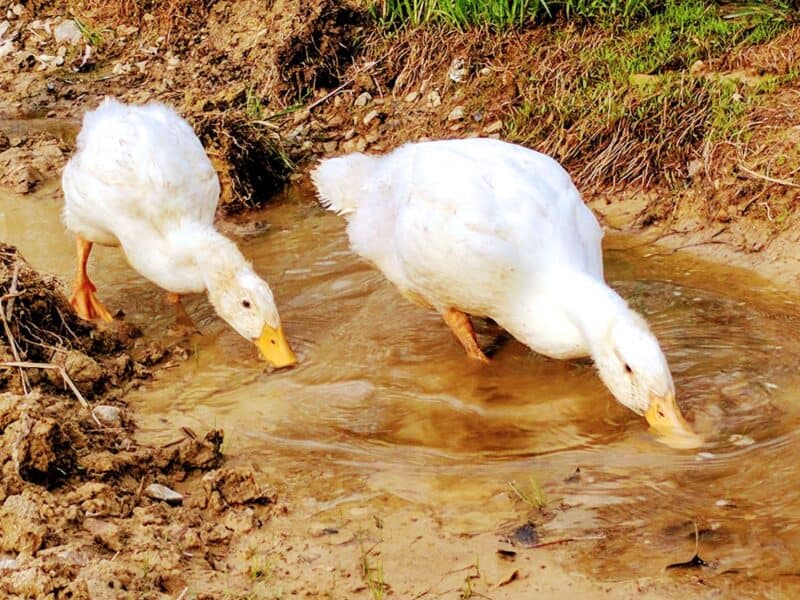
To help keep a steady supply of clean water in your duck hut and coop (I raise my ducks with my chickens and roosters) I recommend using a hanging waterer. Ducks are messy, and will get their feed, mud, and feces into a standing waterer.
Ducklings are voracious eaters. If they do not have enough water to wash down their feed it can get stuck in their crop and cause a potentially deadly infection – or outright choking.
Ducks drink a lot – I mean a whole lot, of water. The five ducklings we recently hatched are drinking about five gallons of water a day.
Those little Mason jar style waterers on display in the poultry section of agriculture stores when they host “chick days” twice each year work fine for chicks, but you would have to refill it hourly if using it with ducklings.
Natural and Free Range Snacks for Ducks
- Weeds and Herbs – When left to their own devices free-ranging, ducks will seek out dandelion, wheatgrass, parsley, rosemary, oregano, rosemary, calendula, and mint. If you do not permit your duck flock to free range, simply pick any of these items and place them into the run as a free-choice treat. The herbs all hold medicinal properties that help boost a bird’s immune system and thwart respiratory infections.
- Insects – A duck will eat any old bug, and it will be fine Flies, grasshoppers, locusts, you name it! As long as you provide a constant water source, ducks can be placed in a “chicken tractor” or growing area border run, and help keep bugs out of your garden. It is also quite fun to watch a flock of ducks jump with excitement and then run water hornworms, June bugs, and potato bugs.
- Worms – Mealworms, whether found in your yard or purchased from a store, are always a favorite treat for ducks. The flock will get extremely excited when it rains because worms will be moved closer to the surface, and make them far easier to snatch up with reckless abandon.
- Grass – When exposed to grass in their run or when free-ranging, ducks will seek out grasses and seed heads of all sorts.
- Tadpoles and Fish Eggs – Ducks will definitely keep the number of noisy bullfrogs down in your homestead pond. They love to eat tadpoles and fish eggs with any chance they get.
- Wild Berries – Unless you do not mind sharing the wild berries on your homestead with the duck flock, you had better keep them fenced in. Ducks are not picky, they will readily consume cultivated berry bushes as well, especially black raspberries.
- Sunflower Seeds – Any type of sunflower seeds will delight your flock of ducks, but black oil sunflower seeds tend to be their favorites.
Safe Treats For Ducks
These treats can be given in moderation on a daily basis. It is always best to give treats only after the flock has eaten their daily feed ration. Like kids, ducks will pick eating a treat over their regular meal every time.
Vegetables
- Broccoli
- Cucumbers
- Corn – cracked corn or cooked corn on the cob poses the fewest choking concerns.
- Popcorn
- Cooked beans
- Kale
- Lettuce – romaine lettuce is the most nutritious. Iceberg lettuce holds no nutrients for the ducks and should not be given with regularity. Some keepers recommend never giving iceberg lettuce, but it doesn’t harm the ducks, is easy to grow and cheap to buy – making it a great training aid in my book. Some duck keepers have witnessed scours (diarrhea) from ducks and chickens after they eat iceberg lettuce.
- Pumpkin – chopped
Apples (sliced, no seeds or cores)
Apples are a good and nutritious food for ducks as long as they get it in moderation. It is definitely not something they need in their diet all the time or in great abundance because they can cause problems.
In apples we’ll find a fair amount of both, including calcium, iron, magnesium, while vitamins include several of the B-complex ones like riboflavin, pantothenic acid and niacin, vitamin A, vitamin E, and vitamin K with others besides.
Ducks can have two small servings of apples per week as a supplement or treat, maybe three at the absolute most if they are a larger breed.
Peas (Cooked)
Yes, ducks can eat peas safely as a supplemental item in their diet. Peas are an excellent source of vegetarian protein and have tons of vitamins and minerals that they need. Ducks should only get cooked peas for digestibility, though…
Looking at the macronutrients first, we see that they are a remarkably good source of vegetarian protein and have only a little bit of fat and plenty of carbohydrates for energy. Even more remarkably, the carbohydrates are split almost evenly between dietary fiber, starch, and sugar, meaning they are well-balanced.
And there’s better news when you assess the vitamins present in peas. You’ll see that they are an excellent source of thiamine, vitamin C, and vitamin K and still a respectably good source of vitamin A, beta carotene, riboflavin, niacin, vitamin B6, folate, and vitamin E.
Peas have a bad reputation for getting caught in their throats and crops if they eat a quantity without water to wash them down. In all cases, cooked peas must be prepared plain with no added ingredients that could be bad for your birds: oil, butter, salt, sugar, etc. are all no-gos.
Asparagus
Ducks can have asparagus safely. It has plenty of vitamins and minerals that can help them, but it tends to be tough, woody, and prone to causing choking.
Chopping up asparagus stems into small bites that are easy to swallow or lightly cooking them to make them softer is a good idea. Many ducks won’t attempt to tear off chunks of the stem if it is left intact- they are just too tough.
Looking at the vitamins first, we see that it has some vitamin A and beta carotene, most of the B complex vitamins in the form of thiamine, riboflavin, niacin, pantothenic acid, folate and vitamin B6, vitamins C, E, and K, and a little bit of choline.
It gets even more impressive when you look at the minerals, as asparagus has a ton of iron and a good amount of manganese and phosphorus backed up by a little calcium, magnesium, potassium and zinc.
It also has just a little bit of naturally occurring sodium, though this is nothing to worry over unless ducks are already getting entirely too much elsewhere in their diet.
Speaking of which, ducks can have asparagus twice a week, maybe three for a larger breed, in small quantities. It should never be the majority part of their diet.
Cauliflower
Cauliflower is a surprising but inspired meal option for ducks: It’s packed with good vitamins and minerals, and is pretty easy for ducks to digest… But they can’t just take a bite out of it as is; you’ll have to spend a little bit of time preparing it, and it isn’t something that they should get all the time regardless.
Looking at the vitamin lineup, we see that cauliflower is a good source of vitamin C, vitamin K, folate, vitamin B6, and pantothenic acid with significantly lesser amounts of thiamine, riboflavin, niacin and vitamin E.
The mineral content, as mentioned, is not quite as good as the vitamins but it’s also a bit more consistent, with roughly equal amounts of magnesium, manganese, phosphorus potassium, and zinc, followed up by a little bit of calcium and iron and a tad bit of naturally occurring sodium.
Fruits
- Grapes – chopped
- Watermelon
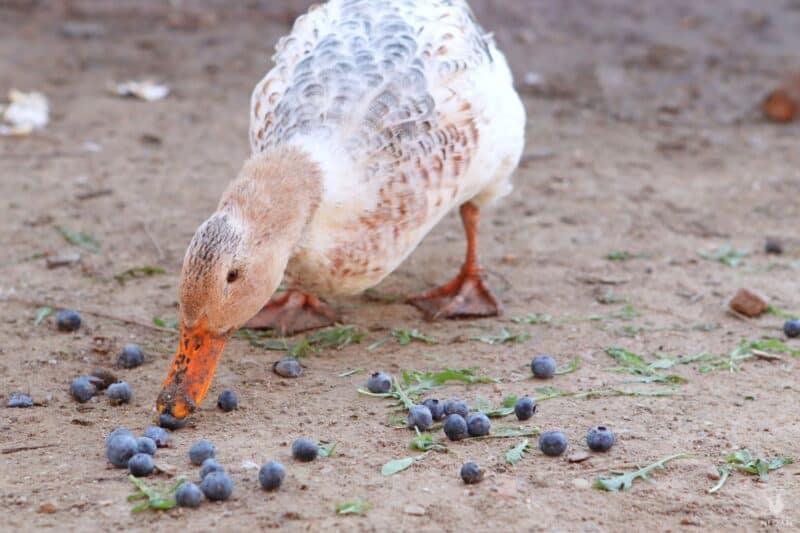
- Berries – raspberry, black raspberry, strawberries, and blueberries are recommended.
- Cantaloupe
- Bananas
Bell Peppers
Ducks may eat bell peppers safely and get good nutrition from them. They have tons of vitamins and a few minerals that will benefit them, but ducks should not eat any other parts of the pepper plant because they are toxic.
Bell peppers can be a great choice for your flock with just a little bit of preparation, but you’ve got to be cautious to avoid giving them any other part of the plant due to the presence of toxic solanine.
For serving bells or any other kind of pepper to your flock, make it a point to cut off the stem and discard it, then wash and scrub the peppers thoroughly to remove any pesticides or other residues.
I also recommend you pop off the top and remove the seed cluster in the middle, though you don’t have to go to the trouble of getting every last little seed off of the flesh.
Cut the pepper up into strips and then chop it into small bits that are appropriately sized for your birds. Don’t forget that your ducks will benefit from having water nearby when eating, even something that is as juicy as peppers.
Are Bell Peppers Safe for Ducklings to Eat?
Yes, so long as they are old enough and they only get very small quantities as an occasional treat. They can be a good snack or treat for ducklings old enough to start getting more real food in their diet besides their starter feed.
Just be very careful to avoid giving them too much and as always keep an eye on them to observe for negative side effects. If you notice that they have loose stools, lose their appetite or, worse, get diarrhea, discontinue the peppers at once.
Can Ducks Eat Bell Pepper Seeds?
Yes, bell pepper seeds are edible by ducks and digestible. However, there is a non-zero chance that they can cause crop impaction problems if they eat too many, so I recommend popping that core out of the peppers when you prepare them and just discard the seeds for safety.
Can Ducks Eat a Bell Pepper Stem?
No. The stem of a bell pepper, while edible if chopped up, contains solanine and must be discarded. Don’t feed the stem, or any other part of the pepper plant to your ducks. More on that in just a minute…
Blackberries
Blackberries are surprisingly nutritious, and are a good source of quickly accessible energy for ducks with plenty of carbs that are split almost evenly between fructose and dietary fiber.
Nonetheless, they still have a bit too much sugar to be good for ducks on a regular basis, so keep that in mind. Be sure to feed them to them raw, not cooked…
Also, don’t make it a point to give them dried blackberries. That’s because dried blackberries, by weight, contain a heck of a lot more sugar compared to whole, fresh ones.
With the water content gone, the sugar content is concentrated, meaning ducks have a lot more room for them compared to fresh ones…
Peaches
Ducks can eat peaches safely but should only have them as a sweet treat occasionally. Peaches are reasonably nutritious, but just too sweet and juicy for ducks to get regularly.
Peaches are wholesome, for sure, but just too sweet. Sweet foods, and especially sweet, moist foods, have a tendency to cause digestive upset for our birds.
And as expected, peaches, being so incredibly juicy, are mostly water with the average one being at least 88% water by weight.
Combined with the vitamins and calories they provide, this makes them a hydrating treat that’s just perfect for helping ducks beat heat stress and maintain a good electrolyte balance.
Wash any peaches you plan on serving to your flock. After that, split them open, remove the pit, and throw it away. Consider peeling them to make sure no large bits of skin are present during feeding.
With that done, you can dice the peaches up into small bits that are easier for your birds to handle and swallow. From there you can mix those bits in with other food to make it a little bit more appetizing, or just serve them as is.
Don’t forget even though peaches are quite juicy your ducks should still have constant access to water when eating so they can swallow more readily.
Pears
Ducks can eat pears safely and can derive some good nutrients from them, but they are very sweet so they aren’t something that they should get all the time. You should also remove the seeds because they can be toxic in high quantities.
Raw pears are just fine for ducks and are the best way to serve them: Raw pears are still very easy for your birds to digest and have the best possible amount of nutrients.
Ducks can eat the skin, but shouldn’t. It isn’t toxic or anything but the skin of a pear tends to be loosely fitting and is prone to sloughing off. A large piece of pear skin can be a choking or crop impaction hazard, and it’s just not worth the risk.
Despite how wholesome they are, despite being totally natural, pears are only ever going to be an occasional treat for your ducks if you want them to stay healthy…
Ducks simply don’t need that much sugar in their diet, and too much will easily lead to problems like serious indigestion, major diarrhea, and potentially worse issues like sour crop, inflammation of the intestines, and fatty liver syndrome.
Now, about the seeds… Pear seeds, like apple seeds, have a compound that will break down into cyanide hydrogen gas when digested and this can easily poison ducks if they eat too many.
Mushrooms
Ducks may have mushrooms safely as long as they are a known edible variety. They’re a decent source of nutrients, but not a major part of their diet. Never, ever give ducks unknown or wild mushrooms because they can be deadly!
Despite not being something that ducks would often eat in the wild, or a majority part of their diet generally, mushrooms are pretty nutritious with a good blend of a little protein in carbohydrates for energy and loads of vitamins and minerals that can benefit your birds.
Looking at the vitamin content first, we see that mushrooms are a dependably excellent source of riboflavin, niacin, and pantothenic acid. They have a whole lot less, but still significant amounts of thiamine, folate, and vitamin B6 with just a tad bit of vitamin D.
The mineral payload is likewise pretty impressive for a few, and mushrooms are a wonderful source of phosphorus, zinc, and potassium with smaller amounts of manganese, magnesium, iron, and calcium.
Also note that the nutritional content will vary somewhat depending on the species, but the baseline I gave you above is dependable for common cooking mushrooms like Criminis and Brown Italians.
Now, I know this will be obvious to most of us, but it bears repeating for those who might not know because it’s so serious: You must never, ever feed or allow your ducks to eat any wild-growing mushroom, and that includes the ones that spring up in your yard.
Over 20% of the mushroom species in the world are seriously toxic, even though a small fraction of those are considered genuinely deadly.
To clarify, while you’ll often see the number of genuinely poisonous mushrooms in the world cited at anywhere from 2% to 3% of all known species, there are many, many others which could be considered merely harmful or sickening.
But what you must keep in mind is that what is considered harmful for humans could still be deadly dangerous for ducks owing to their sensitive avian biology.
You also cannot trust your flock to know which ones are dangerous or not: ducks are pretty good at avoiding things that are legitimately harmful for them, but they’re still just animals. They depend on you to watch out for them and take care of them.
The only exceptions to this rule are if you yourself are an expert mushroom forager and have positively identified the species you gathered as safe.
The rule of thumb is that if a person can eat it, a duck can, too, without worry. But, for the sake of you and your flock, you had better be right!
If you have any doubts whatsoever it’s best to buy them from the grocery store or get them from a trusted grower.
Pineapple
Pineapples are one of those foods that are squarely in the category of “treat” when it comes to ducks. They aren’t harmful as long as you are careful not to give them too much in a single serving or too often.
Looking at the vitamin content, we see that pineapple contains a good variety although the only standout vitamin is vitamin C.
Other than that, we have most of the B-complex vitamins including thiamine, riboflavin, niacin, pantothenic acid, vitamin B6, and folate. This is rounded out by just a tiny bit of choline.
Pineapples are also around 86% water by weight. Together with the electrolytes and vitamins that they have, this can help ducks combat heat stress and stay hydrated.
Keep in mind that too much sugar can potentially lead to serious problems like fatty liver syndrome, obesity, and more. All kinds of sweet, sugary foods can cause sour crop which is basically a yeast infection of the crop that can interfere with eating and swallowing.
The best and pretty much only way to prepare pineapple for your ducks is to remove the crown and skin and then cut the flesh up into small tidbits that are easy for them to swallow.
Grains
- Oatmeal – uncooked and sprinkled onto feed or cooked. During the long cold days of winter, my ducks think I am their hero when I arrive at the coop with a warm bowl of oatmeal
- Pasta – Cooked pasta is also a favorite of my poultry birds. I do not give it daily, but once or twice a month as a special treat.
- Whole Grains – Wheat, barley, and oats are the most nutritious grain treats you can provide your ducks and are often ingredients in homemade poultry bird feed. Beefing up the whole grain intake of the duck may help increase both the quantity and quality of eggs they produce.
- Cooked Rice – This is also an occasional grain treat for my flocks. Even though some duck keeps swear it is a favorite, none of my ducks or chickens have really seemed to be enthused by rice snacks.
- Brewer’s Yeast – Adding a little bit of yeast to the daily food ration or mixing in with healthy treats can improve their overall health and prevent nutrient deficiencies due to its high percentage of niacin.
- Hard-Boiled Eggs – Give the flock some hard-boiled eggs to infuse more protein into their diet. Finely chopping up egg shells and tossing them on top of treats or the daily feed ration can help boost the calcium intake of the ducks – which in turn can improve egg laying and shell hardness during the cold weather months.
Herbs
Cilantro
Ducks can have a sizable serving of cilantro three times a week along with other greenery that they get. If you want to give them smaller quantities, you can feed it to them four times a week.
The reason is, cilantro isn’t a nutritionally complete option for them as good as it is. They still need plenty of other foods, particularly a nutritionally balanced feed, and if ducks fill up on it, they won’t be getting enough calories and will be missing out on other foods that they should still be eating.
To feed it to them, cut off any of the larger stems, then either roughly chop the stems and leaves up so they can nibble at it, or if your ducks are adventurous eaters let them tear the leaves off intact plants.
Another option is to chop it up into small bits and mix it in with other foods. This is also a good way to get it down the hatch for any birds that happen to be picky about it, for whatever reason.
In both cases, make sure they have access to water so that they can switch it and swallow normally.
Controversial – Bread
Oh, the controversy over bread. It does not hold any real nutritional value and will be gorged upon by ducks as they neglect their feed, if allowed. Too much bread can cause the ducks to become bloated or encounter digestive issues – usually temporary.
I give my ducks a small amount of whole wheat bread as a treat, especially during training. They only get the bread in the evening after they have finished their healthy and nutrient-rich food.
I always make sure they have ample water to wash the small bites down with when serving it as a treat.
Even if I get bashed soundly online for serving small bites of bread as treat, I am not going to change my habits. I look at it like ice cream and cake – fine in small amounts once in a while.
My ducks have never become bloated or experienced ill effects from bread treats. They surely do not need bread, so there is no reason to feed it to them if doing so seems risky to you.
What You Should Never Feed Your Ducks
Salty Foods
Never feed your ducks salty treats like chips, peanuts, or similar junk food items. You can still give roasted peanuts to your ducks, but not very often as they are calorie dense and contain a high amount of fat.
Citrus Foods
Eating citrus fruit may disrupt the ability to properly absorb calcium in ducks. When a duck’s calcium content is low her egg-laying habits will likely decrease and the shells will be thin and break easily.
Spinach
Like citrus fruits, spinach can also cause problems with the calcium absorption of the ducks, and cause weak eggs.
Potatoes
Leaves and stems from potato plants are toxic to ducks, as are the vegetables they produce.
Sweet potatoes are not a part of the nightshade family but are a part of the morning glory family and are safe to provide to the flock as an occasional treat.
Green Tomatoes
Because they are part of the nightshade family, and contain a toxin called solanine, these too are toxic to ducks. Solanine is known to attack red blood cells, cause heart failure, and scours.
Some keepers give chop-up red tomatoes to ducks as a once-in-a-while treat because they are supposed to be safe. I have opted to just skip tomatoes altogether as treats due to worries over toxicity.
Eggplant
This vegetable is also a member of the nightshade family and is therefore toxic to ducks, and should never be given as a treat.
Sweets
Do not ever give your ducks sweet snacks or especially chocolate – which can be toxic. The ducks are unable to process artificial sweets properly.
Moldy Food
When poultry birds consume moldy or rotting food it can cause deformities in offspring, hamper wing growth, and cause aspergillosis – a potentially fatal infection of the lungs.
Avocado
Never feed poultry birds the skins, flesh, or pits of avocados. They are toxic to birds and can cause myocardial necrosis.
Rhubarb
The raw leaves from this plant contain oxalic acid, which is toxic. Consumption of rhubarb can cause thin-shelled eggs, as well.
Onions
Ducks (and many types of livestock) cannot eat onions because they contain thiosulphate. This toxin kills red blood cells and can cause both fatal anemia and jaundice when consumed in large amounts.
Caffeine
Do not give tea, coffee, or pop to your ducks because caffeine is a methylxanthine.
Dairy
Milk, yogurt, cheese, and the like can give scours to poultry birds because their digestive systems are not set up to process milk sugars. Some keepers give dairy products in small amounts as a rare treat, but I do not because of the risk of potentially life-threatening scours.
A toxic or allergic reaction to the consumption of specific types of food might not be either immediate or visible. Sometimes the build-up of distressing foods takes time to build to a life-threatening level.
Common symptoms that a poultry bird has consumed something harmful include scours, rapid heartbeat, hemorrhaging, congestion, kidney failure, visceral gout, poor egg quality or reduced egg laying, or convulsions.
Ducks, like most animals, will naturally avoid food that is bad for them. But you must remove any potentially toxic plants or wild weeds from their free-range area or around their coop and run.
Treats, even healthy ones, should not be more than 10% of a duck’s daily diet.

P.S. You can get a PDF with both lists right here that you can print out and add to your homestead management binder for later use.

Get your gift and learn things like:
- how to make this really quick pest spray
- how to prevent egg waste
- two cheap automation devices that will make your life easier

Tara lives on a 56 acres farm in the Appalachian Mountains, where she faces homesteading and farming challenges every single day, raising chickens, goats, horses, and tons of vegetables. She’s an expert in all sorts of homesteading skills such as hide tanning, doll making, tree tapping, and many more.
What about lemongrass?! I’m here in the jungle and I’m told it dries out like straw. I actually just want to use it instead of woodchips, which I have to use instead of straw, because straw gets moldy out here in Hawaii. But if they eat the lemongrass, will it have the same effect as citrus? Will they leave and let it dry out? Maybe I should dry it out ahead of time…
My ducks eat Munchos, potatoe chips and fries. Not all the time, but if I get some they, know and they do get mad, if I dont share.
Especially if they are sitting in the passenger seat. They will give you this look and then a low quaking growl. If ignored, they will try to open the bag. Lol oh and sugar is sometimes recommended in their water.
Thank you… 😉
Whoops, just tried to feed some sweet wild ducks some of my crow cheese today while passing by.
I have recently bought a Grandpa’s feeder to reduce feed the rats that are around my acreage. Can ducks feed from this feeder?
Hi,
I need help. My Muscovy hen laid 18 eggs but now she only has 4 in her nest. I saw her take several eggs out of the nest and those eggs were no good, no duckling. It has been about 33 days and those 4 eggs have not hatched and I afraid they are not good either. Would you recommend me buying some baby ducks and put them in her nest OR just let nature run it’s course?
What a great article. I live in southern BC, in Canada and I came to see what is safe to feed wild ducks. I have a wild Mallard drake and hen that have started to visit the yard 3-4 times a day to clean up under the bird feeders. I have just put some water out for them in a large “tray” that is about 4” deep, and I added a small pump to keep the water circulating. Thank you for sharing your knowledge!
Sally you need to read better it says no medicated .
I’ve been doing some research regarding natural rat deterrent for outdoors, and one deterrent mentioned was bay leaves. My question is are bay leaves harmful to ducks. We started with 4 ducks (each a different breed-Pekin, Mallard, Khaki Campbell and Cayuga) now we are up to 11- our 4 adult ducks, 5 juvenile ducks (2.5 months old) and 2 new ducklings (almost a week old). Being that we live in the country and have woods behind our house, rats seem to be a common occurrence. I don’t want to use any poison that may harm our ducks. Will bay leaf harm my ducks if ingested?
Hi I’ve just read that if you burry or hang garlic in the area your feather babies should be fine as rats hate the smell. I’m just about do the same with tbags soaked in peppermint oil in mesh bags they don’t like that either neither do fox’s as that’s the issue I’ve had. Make sure you pets can not get access to the garlic or tbags as toxic to them. Good lucky.
We now have a bay tree. The ducks don’t seem interested. I haven’t seen any rats ever here though. Maybe the bay is keeping them at bay? I’d suggest a humane rat trap. Catch and then release them at your ex’s house. Just kidding! I used to put mine out in the woods on my other property where I didn’t keep livestock and a garden.
Yesterday, we were very surprised to learn that we have been bestowed with the honor of a Mama Duck and her TEN little ducklings – who chose our very own pool to take up residency in! What’s really odd about this is that our backyard is not easily accessible to anything that is un-flighted, so I’m not real sure How Mama Duck was able to get her darling little duckings in here, but needless to say – she feels that our pool is a safe-haven for her and her babies, and we love that. 🙂
Although we know very little about ducks, but we’d like to at the very least help Mama Duck feel as safe as possible while she cares for her little ones in our pool. We are headed to our local feed store in a few minutes to buy some duck food for Mama Duck, as there isn’t much sustainable for her in our back yard.
BIG thanks in advance to anyone who can share some advice / suggestions / recommendations – I really appreciate it!
I came to your site to find out if I can grate broccoli stems and feed to our ducks. Anyway, about the potatoes… I have a book by Dave Holderread, a duck farmer of 50 years and an expert, he’s raised hundreds of ducks. In his book it says you can cook and feed potatoes to ducks. They do it because they say it reduces the cost of feed (they grow the potatoes). So (not to be contrary) but you CAN give COOKED potatoes to ducks, just not raw and of course, not the leaves or stems of potato plants, and also never any green potatoes, or those with green under the peel (but people shouldn’t be eating that either). They actually wrote 2 pages about feeding potatoes to ducks in the book, and were very specific about the naturally occurring chemicals (or compounds or enzymes or whatever you call them) in the potatoes proper way to do it safely, so I would trust their advice, they were knowledgeable. You are better off peeling the potatoes, to ensure no green (or check just as you would when cooking potatoes for yourself – everyone knows not to eat unpeeled potatoes with green hue on or under the skin, right?). Best regards!
Could you show an example of a hanging waterer?
Re mushrooms/fungi for ducks.I live in Queensland, Australia. At one time I had mounds of woodchip in my yard and from that grew small blueish fungi. My ducks would race to the piles each morning as soon as I let them out and search out and eat every little shroom. It was the first thing they wanted to eat every day. I think ducks can figure out which mushrooms are edible and which to avoid.
Also – too much bread at a time may cause the crop to become impacted. NO MEDICATED CHICK STARTER FOR DUCKS!
Alfalfa pellets softened by water on left in water are nice treats for ducklings as well as koi fish food.
Medicated chick feed is not good for them!! I have almost overdosed 2 of my ducklings on it?they eat a lot more then chicks do and if your using chick feed you need to add b3 to it.
Thanks Tara, very good info to have on hand.