
Recently, I went on a walk in the woods near my house, and I was delighted with what I found. I had read extensively about them but wasn’t aware that I was lucky enough to have some growing right in my own slice of property.
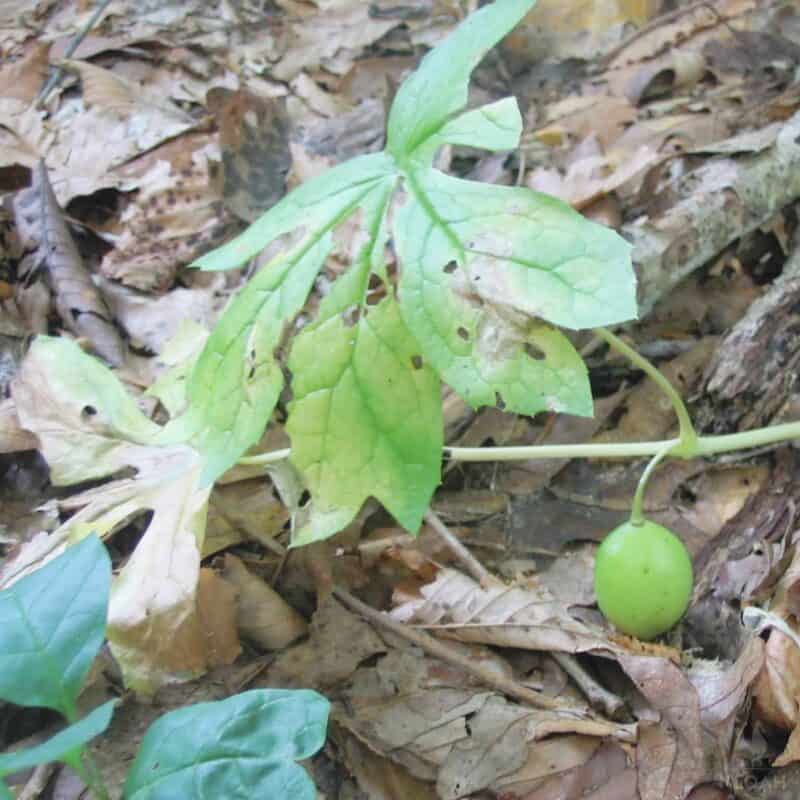
Dense, green foliage. Not a flower, not a fern. Not a mushroom, nor a tree. Six to eight leaves, splotched or solid green… And a delicious, tantalizing smell and taste.
So what are these mysterious plants I’m referring to?
They’re mayapples!
With this revelation, I took another trip into the woods to examine the plants a little closer. I gasped with excitement when I discovered that some already have flower buds forming. They were almost ready to set fruit!
Are you interested in learning more about what these delicious little plants are – and how to find them? Keep reading to learn more!
What Exactly Are Mayapples?
Mayapples are a type of fruit that belongs to the genus Podophyllum. They are native to North America and can be found growing in woods, meadows, and open woodlands. Mayapples are typically about the size of a ping-pong ball and have a yellowish-green color.
The flesh of the fruit is edible, but it contains a small amount of toxin. Therefore, it is important to eat Mayapples in moderation and avoid consuming the seeds or rind.
Although mayapples are not very abundant, they are considered to be a valuable source of nutrition due to their vitamin C content.
Mayapples are a plant that can be found in many different parts of the world. They are only found in North America, and are a popular ingredient in fruit smoothies and jellies.
Toxicity
This plant is mostly toxic unless you’re eating the ripe fruit, which is considered safe. So let me just make a quick list that should make it clear. This is safe:
- ✅ the yellow, soft, ripe mayapple fruit without skin
This is NOT safe:
- ❌ the green, unripe mayapple fruit
- ❌ roots
- ❌ leaves
- ❌ stem
- ❌ seeds
- ❌ skin
In addition, the resin extract from its root, podophyllin, is used in prescription meds – But don’t try to make your own ointment because podophyllin resin is a cytotoxic poison – and your experiment can easily go sideways. The fatal dose in humans is actually very small, around half a gram!
There is actually a documented case of poisoning that I found – and mind you this was because of the solution I mentioned above that was prescribed by a doctor! The study linked says:
According to the CDC, podophyllum is no longer recommended as a treatment of external genital warts because of safer alternative options.
How to Identify Mayapples
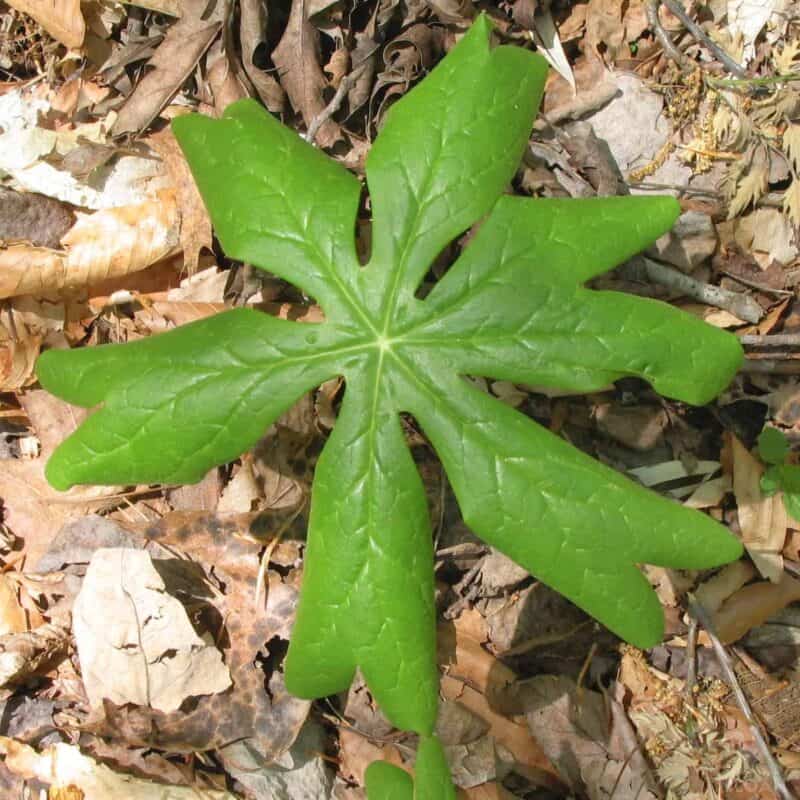
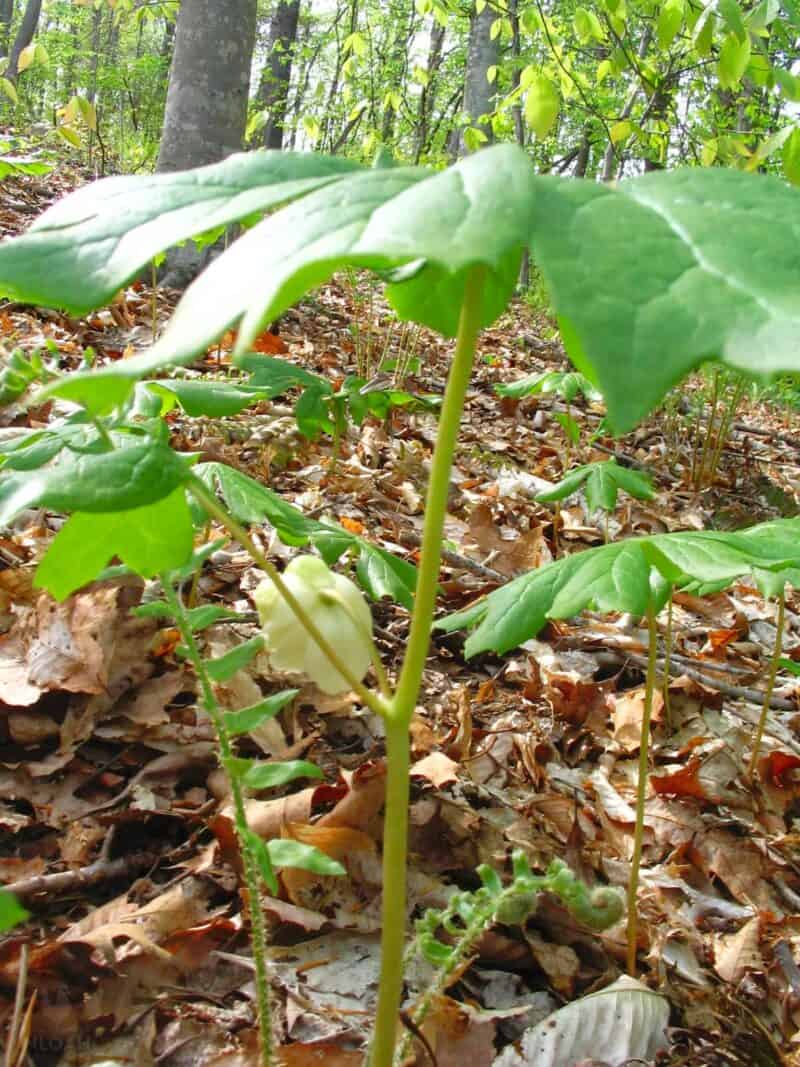
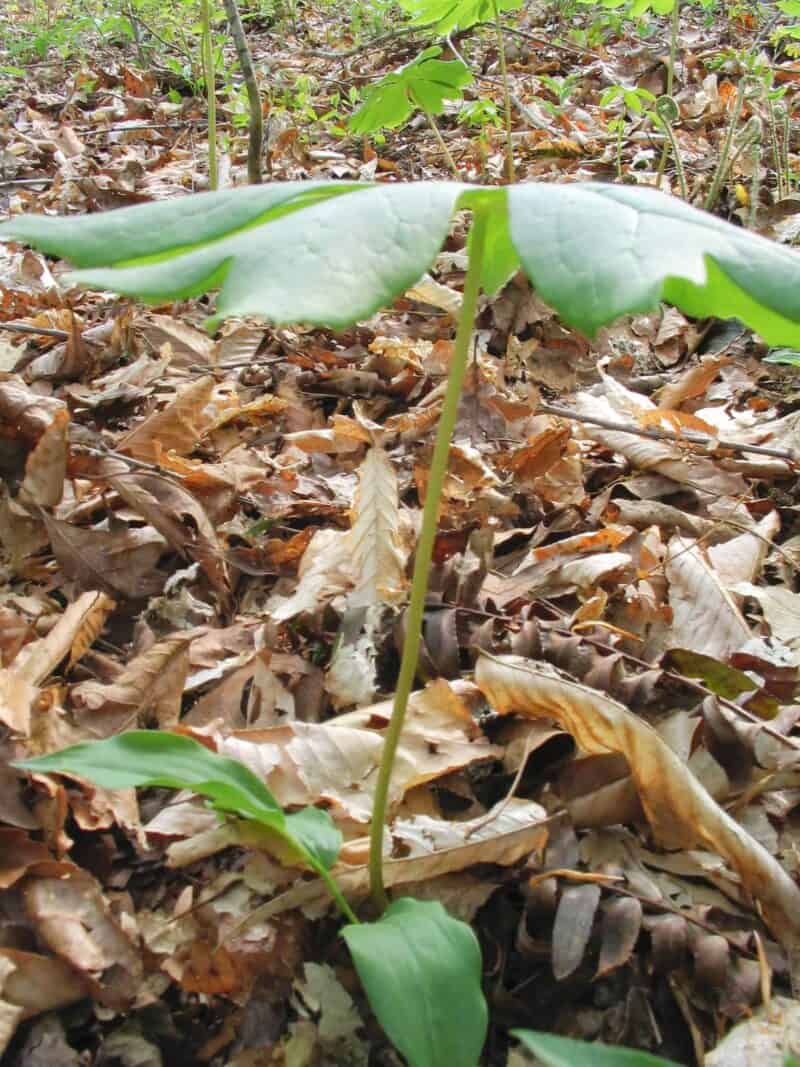
Mayapples (Podophyllum peltatum) e plants can be identified when they are young by their single leaves which are attached to long stems. But mature ones actually have two leaves. The flower grows in the fork (axil) between these two leaves on a mature plant, dangling beneath them.
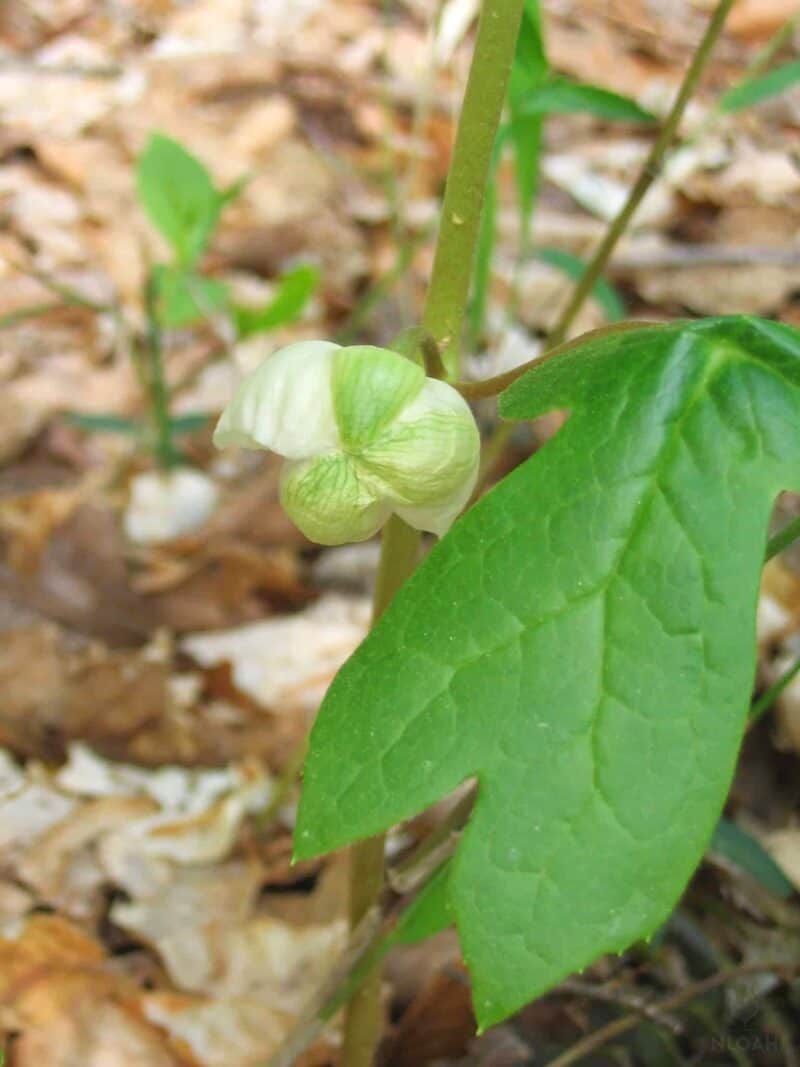
In late spring, this flower will develop into a large, greenish-yellow fruit.
Mayapples are typically found growing in shady areas with moist soil. Although the fruits of this plant are edible, they should not be eaten raw as they may cause stomach upset. When ripe, the fruits can be used in pies or preserves.

As the fruit ripens, the umbrella-shaped leaf dies away, leaving only a stem and a dangling fruit. I read that it can be hard to find them because by then the other plants have grown up around them, hiding the fruit from plain view. The forest will smell like lemons when it’s full of ready-to-pick Mayapples.
Some suggest that it’s easiest to just follow your nose to find them. I’m thinking I might cover a few with a wire cage before they go into hiding so that I might just beat the squirrels to at least one or two fruits.
Where to Find Them
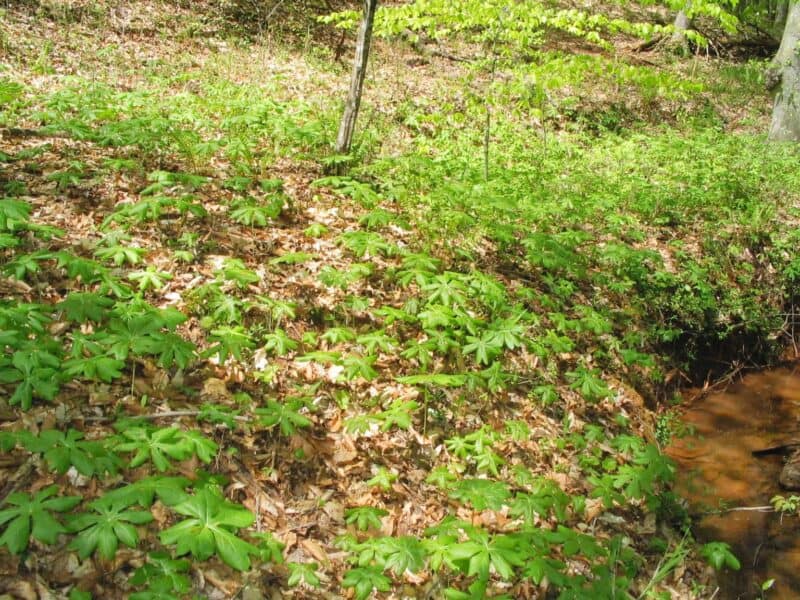
Mayapples are beautiful, unique plants that can be found in woods all across North America. These plants like moist soil and dappled shade, so they are often found along paths or in areas where the tree canopy allows some sunlight to reach the ground. Mayapples typically grow in colonies.
If you’re interested in finding Mayapples, they can be found from Texas all the way to Nebraska, and from the East Coast to Canada. Keep an eye out for these special plants the next time you’re exploring a forest!
When and How to Harvest Them
Mayapples are a delicate, woodland fruit, and harvesting them requires a light touch and patience. These lovely yellow fruits will be ripe for picking around June.
The mayapple’s short growing season means that you must act quickly to beat the forest critters to the harvest. Once picked, the mayapple can be eaten fresh or used in jams and jellies.
Be sure to save some of the seeds so you can plant them next year and enjoy another crop of these delicate fruits.
What Part of the Mayapple Plant is Edible?
The ripe, skinned, mayapple fruit is edible and can be used in pies and jams, or simply eaten raw. The Mayapple root and all other parts of the plant are all toxic.
Can You Eat Mayapple Raw?
No, you shouldn’t to eat it raw. Only the yellow ripe fruit is edible.
What Do Mayapples Taste Like?
Mayapples have a tart and tangy taste similar to citrus fruits. They are sometimes likened to bananas, but with a hint of lemon. Others say they taste like a cross between an orange and a grapefruit. Whatever the exact flavor, there is no doubt that mayapples are delicious.
They can be eaten fresh, baked into muffins, or used in any recipe that calls for banana, pumpkin, or zucchini. They are often used in jams and jellies, as well as pies and other desserts. Mayapples cannot and should not be eaten raw. Only the fully ripe yellow fruit is edible!
The best way to enjoy them is to add them to recipes where their tart flavor can balance out sweeter ingredients. Here are a few that I found:
- smoothies and pancakes
- cake and ice cream
- and, of course, jelly
Disclaimer and Final Thoughts
I am not an expert forager, so please do not take my word for it. Always do your research and be 100% sure you have properly identified a plant before consuming wild edibles. There are many poisonous plants and plant parts to be aware of, so never be nonchalant about what you pick and put in your mouth.
Do you have mayapples growing nearby? Have you had a chance to taste them?

Get your gift and learn things like:
- how to make this really quick pest spray
- how to prevent egg waste
- two cheap automation devices that will make your life easier

A city girl learning to homestead on an acre of land in the country. Wife and homeschooling mother of four. Enjoying life, and everything that has to do with self sufficient living.
We had mayapples in Northeast Missouri where I grew up. The ripe mayapple has a custard like taste.
The plants with two leaves are the mature ones, they take a year or two before a mayapple will fruit.
I’d be interested in knowing whether you ever got to taste the Mayapple. I’m very experienced with the Mayapple plant, having watched it grow since I was a child. We have them by the thousands in the Mid-Western U.S. (Illinois and Missouri) and we use the growth of the Mayapple in determining the proper time to hunt morel mushrooms. The fruits are easy to spot early in their life-cycle, but by the time they are ripe, they are mostly foraged by wood critters. My wife and I picked several yesterday – mostly unripe – and are going to attempt seeing whether they will ripen on the counter before rotting. And then we are going to eat them. Hopefully.
Quint,
Just be careful with those unripe Mayapples. And don’t eat the seeds. I never did get my hands on a ripe one. I’m hoping to try again this year.
For anyone reading this, I would advise against trying to ripen the fruits yourself. The only thing we know it’s safe are the ripe, yellow fruits, minus the skin and seeds. It’s not worth the risk to try to ripen them yourself…
Hello…one more quick bit of info…I have always found luck hunting morel mmushrooms along and under Mayapples! Here in Va…morels usually start to pop up about the time Mayapples open up like an umbrella….between late April and early may! I’ve never tried the mayapple before…I know its not poisonous..just figured it wasn’t too appetising. Its about time to ginseng hunt here now..bestof luck to all the wild pickers!!
That’s GREAT to know, Rockbridge. Thank you for the tips on morels and ginseng. I never know when the right time to look for them is.
While the fruit of the Mayapple is said to be edible persons should use caution with the plant. The leaves, stems and roots are poisonous. Just touching the leaves and stems can cause a serious reaction for many folks. It would probably be a good idea to wear some kind of hand protection and long sleeves when attempting to pick the fruit.
For many of you younger folks persons from the “hippie culture” in the 1960s and ’70s poisoned themselves by eating “poke salad” as a fresh plant without properly parboiling and cooking it.
We have them in our yard as well and up the street and on many of the hiking trails around us. I knew they produced a fruit, but have never tasted them, so would be curious as to what your thoughts are when you try them.
I found a Mayapple plant at a garden center about 15 years ago, and was delighted to get it to plant in my Georgia yard. It reminded me of the Mayapples I used to find in the Virginia woods. As of this year, they’ve spread nicely, and look really cool in the island in my front yard. I’ve yet to get a fruit from one of them, but I like your idea of a metal cage to keep the critters from getting all the fruit first.
Very interesting article. Too bad they dont grow in South Florida. I also read that it is also a medicinal plant.
Hi Kendra,
Love this info. The children and I will check them out. We love learning about wild foraging.
Many Blessings Miracle Farm Homestead
I hope you get to taste some, Hope!
I watched Ruth Goodman pick mayapples on one of the historic farm series she did on BBC 2, but I just assumed they were a British plant. Now that you’ve shared, I believe I have them in the woods surrounding our property. Thanks for sharing!
That would be awesome if you can find them also, Kate!
That’s what those are? So cool 🙂 When I was little my Grandma had a ton of these in her back yard, and either I was little enough or they were big enough I could hide under them. There are less now ’cause the black raspberries have choked out some of them and also the English Ivy. It’s tempting to see if any of them have berries.
I hope you can find some, Kassandra!! My husband told me that his grandpa used to have them growing all over his forest floor, but he always said that they were poisonous. I don’t think he knew they have an edible fruit.
You know, I believe we have those as well behind our house on the hill going down to creek. Thanks for the information. I just might check them out. I looked them up in my Edible wild plants book and they are also in the Medicinal Wild Plants book as well. Seems the roots are excellent in the treatment of warts, venereal disease, and cancers. The Cherokee Indians use to make a tea each season and drink small amounts as a purgative and emetic. Also to kill and expel worms from their digestive tract. They made a tea from the roots and gave in minute doses to the children as a spring tonic. Lastly, the root tea was credited as an antidote for poisons and snakebites. Amazing, drink a poison tea to kill a poison. Amazing discovery you came upon. Great information. Thanks a bunch.
Yeah, I bet you do have them, Elizabeth!! I’m happy to pass the info along, and I’m glad to hear that you did more research! Lots of fascinating stuff out there on Mayapples. 🙂