
For many homesteaders, maximum efficiency is paramount, especially when it comes to raising livestock. Anything you can do that will save you time, effort, or money is to be implemented if you want to keep your sanity intact and your bank account in the black.

Many turn to raising different species together when possible to cut down on space requirements and decrease the amount of work needed to take care of them overall. And how about animals that are very similar, like goats and sheep? Can sheep and goats live together?
Yes, sheep and goats can live together with little worry most of the time…
The two species tend to get along, have similar dietary requirements, and also similar shelter needs. However, goats need significantly more copper than sheep, so you must be cautious when using supplements or supplemented feed.
If you have or are thinking about getting both of these animals, you’re in luck because keeping them together is actually a lot easier than you might be thinking.
That said, there are a few pitfalls I’ve seen that many folks run into unknowingly. But with just a little homework, you’ll be able to avoid those and be well on your way to a happy life with your flock and herd. Keep reading and we will get into it…
Be Mindful of Supplements
Before we do anything else, we must cover what I consider to be the biggest issue when it comes to keeping sheep and goats together, and that is the matter of nutritional supplements.
Simply put, goats need a lot more copper in their diet compared to sheep. They do need some, make no mistake, but if they get the same kind of mineral supplements that are intended for goats, or eat fortified goat feed with too much copper in it, it can easily become fatal for the poor things.
This, naturally, greatly complicates things if you normally set out mineral blocks or just use fortified feed to get your animals what they need in order to thrive.
If you are housing goats and sheep together, you won’t be able to really separate them or prevent them from getting commonly accessible feed or supplements.
A good solution, then, is to stick with feed, treats, and free choice supplements that both can eat with no worry, and then you individually attend to the copper needs of your goats.
This is most easily done using a copper bolus every 6 to 8 months as required, or taking the time to separate them in their own paddock (or taking away the sheep) and then giving them a goat-specific mineral supplement.
If you’re unwilling or unable to do this, I would think long and hard before you keep the two together because it’s only a matter of time before the sheep get poisoned by the copper.
You can give yourself a degree of assurance by keeping sheep that have greater tolerance to dietary copper, like Suffolks, Katahdins, Gotlands, or Icelandics, but this still won’t keep them safe from excessive copper intake.
As far as other minerals are concerned, the two have similar needs. You’re likely to find supplements that have (nearly) identical amounts of manganese, iodine, selenium or cobalt. Copper is really the only issue.
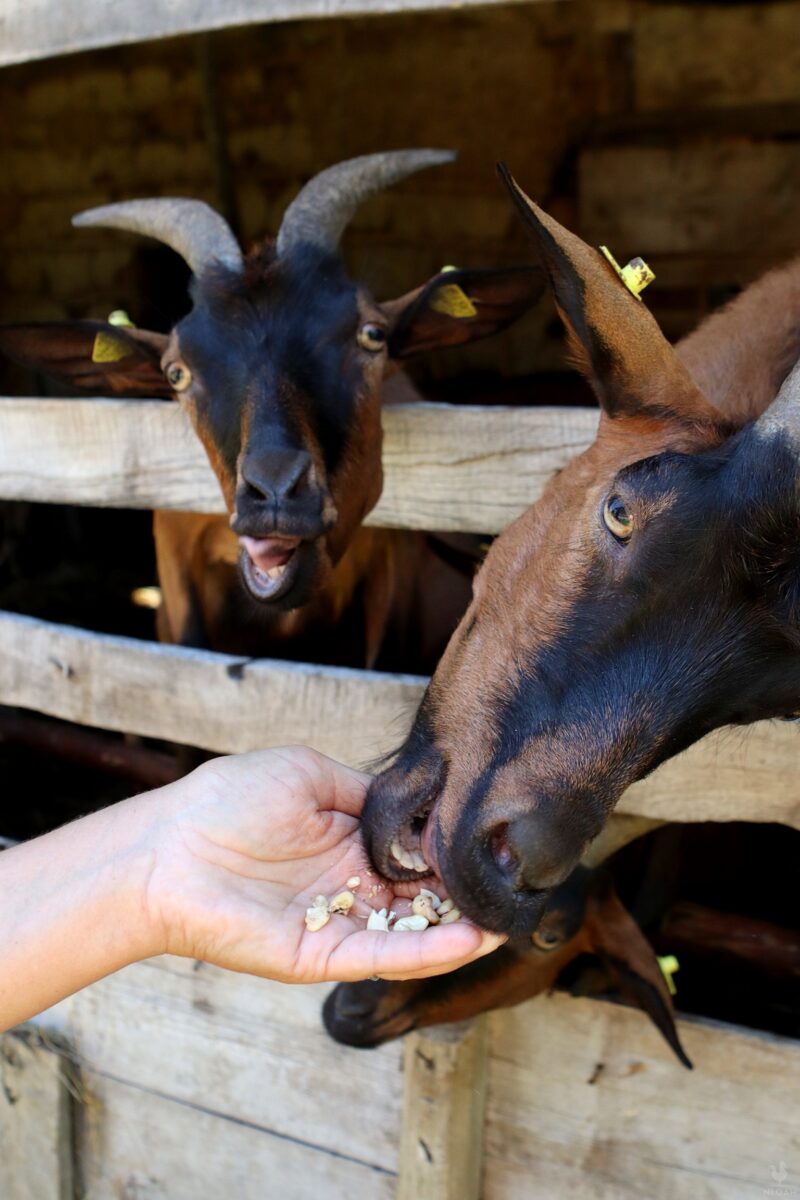
Goats and Sheep Have Some, but Not Total, Dietary Overlap
So, sheep must be very cautious of ingesting too much copper in their diet, and that means they cannot eat goat-specific fortified feed or supplements, but the reverse isn’t true for goats.
As a rule of thumb, assuming you aren’t dealing with some specially medicated feed or one designed to address pronounced nutrient deficiencies, it won’t hurt goats to get sheep-specific feed or minerals within reason. Both species will also eat lots of hay.
When it comes to free-ranging, grazing, and browsing, though, we see many differences. Although both species are thought to have basically identical diets, goats will mostly eat twigs, branches, vines, leaves, and shrubs along with a little bit of grass. Sheep, in stark contrast, will choose mostly grass and broad, tender leaves.
This means you cannot turn goats out onto a wide-open, grassy pasture where sheep would thrive and be happy and expect them to do the same. Goats will need trees, shrubs, berry bushes, sturdy weeds, and more in order to fulfill their dietary requirements.
Because of this, pasture that is considered ideal for sheep usually will not support goats without considerable supplemental feed for them. Likewise, pasture that’s perfect for goats is often not for sheep.
Your best bet for free-ranging is to have a large pasture of mixed terrain that can give both animals what they need and then plan on supplementing as needed.
Goats Like to Eat Off the Ground, Sheep Eat Lower to the Ground
Another small thing, but an important one, and one that is easily overlooked.
Sheep are comfortable eating lower to the ground or directly off the ground, whereas goats prefer to eat with their heads raised. This makes sense because many of their foods grow higher than the usual foods eaten by sheep.
Don’t be surprised if your goats refuse to eat hay that is on the ground. Feeding both animals out of tall buckets or feeders that are slightly raised (about chest height) can satisfy both.
Goats and Sheep Usually Want Shelter at Different Times
Sheep and goats are both hardy animals that do fine outside, but in different ways.
Your goats will typically need shelter when it is cold and raining, whereas sheep will want shelter when it is blazing hot and very sunny. That’s because the wool coat that most sheep have is excellent insulation and protection against wind and rain.
Goats do better when it is hot and dry, but they don’t like getting wet and will want to take shelter from rain and snow most times.
Note that you can keep both species in the same type of shelter, and a simple three-sided structure that will protect them from wind and precipitation is all that is required for short-term housing.
Remember that sheep need slightly more indoor space than goats: around 20 square feet per adult. Goats need only around 15. Plan and build your larger pen accordingly!
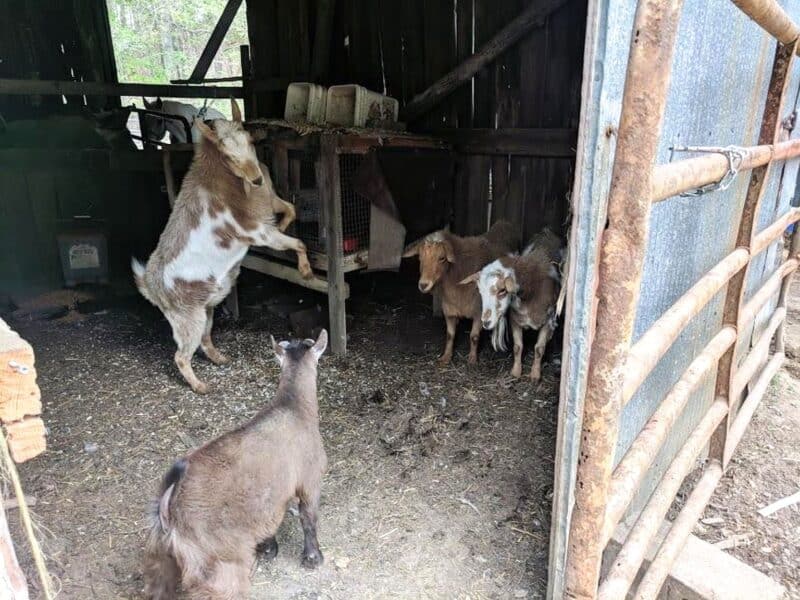
Both Tend to Get Along, But Fights Can Still Happen
I know quite a few homesteaders who assume sheep and goats get along famously well because they are so similar, and in some ways, this is true. Both are prey animals and neither is carnivorous.
When housed together, goats and sheep will often keep to themselves unless they are eating together or nearby one another. However, some animals will mingle and sometimes the urge to establish dominance inside the flock or herd will be extended to the other species.
This can lead to fights, and fights can cause injuries, particularly if one or the other has intact horns.
Don’t assume that you won’t have to keep an eye on them, even if they’ve been living together for a long time. Also, keep in mind that introducing new members to the herd or the flock will change the dynamics – and can suddenly lead to an eruption of attitude problems.
Sometimes these issues will sort themselves out, other times they won’t. You might have to separate troublemakers, or, if you are intent on keeping both together, cull or sell animals that are problematic.
Fences That Are Adequate for Sheep Won’t Contain Goats
Sheep are among the easiest livestock animals to contain. As long as your fences are reasonably strong and about four feet tall, most sheep won’t challenge them as long as they have plenty to eat and are protected from predators.
Goats, on the other hand, are very, very different. Out of all the animals you might keep, goats are going to be the most likely to escape and the best at escaping. They are agile, determined, and can easily wriggle through or push over any fencing or part of your fencing that is found lacking.
Accordingly, any fencing you install for containing your mixed flock must be up to the task of containing the goats.
If it will contain the goats, it will certainly keep the sheep in place. Goat-proof fencing should be woven wire at the least affixed to sturdy metal or wooden posts, and at least four and a half feet tall.
Note that you can’t have any ledges, obstacles, or other objects near the fence line that goats could use to give them a boost for jumping out.
You Can Usually Keep Rams and Bucks Together
Surprisingly, it’s possible to keep rams and bucks together as long as they’re far enough away from females to not feel competitive over them. They tend not to fight, and can keep each other company for mental well-being.
Likewise, castrated males of either species can be kept with intact males with no expected problems. That, at least, simplifies things if you want to keep your own boys on hand for breeding.


Get your gift and learn things like:
- how to make this really quick pest spray
- how to prevent egg waste
- two cheap automation devices that will make your life easier
Tom has lived and worked on farms and homesteads from the Carolinas to Kentucky and beyond. He is passionate about helping people prepare for tough times by embracing lifestyles of self-sufficiency.