
Part of living on a homestead is learning to get along with nature. Let’s face it, we homesteaders have to see and deal with things that our suburban neighbors likely never will! Much of the time, this includes local wildlife. For some of us, that’s just part of the charm.
But you know what’s not charming? Mice and rats. These rodents might look cute on a good day, but they always herald major trouble. If you’ve got chickens, seeing even a single mouse or rat means a major catastrophe is on the horizon if you don’t act.
You’ve got to take care to eliminate rodents and, especially, keep them out of the coop at all costs if you want your birds to stay happy and healthy. It’s a big job, but I’m here to help with a detailed guide to securing your coop and surrounding areas. Roll up your sleeves, and let’s get to it.
Why are Mice and Rats Problematic?
What’s the big deal about mice and rats, anyway? Do they cause any harm running around out on your property? Don’t they have a right to live?
It’s sentiments like that which sentence your birds to misery and an untimely death. Make no mistake: rodents are the avowed enemies of all homesteaders. Consider the following if you need more convincing:
Steal and Ruin Food: Even a small infestation of rodents will steal a meaningful amount of food from your chickens, and what they don’t eat or carry off themselves, they will contaminate and ruin. This costs you money.
Eat Eggs: Rats especially love to eat eggs, and any egg that suffers from a rat’s attention will be completely ruined. In the case of fertilized eggs that a hen is sitting on, this diminishes the next generation of chickens in your flock.
Kill and Eat Chicks: Rats are omnivores, and they will kill and eat chicks, sometimes taking them right out from under their mothers in the dark of night. This is terrible for your flock, potentially traumatizing for your family, and completely unacceptable.
Hurt and Stress Chickens: The presence of any rodents inside the coop is only going to stress out your chickens, even if they aren’t causing any overt harm. Stressed chickens are less productive and more likely to get sick. Worse, rats that are desperate or just particularly aggressive might attack even adult chickens directly, causing injury and infection.
Spread Disease: Last but certainly not least, rodents of all kinds are known harbingers of pestilence. Mice can spread devastating diseases like salmonella, hantavirus, and various kinds of meningitis.
Rats are carriers of the same and can also spread leptospirosis, rat-bite fever, and even plague. Both species also serve as vectors for a variety of external parasites like fleas and ticks, which can affect your birds.
I trust we are on the same page now. In the following sections, I will tell you how to tackle this tricky and persistent problem in a logical and effective way.
Dealing with Both Species Requires a Comprehensive Approach
Ask anyone who’s kept chickens for any length of time, and they’ll tell you how vexing, how maddening, rodent problems can be. Catch one, and it seems like three more appear to take their place. Catch a hundred, and it seems like you’ve barely made a dent in the population.
It’s tricky, all right, but where most keepers go wrong is that they fail to implement a comprehensive approach. I always use a three-pronged system that has never failed me—from Florida to South Carolina and everywhere in between—what I call: Deter, Secure, Eliminate.
By implementing all the following steps, or as many as you can, in a logical order, you will slowly but surely eliminate the rodent menace and save your birds.
Deter
If we can keep rodents at a distance or drive them off, our job is mostly done. The following tips will help you deter them:
Reduce or Remove All Food Sources on Property and Around the Coop
Overwhelmingly, mice and rats are hanging around your property and your coop specifically because of easy access to food.
Get rid of the free meal, or make it a lot harder for them to get to, and many of them will head to greener pastures.
Stop scattering food around in the run and elsewhere on your property. Don’t throw out any kitchen scraps to your birds haphazardly.
Make sure all chicken feed is secured away from the coop. If you’ve got fruit trees, pick up and dispose of fallen fruit or feed it to your animals before nightfall if it’s safe.
Also Reduce or Remove All Water Sources
Similarly, rodents need water along with food, although both mice and rats can live for days without any direct water. Birdbaths, leaky hoses, and faucets, easily accessible chicken waterers, and dishes or bowls that are left out to fill with rainwater are favorite watering holes.
Get rid of the incidental watering stations and secure chicken waterers inside the run to make them less attractive to mice and rats alike.
Obviously, you won’t be able to fully eliminate all water sources, but removing as many options as possible will help you keep rodent populations under control.
Clean Up Likely Hiding and Nesting Places for Mice and Rats
Aside from food, these nasty critters are likely hanging out on your property because it also affords them comfortable, warm, and safe places to live. The trick is that they can live almost anywhere that is quiet, dark, and out of the way.
Popular homes for rats and mice include piles of firewood, brush piles, compost bins, barns, sheds, unused or junked vehicles, overgrown patches of grass and weeds, and even loose dirt.
Every one of these locations that you can eliminate or make unappealing to rodents will help to displace them off your property and away from your chickens. Cleaning up, cleaning out, and hauling off should be your first order of business where possible.
Only Give Chickens Enough Food for a Day
Back to the food issue: our tiny, furry foes are a lot less likely to snoop around the coop at night when they know there’s not going to be any stray morsels for them to eat. Contribute to this objective by only giving your chickens enough food for the day at a time.
If there aren’t any leftovers left out—or far fewer of them—the rodents will learn to look elsewhere for their dinner.
Get a Farm Dog or Barn Cat
Both mice and rats are very, very low on the predator-prey totem pole. They have a natural and instinctive fear of dogs and cats, and leaving a farm dog or barn cat to roam around on the property is a great way to incentivize them to look elsewhere.
Terriers and most cats are especially successful predators, and most mice and rats will go out of their way to avoid them.
Even the lingering odor of these animals and their waste is enough to scare them off in some cases. Obviously, you’ll have to take pains to protect your birds from the same animals!
Consider Using Natural Repellents
If possible, natural repellents can be an ace in the hole for keeping rodents away from the coop.
Live herbs like mint or garlic, or processed stuff like cayenne pepper powder, can be sprinkled around the perimeter of the run and coop to drive off rats and mice. Live herbs can be grown on-site for the same purpose, but you have to stop your chickens from eating them!
Secure
Sadly, both species we’re dealing with tend to be highly persistent, intelligent, and invasive. We have to plan on them at least trying to get in and act accordingly to stop them.
Store Food in Steel, Rodent-Proof Containers
If you are going to keep chicken feed and other food outside, you’ve got to keep it in a steel, rodent-proof container. Only steel will do—not plastic and not even aluminum. Mice and rats both have incredibly strong teeth that are coated in a naturally occurring iron layer.
Rats especially can chew through almost anything, including softer metals. Incredible, but true! Likewise, all containers must have a tightly fitting lid with no gaps that these greasy little creatures could wriggle through. And no, tall containers like trash cans alone aren’t going to cut it, as both species are expert climbers.
Clean Out Deep Bedding and Inspect
If you’ve noticed mice or rats moving around the run and coop, you should already assume that some are living inside the coop. Yep, they could be burrowed in nice and snug in the bedding you laid down to keep your chickens warm.
Assume it’s compromised and pull it all out. Watch closely and don’t be surprised if you uncover a nest or send the vermin fleeing in all directions. Take care to pull everything out, inspect the coop for damage and access points, then lay down fresh bedding for your birds.
Make Sure the Coop is Tightly Fitted and Closed Up
It’s hard to believe just how small a space both mice and rats can squeeze through. The rule of thumb is that anywhere their actual skull can fit, they can go. For mice, this is about a quarter inch on average. For rats, around a half inch, maybe a smidge bigger.
It’s laborious work, but you’ve got to go over every centimeter of the coop looking for holes and gaps that might permit access. Adjust fitment so it’s tight with no gap, or fill up gaps with wadded steel wool or apply sheet steel and epoxy.
Repair All Existing Holes Rodents Could Use to Enter the Coop
Similarly, if you notice any roughly symmetrical chewed holes, you can bet your bottom dollar those were made by the very creatures we are trying to stop…
Your best bet for closing up these holes is to use the steel wool or sheet steel trick I mentioned in the previous section. If you’re dealing with a persistent infestation, don’t be surprised if your foes try to open up a new hole very nearby the old one.
If that happens, keep inspecting and keep fixing the damage, and step up your efforts.
Install Sheet Steel or Hardware Cloth to Stop Intrusions
Two points of interest around the coop and run where mice will typically gain access are the floor and the fence surrounding the run.
As mentioned, they can chew or squeeze through almost anything, and some species are prolific diggers, meaning they can easily slip under a fence. Our old standby, chicken wire, is completely inadequate for stopping both species either way.
Instead, you can install sheet steel under the coop to keep them from chewing through or use a layer of small-gauge hardware cloth. For the fencing, bury a layer several inches deep, extending out several inches from the fence line, to stop digging.
Bring Chicks or Small Breeds Inside
If you’re dealing with rats, bantams and chicks especially are going to be in serious danger. Consider bringing them into your home and temporarily housing them in your mudroom or garage at night to help protect them.
Don’t Forget the “Overhead”!
Remember what I said earlier: these critters are great climbers! Don’t forget to check along windows, eaves, skylights, and vents for access points and close them up accordingly.
Keep Coop, Run, and Surroundings Clean
This will go a really long way toward pushing back the rodent menace. These creatures love cluttered, dirty areas. Stay on top of your chores while implementing other active and passive measures, and you’ll start to get ahead of them, I promise.

Eliminate
Deterring and securing often isn’t enough to send rodents packing. They are pests today, as they have been for millennia, and we have to treat them in kind. Aggressive elimination might be the only way to get a handle on the problem.
Consider Getting a Rooster or Larger Hen
Believe it or not, chickens will readily kill, dismember, and eat mice. More aggressive hens and roosters especially can dispatch them easily if they catch them in the open. Chickens have great reflexes and speed!
Now, rats are a different story. Though larger chicken breeds and roosters can drive them off or potentially kill them, they can rarely cope with a swarm.
Obviously, dealing with a rooster or aggressive breed can introduce different kinds of problems for you! That’s the subject of a different article, though.
Set Snap Traps in Hard-to-Reach Places
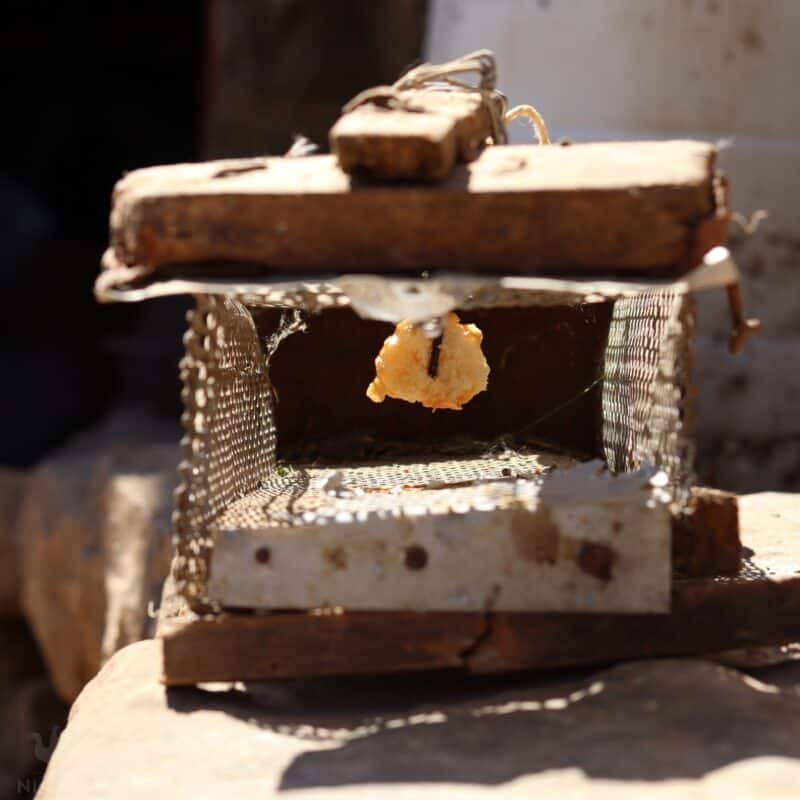
You can use conventional conibear or bar traps, colloquially called snap traps, or modern electronic traps to pick off mice and rats in out-of-the-way places like outbuildings or under a low coop. All traps must be checked and, if necessary, reset regularly to ensure continual function.
It should go without saying that you must place these traps where there is no chance whatsoever of chickens or chicks activating them! These traps can seriously injure your birds or kill chicks.
Use 1-Way or 2-Way Traps Along Usual Routes
Mice and rats both prefer to move along walls and other vertical surfaces for comfort and security. Placing one- or two-way hotel-style traps in these places will help you catch them as they move from nesting locations to food and water and then back again.
Set Bucket Traps to Depopulate Large Infestations
For major infestations, rely on commercially available or DIY bucket traps to catch loads of mice and rats in a single night.
The great thing about these designs is that they are, with few exceptions, continually operating and require no oversight or resetting to work. They can also be set up in lethal or non-lethal modes.
If you do want to go non-lethal, or humane, think long and hard about where you’re going to set your fuzzy captives free—you don’t want them to become someone else’s problem!
Call an Exterminator
Sometimes it’s best to admit that you are outclassed and call in the professionals. A skilled exterminator, especially one with rural or farm experience, can implement a comprehensive plan for coping with your rodent problem while keeping your chickens safe and sound.
Even for the most aggressive and deeply embedded populations, specialized solutions exist. Increasingly, trained dog and mink teams are coming back into fashion.
Minks especially can ravage mice and rat populations; these ferret-like creatures can go where the pests live and travel, tearing them apart with powerful jaws.
Wait a Second. What About Poisons?
You might have noticed that I completely left off the use of poisons from the list of elimination methods above. That was on purpose.
Poisons are indiscriminate killers, and even the so-called pet- and livestock-safe ones that are effective against rodents are anything but for chickens. Worse, unlike traps, poisons take time to affect their victims, meaning a mouse or rat could drop dead anywhere.
Your chickens, being omnivores, might come along to eat the tainted corpse and thus get poisoned themselves. That’s a terrible outcome, and you’ll always have to worry about pets and wildlife suffering the same fate.
For me, there are too many other safe and effective procedures that we can implement to make poison a viable option for most rodent problems.
Act Fast: Mice and Rats Can Multiply Exponentially
Whatever you do, don’t wait to deal with this problem until it’s totally out of control. Mice and rats can both reproduce at an exponential rate: a female mouse can have up to 10 litters of 14 babies a year, meaning 140 new offspring annually.
Rats are almost as bad, with an average female cranking out six litters a year with as many as 12 babies per litter. That might mean 70 new rats, per fertile female, annually.
Worse yet, mice become sexually mature around 6 weeks old at the oldest, and rats at between 8 and 12 weeks depending on the species. Put off the problem, and you’ll have hundreds and hundreds more rodents to deal with!


Get your gift and learn things like:
- how to make this really quick pest spray
- how to prevent egg waste
- two cheap automation devices that will make your life easier
Tom has lived and worked on farms and homesteads from the Carolinas to Kentucky and beyond. He is passionate about helping people prepare for tough times by embracing lifestyles of self-sufficiency.