
I guarantee that if you’ve been on the internet for any length of time, you’ve seen myotonic goats before… I’m talking about these:
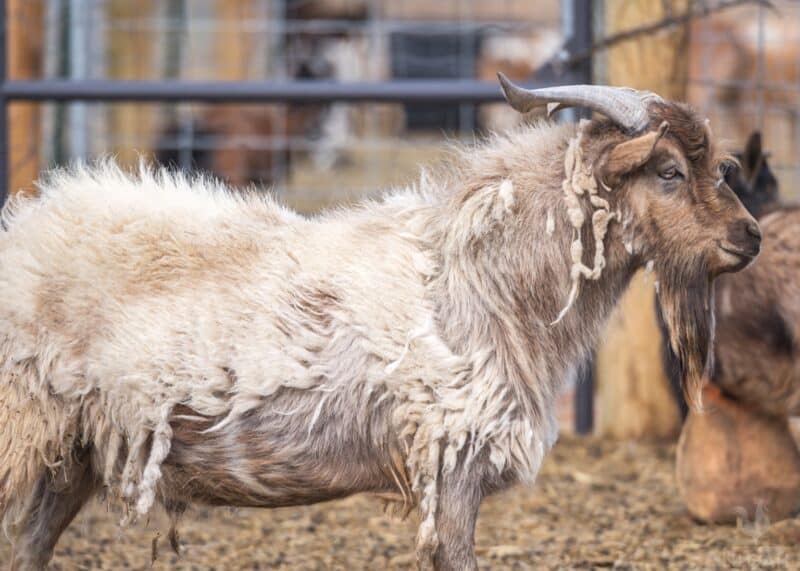
Myotonic goats, also known as fainting goats, live up to the name: when they get startled, these goats go stiff-legged and then topple over hilariously. Most folks can’t help but try to scare them and get a reaction from them!
They seem to make popular pets, for sure, but do these goats have any actual use except as a novelty? Can they be productive if you want to meet or milk? Are they a good choice for homesteaders or not? I think that they can be, and I’m going to make a case for them in this article.
If you’ve been interested in these interesting, hilarious goats, you’ve come to the right place. We’ll get right into it below.
Also Known As…
Myotonic goats have many other common names and nicknames, which can make getting verifiable information on them confusing or challenging.
They’re commonly known as fainting goats as I said, but they may also be referred to as:
- the Tennessee fainting goat or just Tennessee goat,
- wooden leg goats,
- falling goats,
- stiff-leg goats,
- or nervous goats.
As a rule of thumb, you can usually look up good sources of information on them under the name Myotonic or Tennessee fainting goat.
Breed Overview
Tracking down the origins of the myotonic goat is pretty challenging, and the best we know as far as a definitive origin is that they came from somewhere in Tennessee in the late 19th century.
A herd of domestic goats owned by laborer John Tinsley was sold to a doctor named Mayberry because these particular goats, and their young, were short, stocky, and noted for their lack of climbing and jumping ability, which made them easy to contain. That’s always an advantage when you’re dealing with goats!
Apparently, the herd that was sold to Dr. Mayberry experienced a genetic mutation that resulted in their iconic condition, myotonia congenita, which we will talk more about here in a bit.
But ultimately, these goats were of an unknown type although modern genetic analysis shows that they are distantly related to Iberian, African, and Spanish goats. I would say they were probably of a mixed breed to begin with!
From there, some of these myotonic goats were taken to Texas where they were selectively bred for meat production, and this resulted in a divergence in the accepted line today.
The smaller of the two, the ones originally discovered and studied in Tennessee, remained smaller and popular as a pet or utility goats whereas the larger variety, sometimes called the Texas wooden leg, became the choice of goat herders who are focused solely on meat production.
Today the myotonic goat, in all of its many forms, is a popular pet and also a surprisingly good choice as a dual-use goat.
What are Myotonic Goats Usually Kept For?
Nominally, myotonics are popular pets and are also used as breeding stock because of their heavily muscular build. They’re often crossbred with other goats to increase the yield of resulting hybrids.
However, it’s important to know that these goats can produce quite a lot of meat themselves and they are also respectable milk producers.
An average myotonic goat, especially of the larger and bulkier Texas variety, has an average carcass yield that is anywhere from 5% to 10% higher than goats of comparable weight.
Milk production is also quite respectable, with a single young doe being able to take care of two or three kids herself easily thanks to her average yield of anywhere from half a gallon to 1 gallon of milk per day.
Fainting goat milk is notable for its modestly high butterfat content and excellent digestibility, making it a wonderful choice for people who might suffer from modest lactose intolerance.
It has also become a favorite for small-batch cheese-making and other dairy products.
In any case, unless you are concerned with the ultimate inefficiency, myotonic goats can be a respectable dual-use breed for your herd.
Appearance
One thing you can’t count on with myotonic goats is a consistent appearance. Here’s what I mean…
As a rule, this is a medium-sized breed that varies considerably in weight, anywhere from 80 to 200 lb, though those of both the Tennessee and Texas lines are considerably lighter than bucks, usually maxing out at around 110 to 120 lb.
It’s also worth mentioning that sometimes bucks can be considerably smaller, and size alone is not indicative of the breed.
These goats all invariably have bulky, dense bodies and broad heads, and may or may not have bulging eyes and may or may not have beards in the case of males and females. Likewise, myotonics may have horns or be naturally polled.
The coat and fur of the myotonic varies from uniformly short to uniformly long, or with long patches. Most that have long fur will grow lots of cashmere during the cold season.
Every kind of color and pattern is considered acceptable for this breed, so there’s bound to be one out there that is your favorite!
If you are considering buying these goats, pay particular attention to the jaws. They should be evenly set with no overbite or underbite. Either is indicative of bad breeding or defects.
Temperament
One of the best attributes fainting goats have is their temperament. They are famously patient, friendly, and playful, and known to form strong bonds with owners as long as they are raised with good socialization.
If you are around when kids are born, and treat them right, you can expect them to come right up to you for the rest of their lives. But watch out if you raise a bottle baby! They will follow you around like a dog ever after.
However, this friendliness is typically reserved for people that they know well and trust. Around strangers, or people who have treated them harshly, they are cautious, standoffish, and prone to run away.
Keep this in mind if you are buying adult goats or rescuing them because this will likely mean they are difficult to handle.
Ideal Environment
Fainting goats are one of the most adaptable around, and typically put up with harsh weather, both heat and cold, with little concern, though they still need shelter as with all other breeds.
Unless you live in the most scorching or frigid environments, fainting goats will do just fine given a little bit of care and protection.
So What’s the Deal with the Fainting?
Now we come to the million-dollar question: what’s the deal with this fainting anyway?
Myotonic goats get their name from a genetic defect known as myotonia congenita. In essence, it is a muscular disorder, not a neurological one.
I’ll skip the major science lesson, but in short, the muscles malfunction by stiffening up and not relaxing when commanded to, although the effect does not last but for a few seconds or perhaps a minute at most.
Although it is most commonly associated with them being startled or frightened, resulting in a fast, reflexive muscle activation, it can happen even when they are calm and merely stepping or hopping over an obstacle.
Goats are also individuals in this regard, with some seemingly being stricken severely with it whereas others will only occasionally or rarely fall victim to it. Sadly, the condition is not treatable and has no cure as of now.
Does the Fainting Hurt the Goats?
No, not directly. This locking up of the muscles does not directly hurt the goat. It isn’t as severe as a cramp, and the goat is conscious the entire time.
A complete or partial loss of body control does often result in the goat toppling over or falling down on the ground – but this is rarely a cause for injury and is of course quite hilarious.
However, if a goat were to be stricken and fall out of control from a high place, downstairs, down a hill, or into water, it may very well get injured (or worse)…
Do All Myotonics “Faint”?
Yes, to a greater or lesser degree. That’s why they are myotonic goats, after all! They are named after the condition.
It should also be noted that the condition seems to subside somewhat, or at least become more manageable to the goats, as they age. Kids and young goats are more prone to falling over, wobbling, and slipping whereas older ones are less so.
They will always have to deal with it to a point, but as they mature, it will impact them less and less. Also, goats that are calmer and exposed to less stress and frightening stimuli undergo fewer episodes as a rule, assuming all other variables stay the same.
Understanding the “Stiffness” Characteristic
Enthusiasts, breeders, and professionals who deal with myotonic goats have developed an informal, but useful stiffness scale for assessing how much an individual goat suffers from its condition and how often it occurs.
The lower the number the better, but generally, the stiffness factors are defined as such:
- Never seen to stiffen.
- Will only rarely stiffen and will never fall over, even when startled.
- Gets stiff only sometimes, falls over only rarely.
- Goat can walk normally but rear legs will stiffen and front legs might. Falls are still fairly rare.
- Goat can walk normally, but the rear legs stay fairly stiff. Noticeable swivel in hips. Will stiffen entirely when startled or when crossing obstacles.
- Goat is very stiff and completely locks up when startled or when crossing an obstacle.
Note that a myotonic goat with a high stiffness rating is not necessarily one you don’t want. They can still be great performers and charming pets, but they will suffer from difficulties that might make their life, and yours, harder.
And like I said above, keep in mind that the condition tends to become more manageable for them, and they will suffer from it less as they get older. I’ve seen very tippy goat kids that grew up into well-adjusted and capable adults once they were a few years old.
Any Special Requirements for Keeping these Goats?
Not particularly, though you must be ready to help them if they get stuck or injure themselves, and you must take great care to keep them in a low-stress environment. And also, avoid the temptation to deliberately startle them for a laugh.
This will also influence the design of obstacles you provide for them for exercise. Raised platforms that goats can fall clear off of should be avoided, especially if they are tall.
A better bet is to go with a stack of logs or something that’s in a pyramid shape that will at least cushion their fall and let them slide or roll to the ground should they lock up when they are on top of it.
Remember; don’t count on them being okay just because you aren’t going to frighten them: anything from the sudden appearance of a predator to a clap of thunder could lock them up and send them tumbling. Even stepping over something can cause them to fall, so there’s no telling when a spell might strike.
But a great thing about myotonics particularly is that they’re easy to contain compared to most other goats. Although they are fairly agile, they are stocky and relatively inflexible meaning they are less likely to climb and jump high.
They are known to respect fences more than other goat breeds, and that means you won’t constantly be on watch for repairs or escape attempts.
How Long Do Myotonic Goats Live?
With a proper diet, plenty of care, and a good environment your myotonic goats of either line can live anywhere from 10 to 15 years.
Plus, it’s not unheard of for individual goats to live significantly longer than that. If you aren’t slaughtering them, your goats can be with you for a significant portion of your own life.


Get your gift and learn things like:
- how to make this really quick pest spray
- how to prevent egg waste
- two cheap automation devices that will make your life easier
Tom has lived and worked on farms and homesteads from the Carolinas to Kentucky and beyond. He is passionate about helping people prepare for tough times by embracing lifestyles of self-sufficiency.