
Could there be a plant that may not only help keep your skin, teeth, bones, fingernails, and hair healthy, but also aid in repairing those parts of the body? For centuries, herbalists have been using the horsetail plant in remedies designed to address those issues and many more.
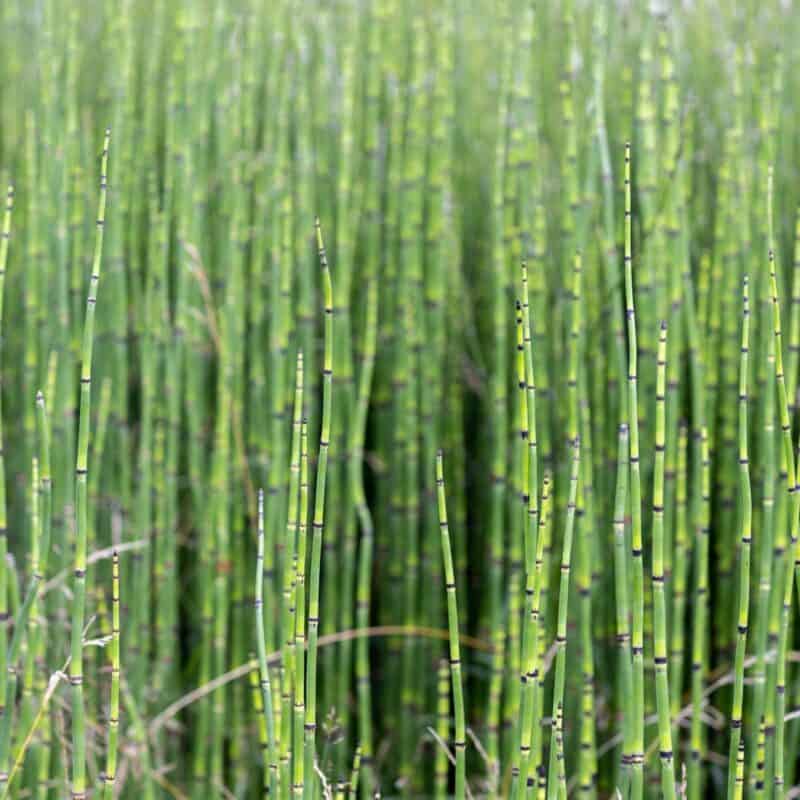
Table of Contents:
Equisetum Genus
The Equisetum genus is likely more than 350 million years old. The term Equisetum is a minglingo the term “equi” which means horse and “seti” which means bristle. The names aptly describe the bristly and rough texture of the horsetail plant.
The term hyemale is a reference to the word winter and is a nod to the frequent tendency of horsetail to be an evergreen plant in some warm climates.
Members of this genus are somewhat related to non-flowering spore producers. The closest relative of the horsetail plant is ferns.
Horsetail Varieties
It’s not uncommon for the different varieties of the horsetail plant to be confused with one another. You must be able to accurately identify the variety of horsetail plant you are foraging because not all varieties are equally infused with either herbal or edible properties.
Some types of horsetail plants have toxic look-alikes, and, more concerning for foragers, many horsetail species are themselves toxic. For our purposes, we’ll focus on Equisetum arvense (a.k.a. field horsetail, a.k.a. common horsetail) because this is the one widely used in N. America.
Field horsetail (Equisetum arvense L.) boasts rhizomes that are both tuberous and extremely fleshy in texture. The fertile stems of this type of horsetail die after dispersing the spores and do not contain chlorophyll.
A field horsetail plant resembles asparagus and is edible. The stems on this type of horsetail plant are wiry and tough in texture.
Never confuse common horsetail (Equisetum arvense) with horsetail of the Equisetum palustre or Equisetum hyemale varieties.
The you also have water horsetail, also known as swamp horsetail (Equisetum fluviatile L.), which is categorized as mildly poisonous. This one has both hollow and jointed stems, and a cone or spore style structure grows at the top of the stems.
Let’s put everything together into a table:
| Species | Common name | Edibility for humans | Parts reported eaten |
|---|---|---|---|
| Equisetum arvense L. | Field horsetail / common horsetail | ✅ Edible with caution; traditional food use documented | Very young spring shoots; fertile shoots/cones; rhizome tubers and some root-associated nodules reported |
| Equisetum hyemale L. | Scouring rush / rough horsetail | ✅ Edible with caution; traditional use documented | Young shoots; shoots and roots/rhizomes reported |
| Equisetum laevigatum A.Braun | Smooth scouring rush | ✅ Edible with caution; traditional food use documented | Young/fertile shoots; stems and roots reported |
| Equisetum fluviatile L. | Water horsetail / river horsetail | ❗️Mildly poisonous; young shoots reported edible; caution warranted | Young spring fertile shoots (strobili); cooked and used as an asparagus substitute |
| Equisetum telmateia Ehrh. | Giant horsetail | ❗️Traditional food use documented, but caution is advised | Young fertile and vegetative shoots; rhizomes |
| Equisetum pratense Ehrh. | Meadow horsetail | ❗️ Traditional food use documented, but limited modern evidence | Rhizome tubers |
| Equisetum variegatum Schleich. ex F.Weber & D.Mohr | Variegated horsetail | ❌ Not enough evidence to recommend as food | No sufficiently reliable food-use information located |
| Equisetum palustre L. | Marsh horsetail | ❌ Do not eat; poisonous / toxic species | |
| Equisetum sylvaticum L. | Woodland horsetail | ❌ Not enough evidence to recommend as food | |
| Equisetum ramosissimum Desf. | Branched horsetail | ❌ Not enough evidence to recommend as food |
Silica
The silica compounds found at high percentage in horsetail plants are the primary reason it has garnered favored status with both Native Americans and herbalists around the world. Silica plays a critical role in the successful completion of the life cycle of this wild herbal plant.
It is the intensely large amount of silica found in horsetail that causes its bristly stem texture. This texture is also why horsetail has been used as a primitive or bushcraft scouring and sanding tool.
You can use a horsetail plant to scour pots and pans – especially if they are made of cast iron with stuck on food or rust.
The horsetail plant has also been used as a fine grit type of sandpaper on wood as well as the scrubbing or polishing of metal.
Native Americans would “bleach” horsetail plants by thoroughly wetting them and then allowing them to completely dry in the sun before making use of their silica properties or sanding and scrubbing.
The sanding of woodworking with horsetail plants by the tribe members would create a shiny and silky finish. It has been said that Medieval knights used horsetail plants to shine up their armor so that it glistened in the sun.
The silica compound is found in great abundance in nature, but most often in the form of poorly absorbed minerals, like quartz. Many if not most forms of silica are not readily absorbed by the human body.
Now keep in mind that the FDA has not classified silica as a nutrient nor has it approved horsetail to be deemed any type of a supplement or medicine.
Photosynthesis is carried out mainly by the stems, which are usually non-branching. The stalks are evergreen in warmer regions and are deciduous in colder areas.
At certain stages of growth, some of the stems will be topped by a pine cone-like structure, which produces the plant’s spores.
Horsetail Plant Facts And Growing Tips
- This wild plant is a perennial, but each portion of its life cycle occurs for only a short amount of time.
- Most modern varieties of horsetail plants generally grow to be only about one or two feet tall. The tallest variety of horsetail can sometimes reach six feet in height.
- This herbal plant is part of the Quisetaceae family.
- Horsetail plant stems are a vibrant shade of green and thick.
- Horsetail has a strong rhizome that grows deeply into the soil.
- Horsetail prefers to grow in partial shade but can withstand a decent amount of sun. When cultivated in places of high latitudes it is common to spot wild horsetail growing in full sun.
- You can grow horsetail in deep planters in your yard or in boggy areas.
- Horsetail is far easier to grow from root cuttings than it is from the spores it generates.
- This wild plant does not flower nor does it produce seed. Instead, horsetail reproduces via inside of a cone shaped organ that is located at the top portion of the herbal plant.
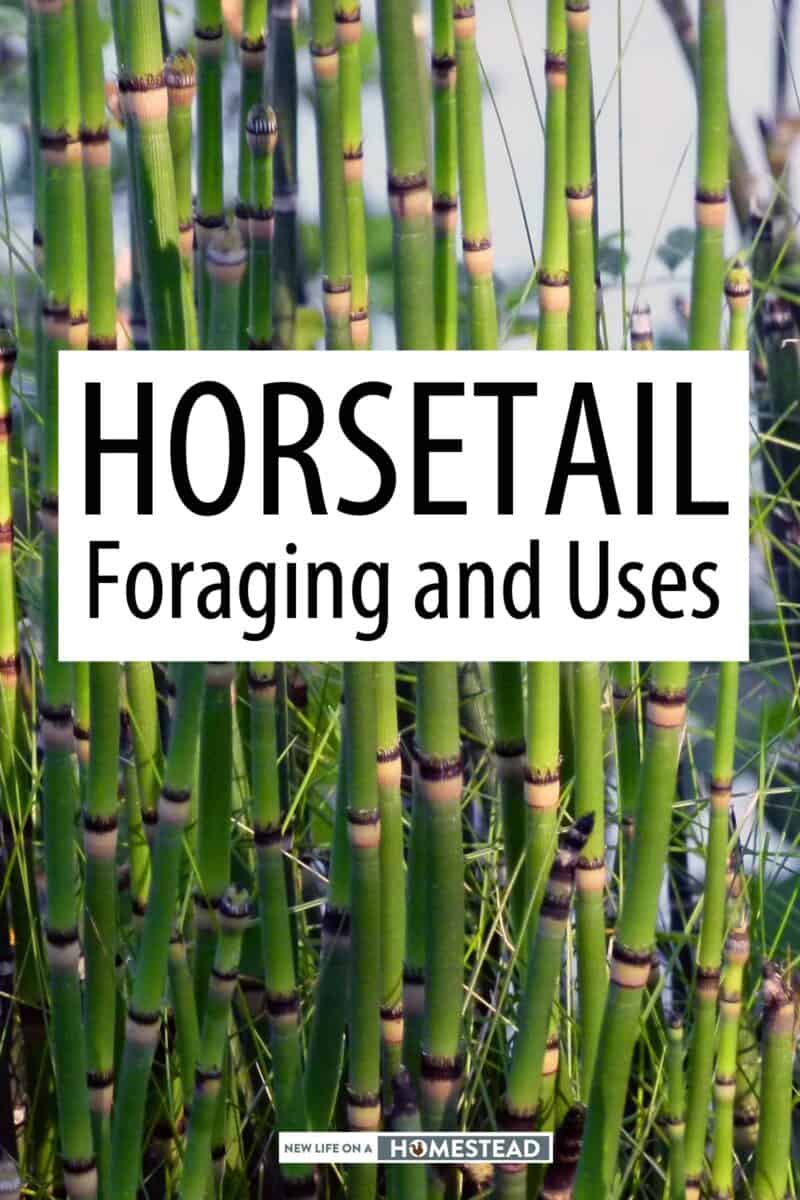
- Unlike the fern plants that it is related to, horsetail plants do not have feathery leaves. This plant appears a lot more like a rush plant (hence the other ‘rush’ names it is also known by) with multiple stems that are staunchly upright in position and have no seemingly obvious leaves. The “leaves” on a horsetail plant are extremely small and wrap around the stem to form a type of sheath on top of its nodes. A thin black line shows above and below the node covering tiny leaves.
- The above ground portions of this plant is used in both edible and herbal recipes.
- It has a bittersweet flavor when consumed.
- Horsetail plants (like many beneficial wild plants) are often dubbed to be nothing more than a mere “weed.”
- These plants typically grow in marshes, wetlands, rivers, swamps, and creeks.
- Horsetail plants are capable of both reproducing and spreading quiet quickly and easily – so much so that this wild herbal plant has been deemed invasive by some property owners. It thrives in wet sand and clay style soil.
- The horsetail plant is also known as: scouring rush, barred horsetail, Dutch rush, Kamchatka horsetail, winter scouring rush, snake grass, and rough horsetail.
- Approximately 15 species of the horsetail plant exist.
- Horsetail grows nearly everywhere around the globe, except in Antarctica, a few Pacific Ocean islands, New Zealand, and Australia.
- Earliest forms of the horsetail plant were capable of reaching heights up 50 to 85 feet tall.
- Horsetail is a hardy plant that is not really susceptible to bacterial or viral infections – one of the reasons why some folks look at it as an unwanted and invasive plant.
Horsetail Life Cycle
The horsetail plant’s life cycle has two distinct stages: sporophyte and gametophyte. During the sporophyte portion of the life cycle changes to the horsetail plant are visibly present.
But, during the gametophyte portion of its quickly changing life cycle all of the microscopic changes to minute structures in the plant are not visible to the naked eye.
During the sporophyte stage spores are produced and will later develop during the gametophyte stage. It is during the gametophyte stage of horsetail’s life cycle that the cells that are necessary for reproduction grow.
The sporophyte includes both the fertile and sterile portions of the horsetail plant. The fertile portion of the stem starts growing in the spring and then quickly dies after releasing its spores.
The sterile part of the horsetail’s green stem grows from the rhizome during the hot weeks of summer.
Harvesting
Horsetail plants can be harvested at any time of the year as long as their stems are green. Before harvesting horsetail plants you must remember how invasive it can be.
If you want to fill an entire acre of your land with this valuable wild plant, start whacking at the stems with reckless abandon.
But, if you do not want horsetail plants to take over the land and possibly kill off other equally valuable wild plants, commit the harvesting tips below to memory.
Green Tops
If you harvest horsetail during the latter months of spring the leaves on this wild plant will boast leaves that are a brilliant shade of green and pout either straight out or straight up.
Simply pinch off a part of the stem about two to four inches above the ground – remaining careful not to remove the entire plant. Next, remove the paperlike brown covering from the harvested stems.
If you plan on making horsetail tea, many herbalists swear by the good taste that comes from this portion of the plant. These shoots are also good for powdering, for use in a saute dish, or chopped finely and tossed into a stew or soup.
Tan Stems
The stems on a horsetail plant will have a tan cast after first emerging from the earth in the early weeks of spring. It is during this period of growth that the stems will be less fibrous and far less tough.
If you are going to use the horsetail stems for chewing as part of a natural oral health regime, harvesting them at this time of year will make the chewing process a lot easier on your teeth and gums.
Fall Harvesting
When harvesting horsetail plants during this time of the year, the silica content has dropped a bit, but remains relatively high. But, the shoots will be incredibly tough at this point, making them last tasty in teas and far more difficult to chew.
Breaking the stems of a horsetail plant will not kill it… If you till up a section of horsetail plants more will start growing in its place from every little fragment of root that you have dispersed.
While horsetail plants can be harvested and keep coming back for a long time, eventually the constant harvesting or tilling will ultimately weaken the plant to the point where the harvest will be weakened or no longer be sustainable.
To harvest horsetail wisely so that it keeps coming back yet does not smother out all of plant growth as it expands its area, cut only roughly one-eighth of any plant stem to allow it to continue to grow and not disperse chunks of its roots.
While some property owners loathe horsetail because it can take over a space where it is planted, bushcrafters and wildcrafters love it. This wild plant has many valuable uses and can easily be preserved to create a shelf-stable herbal remedy.
If hanging drying horsetail stems as you would cultivated or foraged herbs, be careful not to band too many together or to arrange them so tightly that proper air ventilation does not occur. When thick bunches of horsetail plant and hang dried they will often sweat and mildew will grow, ruining the whole bunch.
Dehydrating and storing it in a Mason jar with a firm fitting lid (or similar airtight container) and kept in a dry place out of direct sunlight, should maximize shelf life, though I can’t give you an exact shelf life.
Traditional Uses
Traditionally, herbalists and Native Americans have touted what they believe to be the antimicrobial, blood clotting, diuretic, wound healing, integumentary, and tonic attributes of the horsetail plant. It has also been used to address urinary and renal issues, but this does not mean its efficacy is proven.
Horsetail is most often used in a powdered form when used as part of a home remedy recipe. The plant is sun-dried or dried in a dehydrator and then pulverized using a mortar and pestle or a food processor, into a powder.
The aerial portions of horsetail have also been simply harvested and the fresh plant parts chewed upon. The Kiowa tribe used the base portion of the horsetail plant as a food dish chewed upon alone or as an ingredient in soups.
Keep in mind that, while common horsetail (Equisetum arvense L.) is edible for humans, horses and some other animals can be poisoned if they eat enough of because of a protein known as thiaminase, which causes a thiamin efficiency in horses. If a lot of horsetail is consumed all at once or large amounts on a regular basis, this same type of poisoning could occur.
Horsetail Nutrients
- Iron
- Potassium
- Manganese
- Calcium
- Vitamin A
- Magnesium
Primary Uses
- Tendons and Bones – To help stabilize or aid in repairing imbalanced weakness in both tendons and bones.
- Teeth and Gums- Horsetail has most frequently been used by herbalists and Native Americans to help keep both teeth and gums healthy and to aid in their recovery when damaged or sore.
- High Cholesterol – Horsetail powder has been consumed or sold by herbalists to aid in the lowering of high cholesterol, though clinical evidence is lacking here.
- Kidneys – Powder from this wild plant may induce a diuretic action.
- Wound Healing – Horsetail powder has been used to help slow down or stop bleeding and also as a coating placed on wounds to both help prevent infection and to enhance the healing process.
- Cartilage – This wild plant has also been used to aid in the strengthening of cartilage along with supporting proper joint function.
- Skin – The powdered form of the horsetail plan may provoke the production of collagen and even help your skin look younger.
To lesser degrees, horsetail has also been utilized by Native Americans and herbalists to address gout, tuberculosis, weight loss, jaundice, heavy bleeding during menstruation or after child birth.
All of this possible healthy and strong growth and repair is credited to the high levels of silica in the plant, by herbalists.
While the benefits of silica to the teeth, gums, tissue, bones, and joints could be great, how lasting its effect is can be a hotly debated topic. The bonding of the silica to the various parts of the body and the strengthening induced by it could only be temporary.
After the body eliminates the silica, some folks feel that the bonding effect is weakened.
Horsetail Usage Tips
Powder
Horsetail powder can be used externally to apply to a wound to help stop bleeding and to help enhance the healing process.
You mix the powdered horsetail with just enough water to create a thick paste. The paste is then spread over the wound to help deter infection, curtail bleeding, or foster healing.
Fresh Horsetail Stems
If the horsetail plant is being used for internal woes, the most common way to apply it is to simply chew on fresh stems. After cutting up freshly harvested horsetail and washing it, just chew on a piece of it, much like would be done with a piece of celery.
The chewing process will help extract the juices inside of the stem. You can choose to spit out the pulp generated during the chewing process, but it is typically swallowed.
The younger the horsetail plant stem, the more silica it will contain. Younger plant stems tend to be far more tender and easier to chew.
If you have already badly damaged or weak teeth, chewing on the thick horsetail stem could cause more harm than good.
Dicing up the stem into smaller bits or consuming the powder might be the easiest and least destructive manner to expose your teeth and gums to the silica the plant contains.
Adults can also dump one teaspoon of the horsetail powder into a glass of water and swish it around in your mouth before spitting it out, or swallowing.
The human body is not used to being exposed to such a high level of silica or a silica that is so easily absorbed. When first taking horsetail as a powder or in the form of a fresh stem, it would likely be wise to do so in small amounts at first to allow the body time to adapt.
Herbalists typically take horsetail for five to 10 days and then allow their body to have at least several days without consumption before restarting their routine.
While silica is a naturally-occurring, it’s never wise to start any type of a natural remedy routine without first consulting your doctor. Just because something is natural does not mean it cannot spark a reaction or interact poorly with other prescriptions or OTC supplements and medications you are already taking.
Horsetail Tea
Horsetail Precautions
- Chewing on horsetail can be harmful to weakened teeth.
- The thiaminase in horsetail may deplete levels of the B1 vitamin and thiamine in the body when consumed in excess over a long time period. If taking horsetail regularly or in large amounts, eating more foods that contain B vitamins or taking B vitamins supplements may be wise. Keep in mind the thiaminase in horsetail is NOT neutralized if the horsetail plant has been dried or heated before eating.
- Consuming high levels of silica can cause stomach aches or similar digestive system issues. Again, if you and your doctor believe it is safe to take horsetail, do so in small amounts initially to better determine how your body will react to all of its compounds – silica in particular.
- The University of Maryland Medical Center cautions against consuming the horsetail plant if you are pregnant, breastfeeding, have kidney disease, are diabetic, or are experiencing gout.
- The side effects of horses or other animals from eating too much horsetail plant could include: tremors, general weakness, staggering, weight loss, or even death.
- Consumption of the Equisetum arvense horsetail plant could possibly cause skin dermatitis in folks who are also allergic to cigarette smoke.

Get your gift and learn things like:
- how to make this really quick pest spray
- how to prevent egg waste
- two cheap automation devices that will make your life easier

Tara lives on a 56 acres farm in the Appalachian Mountains, where she faces homesteading and farming challenges every single day, raising chickens, goats, horses, and tons of vegetables. She’s an expert in all sorts of homesteading skills such as hide tanning, doll making, tree tapping, and many more.
love your page, i just found horse tail a few month back an i love the tea, i also made salve out of it, an it works great. you can put some honey in the tea an it taste’s a lot better.
i would love to follow your page you have a lot of knowledge thank you for sharing.
I found horsetail extract at the vitamin store. Is this the same thing? It was recommended for an UTI
Thank you, Tara! Nice to hear from you, again!