
It must be a southern thing, ’cause I’d never in my life heard of dilly beans before moving out here. For those who don’t know, dilly beans are a kind of pickled green bean. You eat them cold, like you would pickles. And this morning I just canned a batch of them.
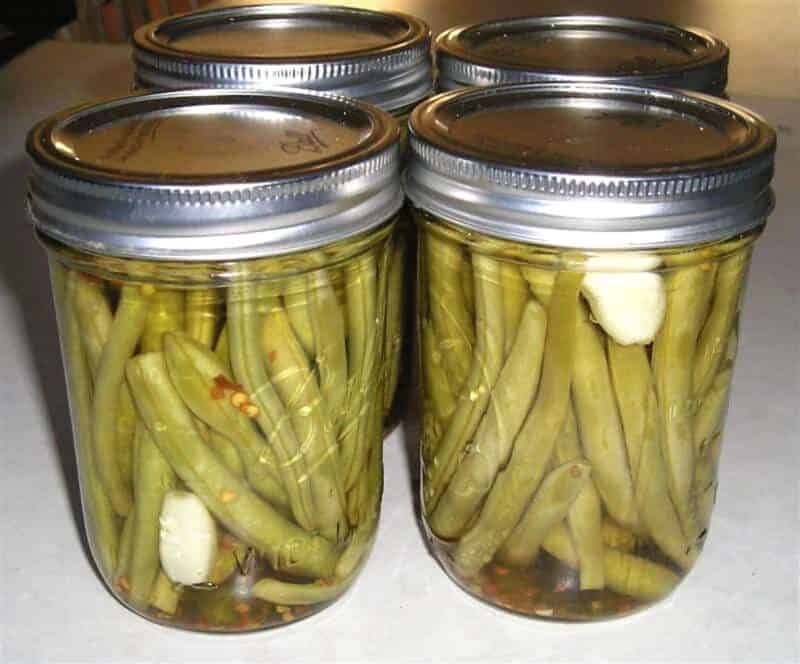
I haven’t had a chance to taste them yet, I’d like to let them sit in the brine for about a week before I open a jar, but I thought I’d go ahead and share the recipe with you in case you’d like to make some for yourself! This recipe came from the NCHFP, so rest assured the steps and process are safe.
Adding Dill to the Recipe
I want to start off by explaining something that you obviously noticed in the title: this particular recipe calls for dill. But exactly is a head of dill?
Well, it’s actually the flowering ‘head’ of the dill plant. I don’t think you’ll have much luck finding it anywhere unless you or someone you know grows dill. And for good reason: dill has a tradition of being used in the Appalachian and the South for canning.
I just so happened… proudly puffing up chest… to have some fresh dill heads growing in my garden!
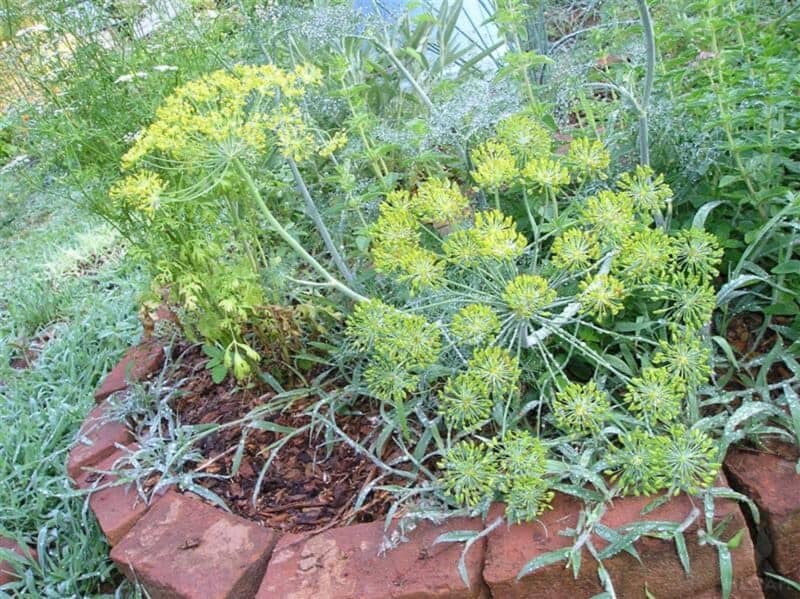
I thought it was so awesome that the dill was coming to a head exactly at the same time the green beans were coming in. It’s as if the Lord meant for them to go together!
The flowering clusters at the top of each stem are the heads. Each individual round cluster is one head. So, for this recipe I just snipped off one round cluster to drop into each jar of beans.
Alright, so now that that’s all cleared up… on to the recipe!
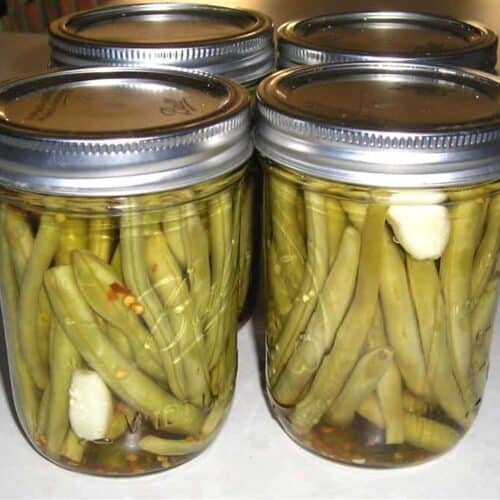
Dilly Beans Canning Recipe
Ingredients
- 2 pounds green beans about six cups
- 1/4 cup canning salt
- 2 cups 5% white vinegar
- 2 cups water
- 1 teaspoon cayenne pepper, divided I used the flakes, not the powder
- 4 cloves garlic
- 4 heads dill
Instructions
- Wash beans, and trim ends off. I measured mine to within 1/4″ from the rim of my pint jars and snipped them to size.
- Sanitize the empty jars in the dishwasher or wash by hand with soap and water. If you're at above 1,000 feet elevation, sanitize the jars by boiling them empty for 10 minutes.
- Next, combine salt, vinegar and water in a large saucepot.
- Bring to boil.
- Pack beans lengthwise into hot jars.
- Add 1/4 tsp cayenne pepper, 1 clove garlic and 1 head dill to each pint jar.
- Ladle hot liquid over beans, leaving 1/2 inch headspace.
- Remove air bubbles.
- Adjust two-piece caps.
- Process for 5, 10, or 15 minutes (altitude-adjusted) in a boiling water bath.
- Remove jars with a jar lifter and set aside to cool. You may hear popping sounds at some point, this is perfectly normal and to be expected.
- After 24 hours, check the seal. the lids should be concave (drawn inwards), and should not flex.
- Remove bands. Store in a cool, dark place.
Notes
- This recipe makes 4 pint jars.
- Only use pint jars, not quart jars. This is what the canning authority-approved recipe uses.
Processing Times
If you are going to be boiling the jars in a water bath for 5 minutes, there’s one extra step for you to do: after you sanitize (a.k.a. clean) the jars, you need to sterilize them, too. You don’t need to do this if you process them for at least 10 minutes.
Sterilization is really easy; simply boil the empty jars
And now here’s the altitude-adjusted table, if you happen to live at an elevation higher than 1,000 feet:
| Elevation | Pre-Sterilize Empty Jars? | Process Time |
|---|---|---|
| 0 – 1,000 ft | Yes — boil for 10 minutes | 5 minutes |
| 1,001 – 6,000 ft | No | 10 minutes |
| Above 6,000 ft | No | 15 minutes |
Thinking About Changing the Recipe? Not So Fast!
Here’s a quick overview of what you can and cannot change to suit your tastes. Spoiler alert, there’s not much you can change:
| What | Verdict | Why & How |
|---|---|---|
| Spices (cayenne, dill, garlic) | ✅ Safe to Tweak | Flavor-only. Does not affect acidity or safety. |
| Type of vinegar | ✅ Safe to Tweak | White or apple cider OK, must be 5% acidity. |
| Crispness aids (Pickle Crisp) | ✅ Safe to Tweak | Optional. Doesn’t affect safety margin. |
| Salt amount | ⚠️ Tweak with Caution | For flavor/texture only; don’t remove entirely. |
| Extra low-acid vegetables | ⚠️ Tweak with Caution | A little is fine; don’t bulk up the jar. |
| Vinegar-to-water ratio | ❌ Never Tweak | 1:1 ratio ensures safe acidity for water-bath canning. |
| Vinegar acidity (%) | ❌ Never Tweak | Must be 5% or higher. No homemade/unknown vinegars. |
| Processing time | ❌ Never Tweak | Use altitude-adjusted tested times only. |
| Headspace | ❌ Never Tweak | Exactly ½ inch. Too little = siphoning/seal failure. |
| Jar size | ❌ Never Tweak | USDA only tests pints. No safe data for quarts. |
Shelf Life
As with other home-canned products, dilly beans should last for about a year in a cool, dark pantry or root cellar.

Get your gift and learn things like:
- how to make this really quick pest spray
- how to prevent egg waste
- two cheap automation devices that will make your life easier

A city girl learning to homestead on an acre of land in the country. Wife and homeschooling mother of four. Enjoying life, and everything that has to do with self sufficient living.
My friend gave me a jar of dilly beans and i just love them. They taste like pickled okra from the store that i just crave. I am definitely a big fan of dilly beans and will try the refrigerator suggestion in the comments until the harvest for beans come in this summer. Thanks for sharing.
We slice carrots lengthwise, about the diameter of the beans, and add a few of those to the jar. They turn out great and make a nice crunchy addition.
Ooh! That sounds yummy!
I grew up on Whidbey Island (about 60 miles north of Seattle WA). When I was a little girl in the late 50’s, early 60’s, my best friends mom would make us a special lunch of smokey cheese sandwich, bar-b-q potato chips, and dilly beans! She used the Ball Blue Book recipe, and that is the recipe I have always used, though I only add half the salt. I’m tempted to try a different recipe (I love the idea of adding onion and bay), but I love these dilly beans, and I’m afraid my kids would have a fit if I changed the recipe. What’s the saying? If it’s not broke, don’t fix it! 🙂
I’ve been making these for a couple years. We were growing beans for the freezer and had way too many to eat. So I used my Kosher dill pickle recipe and subbed in beans for the cukes. My kids eat a pint at a time. Sometimes I’ll throw in jalapeno rings, with the seeds still attached, to give them some zing, but no more than 3 rings/pint or they are too spicy for the kids.
BTW – my favorite way to cook green beans is steamed with a light amount of garlic powder, butter and a heavy amount of dried dill sprinkled on top. Steamed green beans just seem to be made for dill.
I’ll have to try that recipe, Matt. Sounds De-Lish!
Kendra-could you tell me specifically how many pints this makes? It sounds very yummy, I like 3 bean and 7 bean salad, and this sounds like a better variation of them.
Hi Micki,
This recipe makes 4 pint jars 🙂
I found a great recipe for “dilly beans” last year but was a bit hesitant to try them even though I love dill pickles. I finally made them this year and we absolutely LOVE them! What a great crunchy addition to a sandwich for lunch! The recipe I used is not a canning recipe – just a refrigerator recipe so they won’t hold for long. They didn’t last long enough here though to have had to worry! =)
The recipe I used was a bit different from yours.
Bring 1/4c. pickling salt, 2C water, and 1C white vinigar to a full boil. — Let cool to room temp.
In each jar add the following:
2 thin slices of onion
1-2 cloves minced garlic
fresh dill
1 bay leaf
green beans
* I add the fresh dill first and use the end of a wooden spoon to crush it up and release the oils. Then I add the rest of the ingredients.
Pack your green beans into the jar and then fill almost to the top with brine.
Let sit 5-7 days in the refrigerator before eating. I like to give my jars a shake every here and again while I’m waiting!
These are fabulous!!!
Kendra,
Mom and I were talking last night and I told her that you had made your first batch 🙂 She said that when she was growing up there was woman that made hers in a crock.. She didnt can them, she pickled them in her fridge like you would for grape leaf pickles.. She said those were the best dilly beans that she had ever had!!Just thought I would share
That’s interesting, Lindy 🙂 I wonder if they were fermented? So, Jerry and I tried the dilly beans the other day. Jerry did NOT like them, lol. He said, “If I wanted to eat something that tasted like a pickle, I’d eat a pickle!” It was weird to him. I liked them. But I kinda felt like the beans I used were too big/tough. 😉
Update: We tried the dilly beans again a couple of weeks after I made them, and they were actually really yummy! I guess they just needed more time to sit 🙂 The thinner beans were crunchier and better than the fatter beans.
Now I know what Dilly beans are! Thanks 🙂
I’ll be lucky to get any green beans this year…the weather is not playing ball. Very wet now after a very dry spring.
Actually dilly beans are an old canning recipe. I remember my grandma making them back in the mid 60’s. Of course she didnt put any hot spices in them. They were mostly sweet/sour tasting. I’ve also put up some a year ago and I tried them heated up. They are mighty tasty either way. My hubby doesnt like them though – more for me LOL.
You may be surpised…this time of year: pickling season, most grocery stores in my area carry dill…produce section by the fresh herbs.
Lynda,
I’ve seen dill in the stores, but not with heads on them. You’re fortunate if you have them!
It’s been ages since I’ve had dilly beans. So your post is making my mouth water! Hopefully I will have some extra beans to make a batch or two this summer.
Thanks for sharing!
That sounds so easy! What a great veg to add to salads in the summer!
Thanks, Kendra!
I made dilly beans last summer, but I lacto-fermented them in a salt brine, instead of canning them in vinegar. I still have a partial jar in my fridge, so the fermentation was a success… they have lasted a year. They are so good! I also used flowering dill heads from my garden. Be warned, if this is your first year growing dill, that it is prolific! We had a few plants go to seed last year, and this year dill came up everywhere. And I do mean everywhere! 🙂